


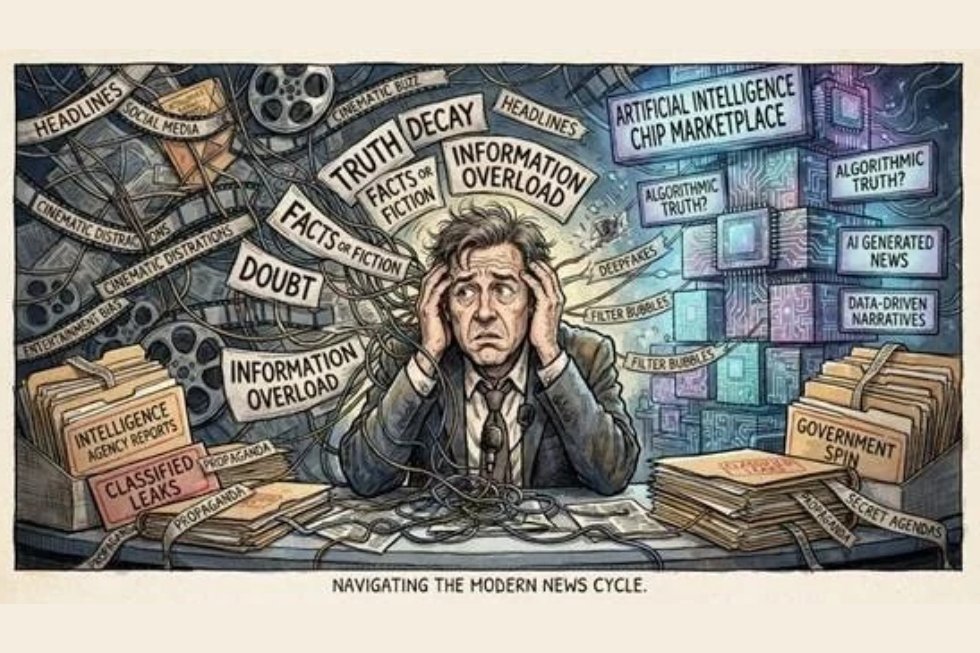



Is lying a sin or just a way of getting people’s attention? In plenty of professional contexts, it’s the primary engine for making a buck. Failing to lie at a competent professional level could lead to being shamed or judged unworthy. Some see this as contradictory with their upbringing, but most people adjust to the reality of what it requires to make a living, as well as the small supplement required to “make it big.”
In movies like Michael Clayton, The Insider or Thank You for Smoking, Hollywood unmasks this trend. But Tinseltown literally spends more money and makes more profit from movies that celebrate “truth evasion” in the interest of financial success, even while exposing it. In movies like Catch Me If You Can, The Wolf of Wall Street or American Hustle, the cautionary tale seems to be: “Do it, but make sure you know when to stop, if only to protect your winnings.”
As former Trump CIA Director and Secretary of State Mike Pompeo helpfully reminded the world, intelligence agencies train their troops to “lie, cheat and steal.” The notorious “Project Mockingbird,” which consisted of buying news outlets’ loyalty and infiltrating their news desks, allowed the CIA to craft the nation’s news to consistently reflect its own version of “useful truth.” Even former CIA officer and whistleblower John Kiriakou admits, with a hint of lingering professional pride, that although he was willing to go to prison for telling the truth, he’s “a good liar.” In certain ethical systems, deception isn’t a flaw; it’s a core competency.
Lying has never been more visible in our culture. Social media and alternative outlets spend much of their time exposing the “professional lies” of mainstream media. We’re used to it to the point of feeling inured, especially in the age of Donald Trump (Prevaricator-in-Chief), “fake news” and our increasingly annoying exposure to deepfakes. Yet occasionally a story appears that cuts through the haze of habit and leaves the ordinary news reader completely paralyzed, wondering if there is any remote way of approaching that elusive thing known as “the truth.” One such story broke this month: the fall of Jensen Huang, a tale of business, intelligence and political intrigue that has managed to put the latest “forever war” in Iran, the still-awaited Epstein files and even this week’s “Yalta 2.0” in Shenzhen on hold.
The Huang global psychodrama became explosive “news fit to print” on October 29, when The New York Times published an article claiming that a Chinese woman named Alice Huang, with whom Jensen is alleged to have had an affair, was spying for the CCP. “American officials,” the newspaper informs us “had concluded that she was a Chinese intelligence asset, funneling information to Beijing.”
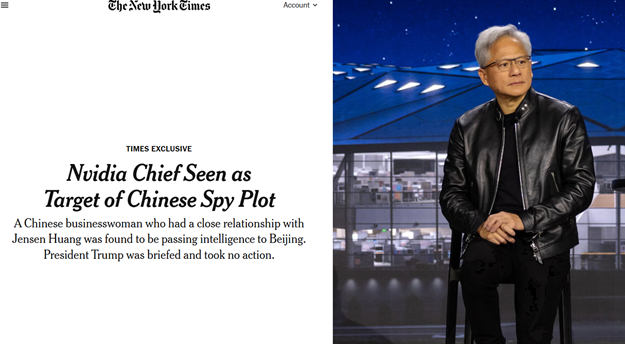
The story was just getting started and neither the NYT nor any other news outlet was about to let it drop. Within a fortnight, it led to Huang’s departure from Nvidia, the company he had created 33 years earlier.
Here’s a timeline of NYT headlines over the following weeks.
- November 8: “Nvidia Opens Investigation Into Jensen Huang’s Relationship With Suspected Chinese Spy”
- November 10: “The Woman in the Middle of Nvidia’s Spy Scandal”
- November 11: “Jensen Huang Resigns From Nvidia After Affairs”
- November 12: “In China’s Spy Operations, Romance Can Be a Long Game”
- November 14: “Jensen Huang Carried a Secret for More Than a Year. It Led to His Downfall.”
- November 18: “How Nvidia Chips Ended Up Within Reach of China’s Military.”
When the truth fails to be “news that’s fit to print”
During the three weeks following the NYT’s triggering revelation, analysts, investigative journalists and informed commentators have called into question the Gray Lady’s comforting honey trap scenario and explained in detail why it is not credible. The NYT’s latest article, published two days ago, nevertheless repeats its initial, now discredited message: “For the past several weeks, Nvidia has been convulsed by revelations that Mr. Huang had an extramarital relationship with Alice Huang, who U.S. officials say is an asset for Chinese intelligence and was passing information to Beijing.”
The most informative reporting we’ve seen doesn’t focus on honey traps or either of the unrelated Huangs — Jensen or Alice — and even less on their purported intimacy. Serious commentators have appeared in alternative media to help us understand what this story is truly about and why it may have an impact on our lives. They note that no evidence exists supporting the contention that Alice has acted as a classic “honeypot.” On the contrary, posting pictures on social media to proudly put on display her intimate familiarity with Nvidia’s CEO is hardly consistent with standard honeypot operating procedure.
Reuters and other news outlets covered an event the NYT preferred to ignore. On November 12, US Attorney General Todd Blanche, responding to the question of a journalist, admitted out loud that the government had drawn no conclusion. The title of the Reuters article reads: “US Justice Department has not concluded Alice Huang was Chinese spy, Blanche says.” It quotes US President Donald Trump’s admission of uncertainty at best. “I don’t know if that’s been determined yet.”
Commentators available only in alternative media have dared to separate fact from hearsay. I’m thinking of the likes of Ed Zitron, Daniel Dumbrill, Simon Dixon, the Corbett Report, James Li or The Young Turks, but there are many others. They never claim to “possess” the truth or make definitive assessments. Instead, they are careful to navigate around what appear to be convenient lies and focus on what really matters. Some of them even take the trouble to explain how hearsay sourced from anonymous “intelligence sources” may systematically orient the news reporting of certain outlets, including newspapers of record.
The most basic job for any of these commentators and independent journalists has been to show that there is no serious basis for presenting the Huang drama as a story about spying. They all point to an obvious contradiction: If Alice’s alleged espionage was designed to help Beijing get its hands on America’s best technology, how do we explain the fact that the Chinese government has an official policy of discouraging, if not banning, the import of Nvidia’s chips?
That contradiction alone suggests there are far more consequential stories buried beneath the tabloid melodrama, though one can hardly blame a newspaper of record for preferring a sexy spy thriller to a tedious audit of how our complex industrial and financial system actually operates. Serious commentators have done the unglamorous work of digging into the political decisions and market ideologies behind the scandal. That means untangling the observable distortions of today’s Godzilla-like AI marketplace and the systemic risks of circular financing. It means examining the gray-zone mechanics of chip smuggling and what they reveal about “the AI bubble” — a marketplace in which, as financial analyst Ed Zitron observes, “nothing makes money,” yet perceived value is sustained by an ideology of “growth at all costs.” Beneath the supposed honeytrap soap opera lies a far more urgent question facing not just Wall Street, but humanity itself: the competing values and risks of open-weighted versus closed-source AI.
The spy who came back from the cold
This brings us back to Kiriakou, who was quick to add his own commentary on the case, recycling his CIA training. He is a principled whistleblower, a generous conversationalist I have had the privilege of interviewing, and a man who paid a steep personal price for exposing state torture. Anyone who genuinely cares about truth in public life owes Kiriakou a debt of gratitude. Yet when he weighs in on the Huang affair, we are reminded of an old professional hazard: You can leave the Central Intelligence Agency, and even go to prison for defying it, without ever fully purging its operating system from your analytical instincts.
In his podcast Briefing Room — which I highly recommend for much of its generally well-informed analysis — John sought to explain what he characterized as “one of the biggest honeypot scandals in American history.” He affirms that Alice “was apparently placed there by the Chinese intelligence service.” In this and various interviews on the web — including this week on Steven Bartlett’s Diary of a CEO — John delights in describing how men of a certain age, aware of their graying hair, are seduced by young women with a friendly smile. He appears to ignore the careful, subtly reasoned analysis provided by the many critical observers who refused to be seduced and distracted by a tale of seduction.
Bartlett’s show was something of a Hollywood-style media production. He opens by inviting Kiriakou to explain — for at least the third time I had heard it — the behavioral laws that apply to males with gray hair and receding hairlines and females with seductive smiles. The host then dramatically announces his intention to introduce the former CIA operative to a real Soviet honeypot, whom he promptly invites into the room to tell her fascinating and “harrowing” story. The following day on his own podcast, Kiriakou begins to modify his position. He admits that “we” — a collective pronoun that may include the NYT and its intelligence sources — “have been pretty quick to describe Alice Huang… as a Chinese spy.” Obviously ill at ease as he backs down from his initial position, he explains: “She appears to have been a Chinese spy but I want to emphasize something: she is an alleged spy.” It gets slightly worse after that as he seeks to cover the superficiality of his analysis even while admitting that his initial strongly affirmative take was no longer tenable.
What does the Huang story tell us about the question I raised at the beginning, about lying and the truth? The first lesson that should jump out at all of us is the same one Akira Kurosawa dramatized in his celebrated film Rashomon. It is known as “The Rashomon effect” and can be defined as follows (I’m reproducing the suggestion of Gemini):
Rashomon effect (noun): The phenomenon in which the same event is given contradictory, yet equally plausible, interpretations by different individuals due to subjectivity, self-interest, and memory bias rather than deliberate deception
I leave my readers to assess which of the interpretations of the Huang parable they see as “equally plausible” — and to forgive themselves if their heads are spinning. Were this Devil’s Advocate to play the role of judge of the tribunal, I would spend considerable time examining the “subjectivity, self-interest, and memory bias” of the newspapers, podcasters and other commentators I have consulted on the event along with the various business and political actors involved, including, for example, Commerce Secretary Howard Lutnick and Secretary of State Marco Rubio. I might feel compelled to suspect, in some cases, an attempt at “deliberate deception.” It’s one thing to account for a murder in a Japanese forest; it’s another to account for what happens in a trillion-dollar marketplace.
*[The Devil’s Advocate pursues the tradition Fair Observer began in 2017 with the launch of our “Devil’s Dictionary.” It does so with a slight change of focus, moving from language itself — political and journalistic rhetoric — to the substantial issues in the news. Read more of the Fair Observer Devil’s Dictionary. The news we consume deserves to be seen from an outsider’s point of view. And who could be more outside official discourse than Old Nick himself?]
[Lee Thompson-Kolar edited this piece.]
The views expressed in this article are the author’s own and do not necessarily reflect Fair Observer’s editorial policy.
AI Can Destroy Humanity. But Why Would It?
We often imagine artificial intelligence rising against humanity because we attribute to it human emotions and drives — things machines...

When the CIA Stopped Lying, The New York Times Stopped Reporting
Citizens must develop critical thinking skills to navigate institutional truth claims. A critical examination of The New York Times’s treatment...
FO° Talks: Did Russia Recruit Donald Trump as a Spy? Former CIA Officer Reveals
In this episode of FO° Talks, Fair Observer Chair Claire Whitaker and retired CIA officer Glenn Carle discuss US President...

Lucifer, The New York Times and a Debrief on 2024
2024 was a year of crime and confusion, pleasing to the diabolical author of our Devil’s Dictionary who recounts his...

Understanding the Personal Conflicts of a CIA Operative With Glenn Carle
In today’s episode, Rod interviews former CIA officer Glenn Carle. Glenn shares his personal journey of finding a home among...

Support Fair Observer
We rely on your support for our independence, diversity and quality.
For more than 10 years, Fair Observer has been free, fair and independent. No billionaire owns us, no advertisers control us. We are a reader-supported nonprofit. Unlike many other publications, we keep our content free for readers regardless of where they live or whether they can afford to pay. We have no paywalls and no ads.
In the post-truth era of fake news, echo chambers and filter bubbles, we publish a plurality of perspectives from around the world. Anyone can publish with us, but everyone goes through a rigorous editorial process. So, you get fact-checked, well-reasoned content instead of noise.
We publish 3,000+ voices from 90+ countries. We also conduct education and training programs
on subjects ranging from digital media and journalism to writing and critical thinking. This
doesn’t come cheap. Servers, editors, trainers and web developers cost
money.
Please consider supporting us on a regular basis as a recurring donor or a
sustaining member.
Will you support FO’s journalism?
We rely on your support for our independence, diversity and quality.





Comment