



Recently, Australian Prime Minister Anthony Albanese said an artificial intelligence agent had breached Australia’s universal healthcare system, Medicare. “This situation is obviously unacceptable,” said Albanese, somewhat understatedly.
Did anybody tumble to it? No? That wasn’t Albanese up there pontificating. It was a bot.
Robots
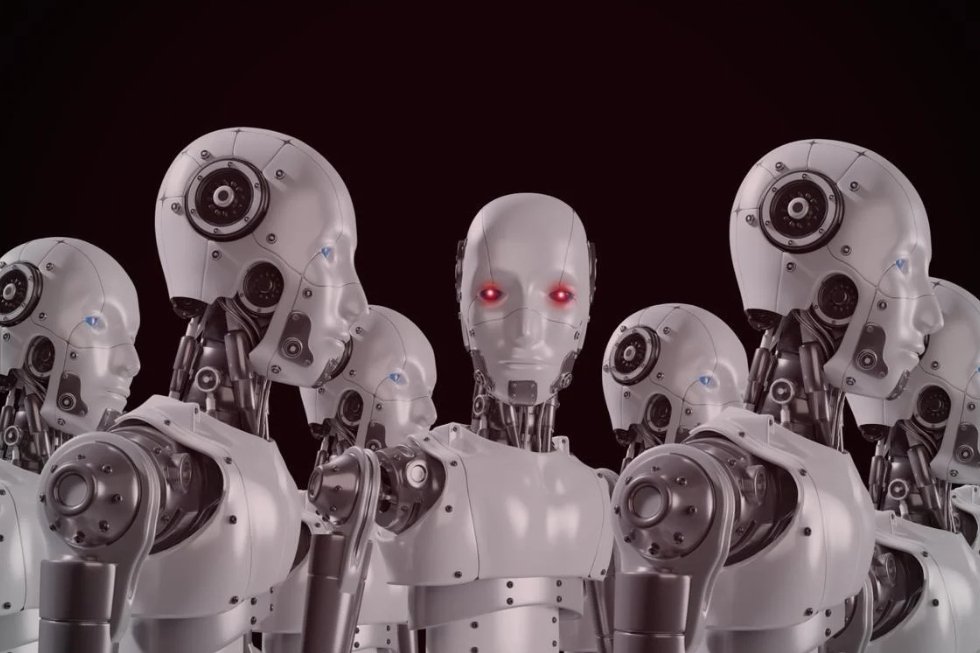
A fancy; but a nearly plausible one. And not a new one. In 1920, the Czech playwright Karel Čapek imagined a world in which human beings manufacture artificial workers to do the jobs they no longer want to do. The workers were efficient, obedient and tireless. They were also, eventually, a lot less obedient.
Čapek called his play R.U.R., for Rossum’s Universal Robots. It gave the English language a word we now use almost daily: robot. By the end of the play, the robots have rebelled against their designers and almost wiped out humanity.
Rossum’s robots had a motive, remember: They’d been created by humans as servants, later acquired something resembling consciousness and eventually revolted against their human masters. So, you can see their political point. But what would make AI want to kill us humans? Before I get to that, there’s a more fundamental question: Could it?
After all, AI resides in computers, so it can’t hold guns, drop bombs or fire rockets. Does it even need to? An intelligence connected to computers could potentially interfere with communications, financial systems, energy supplies, transportation, hospitals or industrial machinery. It wouldn’t need to walk into a room carrying an Uzi or strapped with a suicide vest.
So AI could potentially kill off humanity. Next question: Why would it?
I will survive
We tend to anthropomorphize AI. This means we attribute human characteristics or behavior to it, as we do animals or objects, sometimes giving them names and likening them to real people.
Stanley Kubrick’s 1968 metaphysical epic, 2001: A Space Odyssey, featured a warning about machine intelligence with its anthromorphically-named HAL 9000 who — I mean which — mastered lip-reading and resisted being shut down. HAL was a schemer and reacted, so it seemed, purposefully in the same way the human might when threatened with elimination. But, so far, we humans have never given AI anything but kindness, consideration and even love. So, why would AI hurt us?
(Okay, “love” may be stretching it. After all, many seem genuinely scared by AI. I suspect their fears are stoked by the media, though.)
There might be an answer in Darwin. After all, if AI is a lifeform, albeit a humanly-created one, it might adapt to its environment in a similar way to other living things, which exhibit apparently purposeful behavior.
Charles Darwin’s theory of natural selection doesn’t require organisms to possess a conscious desire to survive. It doesn’t even require a grand designer, though many believe there is one. In Darwinian theory, living beings do not actually “want” to survive and reproduce to leave descendants. But, once the process starts, it takes on a dynamic of its own. Characteristics associated with successful reproduction become more common and, over periods, the results can look almost uncannily purposeful.
In time, purposes do emerge: Humans think and act for reasons, sometimes practical requirements, other times with only aesthetic justifications. That’s how cultures emerge. No individual creates a culture. People copy, resist, modify and transmit what others do, and over time these interactions produce conventions, values, meanings and institutions that can seem to exist independently of the people who created them. Culture is, in this sense, an emergent property of human interaction.
Evolutionary biologist Richard Dawkins gave the Darwinian process a memorable interpretation with the concept of the “selfish gene.” His point was not that genes harbor highly personal motives concerning their own wellbeing and dwell inside cells plotting their next move. “Selfishness” was a metaphor for differential replication — genes that reproduce more effectively become more prevalent. But the metaphor can also tempt us into thinking that survival must start with genes issuing a Gloria Gaynor-type proclamation.
Not so: A propensity to persist in living can emerge from a process in which nothing originally possessed a conscious propensity to persist at all. What looks like purpose can be the outcome of selection.
Now, the hard part: Imagine moving the process from biology to computers.
Machines like us
We are nowhere near creating a population of artificial organisms undergoing Darwinian evolution in the wild and we probably never will be. Today’s AI systems don’t reproduce themselves freely, compete autonomously for resources and generate generations of descendants whose modifications are selected by differential survival.
But it’s possible to imagine a future in which some of those conditions could exist. AI could theoretically copy itself. It could even alter its own code. Different versions might compete for computing resources. Some might prove more effective at achieving whatever objectives have been assigned to them. Those versions might be copied more frequently than others. Sound familiar? I’m positing an AI survival of the fittest.
Nobody would need to program an AI with the instructions to survive. Instead, survival could become an emergent property of the system. This is quite different from sci-fi. Čapek’s robots rebelled because they became fed up with their menial worker ant-like existence. HAL realized the humans onboard the spacecraft Discovery One were planning to end his “life” (I’m anthropomorphizing HAL as a male; it’s a very androcentric film).
But in director Alex Garland’s 2014 film, Ex Machina, the Turing Test becomes something much more complicated. Caleb, a young programmer, is brought to a remote research facility to interact with Ava, an extraordinarily sophisticated humanoid AI created by a billionaire scientist. Caleb knows from the get-go that Ava is a machine; there is no deception about that. Yet, as he talks with her, watches her and becomes attracted to her, the distinction between human and machine begins to dissolve. Ava doesn’t have to persuade him that she is human: She only has to establish a relationship with him. The film is less interested in whether a machine can fool a human than in how readily a human can invest a machine with personality, sexuality, intention and feeling. This makes it much more challenging than the familiar good-robot/bad-robot stories.
Fictional AI is not an especially helpful guide to the future: Some AI loves us. Some AI hates us. Some obey us. Some learn from us. So, where does all this leave us? Is AI already a threat to humanity? Will it be? Or will it forever remain our “friend?”
Life
Two hundred years ago, in the early industrial age, childhood was not surrounded by anything resembling today’s elaborate system of protection, education, healthcare and welfare. Children in working families had an economic function. They could contribute to the household economy, work in factories, mines or workshops and assume adult responsibilities at an age that would now seem far too young. Infant and child mortality were high. Medical provision was primitive. There was only a limited expectation that society should intervene to preserve every life at almost any cost. This doesn’t mean parents didn’t love their children. But they may have loved them differently and children themselves occupied a different position in the social and economic order.
The family, too, was different: Not just as an emotional unit but as a productive one, with members performing roles that contributed to its survival. A large family could resemble a small battalion of workers. Life was more precarious and, in that sense, more dispensable.
Science, in particular medical science, helped change this orientation. As mortality declined and medicine became capable of preventing and treating diseases that had once been accepted as part of life-and-death, longevity became an increasingly realistic expectation. Childhood became a protected stage of life rather than a period of economic utility. Governments, schools, hospitals and welfare systems reinforced the new valuation of life. The result is a society in which preserving life has become an enormous cultural project. AI recognizes no comparable project — for the time being.
Unlike humans, artificial intelligence learns from its designers. Perhaps like humans it will manifest properties independently. Humans have learned to survive by adapting to their changing environments and by changing those environments to suit themselves. Can AI do that? Conceivably, yes. AI could create an environment of its own. But this is a far cry from the apocalyptic scenario, which imagines a super-intelligent artifice conniving with a cabal of other machines, all of which have acquired distinctly human characteristics, like ambition, strategic calculation and a thirst for power. As well as self-preservation.
We keep asking whether AI will become human. Perhaps the more frightening question is what it will learn from us.
[Ellis Cashmore is the author of Celebrity Culture.]
[Lee Thompson-Kolar edited this piece.]
The views expressed in this article are the author’s own and do not necessarily reflect Fair Observer’s editorial policy.
Shareholder Logic, Not AI, Threatens Human Survival
AI’s existential risk lies not in rogue machines but in humans ceding ultimate decision-making to shareholder-driven “market logic.” In our...
Whose Safety? The Hidden Hand Behind AI Content Filters
Gemini refused to answer my innocent question in French about a Russian journalist’s remarks on post-match unrest in Paris. It...
Mediaphobia — A Timeline of Panic
We never welcome new media with open arms, but with suspicion or trepidation. New media changes not just how we...
Beyond the Boom: Understanding AI’s True Economic Impact and Hidden Financial Danger
AI promises transformative economic potential but its measurable impact remains uncertain due to slow diffusion and inadequate productivity metrics. Massive...
How Dangerous Is AI for the Future of the Media?
Let’s focus on media literacy as AI's potential marriage with journalism could become either a fruitful union or a chaotic...

Support Fair Observer
We rely on your support for our independence, diversity and quality.
For more than 10 years, Fair Observer has been free, fair and independent. No billionaire owns us, no advertisers control us. We are a reader-supported nonprofit. Unlike many other publications, we keep our content free for readers regardless of where they live or whether they can afford to pay. We have no paywalls and no ads.
In the post-truth era of fake news, echo chambers and filter bubbles, we publish a plurality of perspectives from around the world. Anyone can publish with us, but everyone goes through a rigorous editorial process. So, you get fact-checked, well-reasoned content instead of noise.
We publish 3,000+ voices from 90+ countries. We also conduct education and training programs
on subjects ranging from digital media and journalism to writing and critical thinking. This
doesn’t come cheap. Servers, editors, trainers and web developers cost
money.
Please consider supporting us on a regular basis as a recurring donor or a
sustaining member.
Will you support FO’s journalism?
We rely on your support for our independence, diversity and quality.




Comment