


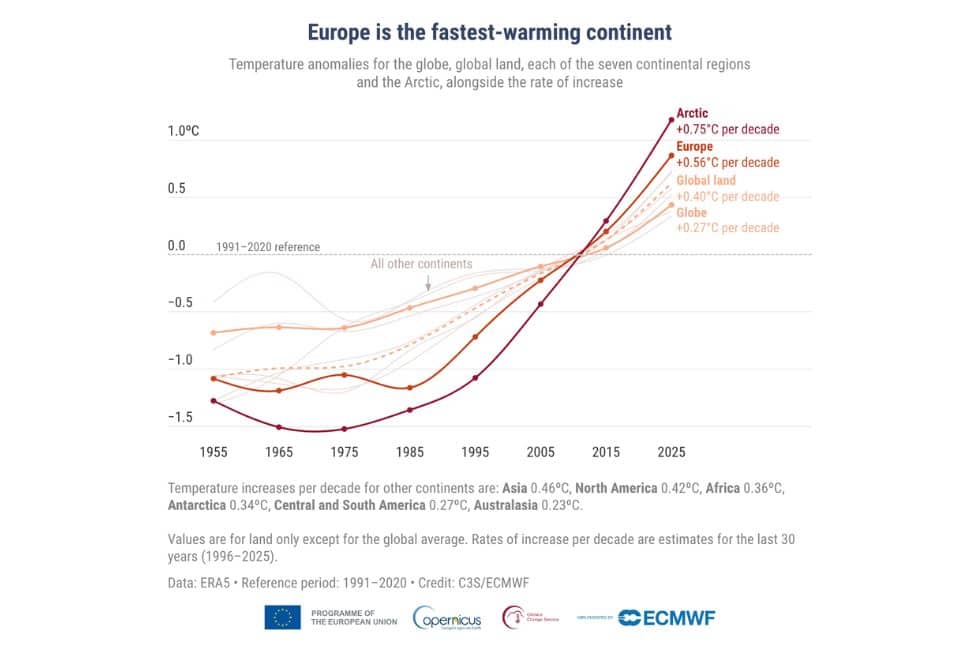



The average temperature of Earth continues to rise, but not all areas of the planet are warming at the same rate. Europe is the fastest-warming continent, with temperatures rising at more than twice the global average rate: 0.56°C per decade against the global 0.27° C.
Over May and June, Europeans have experienced two record-breaking heatwaves just a couple of weeks apart. Across France, Germany, Italy, Spain and Southern England, temperatures reached 5-12°C above seasonal averages. Indoors, people are not doing better. Approximately 45% of urban European regions are experiencing record levels of indoor Wet-Bulb Globe Temperature, a measure of the body’s ability to cool itself.
In Europe, this is the most severe heatwave ever recorded. In 2003, the first major heatwave of this century, daytime heat like this would still have been ten times less likely than today, while nighttime temperatures such as this summer would have been more than 100 times less likely in 2003. The climate baseline has shifted. Similar circulation patterns to the ones described below have historical analogues, but now it produces significantly hotter temperatures than it did in the mid-20th century. Europe has no choice but to adapt.
Why Europe?
As Europeans endure yet another week of record-breaking temperatures, while searching for ways to cool off, they must have asked themselves more than once, “Why?” Europe is sitting at the intersection of several independent physical processes, all of which happen to be pushing in the same direction. These phenomena happen in a broader context of a planet that is experiencing an increase of the average temperature: +0.27° C per decade. Human-caused climate change makes every heatwave stronger and more likely.
Europe’s proximity to the Arctic is a relevant factor for what is happening there. The region, covered with snow and glaciers, is warming at a rate that is at least three times greater than the global average. This is called Arctic amplification. It’s driven by the reduction of the albedo (which means, from Latin, whiteness) of the region. Why is the color of the region so relevant to temperature increase? For the same reason we would rather wear a white shirt on a hot summer day instead of a black one. To put it simply, we prefer to reflect the light (i.e. the heat) instead of absorbing it. The same principle applies in the Arctic, at planetary scale: As the white snow and ice melt, they reveal darker surfaces underneath, such as ocean or bare ground, which absorbs more solar energy. The more it absorbs heat, the more it increases its temperature and leads to further melting, in a self-reinforcing feedback loop.
Because of the increasing Arctic temperature, the temperature difference between the Arctic and the European continent is gradually narrowing. Part of the scientific community thinks that this has serious consequences on the mechanism that allows Europe to have a temperate climate. Usually, the polar jet stream, a narrow band of fast-moving air at 8–12 kilometers and up, flows because of the temperature contrast between cold Arctic air to the north and warmer air to the south. It’s like Europe is sitting in a sushi conveyor belt, waiting for all the kinds of Japanese dishes to be served.
Whether Europe likes the dish or not is not really a problem. The positive aspect of this is the fact that it flows, giving the spot to the next one. No matter if the belt (i.e., the jet stream) will bring a wet spell or a cold snap; none of it will last too long. But if the belt gets stuck, Europe will be forced to eat the dish that it has in front of it, whether it may be a bluefin tuna nigiri or a mayo California roll. That’s the problem with the jet stream slowing down: a heat dome stays over a region for days or weeks rather than moving on. This structure is called Omega block because it resembles the shape of the uppercase Greek letter omega, Ω, with the “hot dome” centered over Europe flanked by two lows.
Beyond the influence of air currents, usually Europe also benefits from the ocean currents’ influence. Indeed, Europe sits at the terminus of the Atlantic Meridional Overturning Circulation (AMOC), which is a system of ocean currents that normally transports enormous amounts of heat from the tropics northward. Essentially it is another conveyor belt. It is a mitigating factor for Europe’s climate. AMOC was the main reason why a city like Paris had historically much milder summers than Moscow, which is at the same latitude, but without the maritime Atlantic influence. But AMOC is weakening, and as it does, European summers start behaving more like continental ones, but on a warmer baseline.
Why is cleaner air making things worse?
A curious factor in Europe’s accelerating warming is, paradoxically, its cleaner air. Over the last decades, Europe decreased its air pollution, but this came with a cost. Sulfate and nitrate aerosols from pollution made clouds more reflective, casting sunlight back to space and ultimately shielding the region from the warming. After Europe cleaned up its air (for good public health reasons), this accidental cooling shield was removed, unmasking extra warming that was there all along due to greenhouse gases.
The ocean tells a version of the same story. In 2020, new international rules slashed the sulfur content allowed in ship fuel, and cargo vessels crossing the North Atlantic and Mediterranean suddenly stopped seeding the sky above their wakes with sulfate haze. Studies from 2023 and 2024 point to this cleanup as a likely contributor to the unusually fast warming now showing up in both basins.
Why is Europe so vulnerable?
“In the European region, heat stress is the leading cause of climate-related death in the region,” said WHO Regional Director Dr. Hans Kluge. Why is Europe so vulnerable? According to World Weather Attribution, heatwaves already cause more deaths in Europe than all other natural hazards combined. Air conditioning is not widespread in the continent (only 20% of European homes have it, compared to roughly 90% in the United States) because it is simply not accustomed to such oppressive heat. Schools, hospitals, transport: They are all designed for a different climate. Europe’s ageing population is another factor to consider in order to get a sense of the extent of the perils of this new normal climate.
This situation is deepening the existing socioeconomic inequalities, as vulnerability is higher for those with uneven access to air conditioning or heat-resilient housing, particularly for elderly people living alone, homeless populations and migrants. Moreover, outdoor workers, particularly in construction and agriculture, are at high risk for heat-related injuries.
The immediate future offers little reassurance. Europe has already absorbed two distinct heat episodes — one in late May, one beginning in mid-June — with barely a week of relief between them. This back-to-back structure is itself significant. Recovery time matters as much as peak temperature, because soils, buildings and human bodies accumulate heat across successive events. A landscape that never fully cools becomes, with each new episode, progressively more vulnerable to the next. Whether further episodes strike in July and August is not something physics can predict precisely. What it can say is that the atmospheric conditions favoring these events are not going away.
Due to global warming, these very high temperatures are now expected regularly during the summer months in many European capitals. What was a once-in-a-century event is becoming decadal, then annual. This can lead to a massive disruption of the healthcare system. During the summer of 2022, more than 60,000 people across Europe died as a result of extreme heat. Even in the following, significantly cooler summer, over 47,000 heat-related deaths were recorded. A toll running into the thousands only a few weeks into summer 2026 fits a worsening trend. According to WHO, by 2050, with no further adaptation, this could rise to 120,000 heat-related deaths every year in the Region.
Moreover, the sharp rise in electricity demand — driven by the increasingly widespread use of air conditioning to cope with the heat during these weeks of intense heat — has put Europe’s energy infrastructure under severe strain. Belgium is a case in point: Electricity prices hit a record above 1,000 euros per megawatt-hour at sunset as solar output dropped just as demand was still running high.
The irony of this feedback loop is evident: cooling demand drives fossil fuel consumption, which drives further warming. This is clearly not a once-in-a-lifetime event. Europeans must now contend with a hotter Europe, one that is here to stay. Infrastructure must adapt, or else more Europeans will suffer.
[Cheyenne Torres edited this piece.]
The views expressed in this article are the author’s own and do not necessarily reflect Fair Observer’s editorial policy.
Freezing During Global Warming
The blizzards that have hit the United States this January have been terrible, but not new. Global warming has only...
Amidst Climate Multilateralism and COPs’ Credibility Weakening, Countries’ Political Morals Will Face a Defining Test
Global climate cooperation is weakening as geopolitical tensions push countries inward. Developing nations still look to Conference of the Parties...

Climate Change: An Existential Threat to Developing Nations
Since the period of industrialization, the climate has changed at an accelerated rate. Developing countries, relying heavily on natural resources,...
Support Fair Observer
We rely on your support for our independence, diversity and quality.
For more than 10 years, Fair Observer has been free, fair and independent. No billionaire owns us, no advertisers control us. We are a reader-supported nonprofit. Unlike many other publications, we keep our content free for readers regardless of where they live or whether they can afford to pay. We have no paywalls and no ads.
In the post-truth era of fake news, echo chambers and filter bubbles, we publish a plurality of perspectives from around the world. Anyone can publish with us, but everyone goes through a rigorous editorial process. So, you get fact-checked, well-reasoned content instead of noise.
We publish 3,000+ voices from 90+ countries. We also conduct education and training programs
on subjects ranging from digital media and journalism to writing and critical thinking. This
doesn’t come cheap. Servers, editors, trainers and web developers cost
money.
Please consider supporting us on a regular basis as a recurring donor or a
sustaining member.
Will you support FO’s journalism?
We rely on your support for our independence, diversity and quality.





Comment