


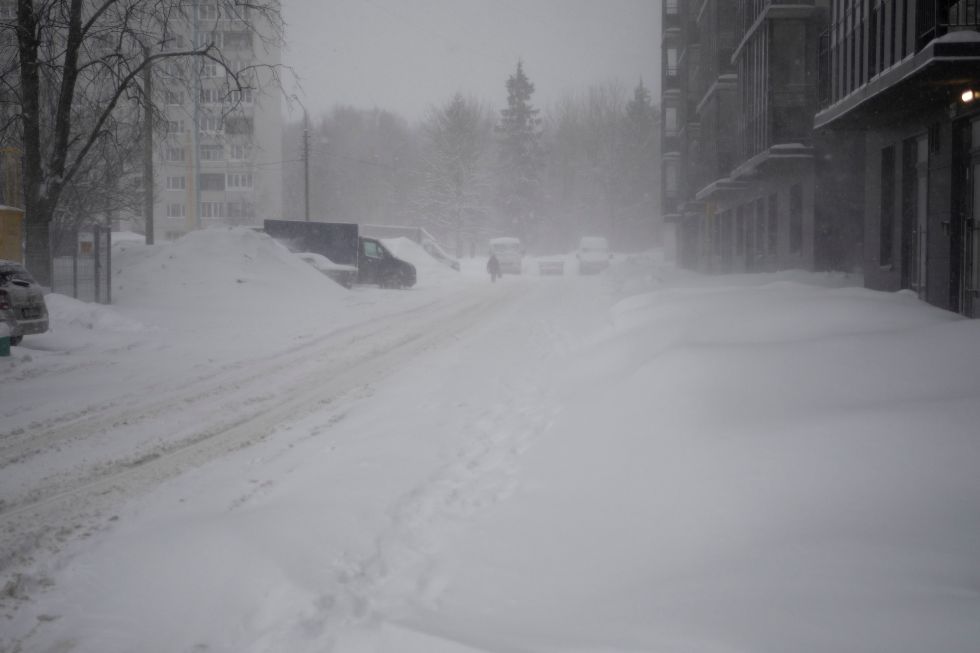



NBC News, January 27, 2026: “Extreme cold warnings were in place for millions from the Great Lakes to the Gulf Coast on Tuesday, as communities across the eastern third of the United States repaired damage from a huge winter storm that has killed at least 51 people.”
Reading the above headline, a reasonable person interested in climate change would wonder how we can have global warming and simultaneously experience such extreme cold events sweeping through large areas of the United States. But a climate scientist would simply nod their head.
The simplest answer is that global warming causes climate change, and climate change is all about extreme weather. And extreme weather means more frequent and more severe heat waves, floods, droughts, storms and yes, cold weather. As more of the heat gets trapped in our atmosphere, it provides more energy into the weather system. This added energy feeds the movement of air and ocean currents, changing our climate. In doing so, it’s as though climate change stretches the normal distribution curves of weather events, with more extremes at either end.
All of these intense events are happening and will continue to happen, inconsistently and unevenly, non-linearly. That means temperatures will not rise in a straight line, going up year by year. In some years, they may drop. They will not happen evenly throughout the world, and the extreme events will not increase in their frequency or intensity linearly. Some areas will become drier, others will get wetter. Some will become hotter while others may even get cooler. All of that is because the world’s weather is dependent on countless interacting factors and complicated connections.
Warming the polar vortex
Let’s now hone in on the one aspect of the news item regarding the bitter cold sweeping through the eastern parts of the US. Incidentally, this event is not new. In 2014, 2022 and early 2025, the US experienced significantly intense, widespread winter storms and freezing temperatures. So, what is going on?
The paradox of global warming and freezing events in the US is driven by a number of factors. First, winters are the fastest-warming season in the US — up 3.9° F (-15.6° C) on average from 1970–2025 — with 98% of cities experiencing warmer winters. Despite this, warming is linked to the increased number and intensity of extreme cold events.
That’s because this warming is affecting what is termed the “polar vortex.” A polar vortex is a large, persistent, low-pressure area of circulating, frigid air that exists in the stratosphere and upper troposphere above both of Earth’s poles, strengthening in winter and weakening in summer. During winter, it acts as a vortex of wind that traps cold air near the poles. It is not a new or artificial phenomenon; it is a natural, recurring feature of the Earth’s atmosphere that exists year-round.
A strong vortex keeps cold air trapped at high latitudes, which brings normal conditions. But because the Arctic is warming nearly four times faster than the rest of the world, the polar vortex is weakening. When this band of strong winds becomes unstable, it can shift or split, allowing arctic air to spill into mid-latitudes and causing the severe cold snaps Americans are experiencing. Disruptions to the stratospheric polar vortex appear to be increasingly linked to the rapid Arctic warming, potentially making the vortex more prone to stretching and splitting. So, this effect isn’t going to go away, quite the contrary.
Social and economic devastation caused by extreme cold
Such severe winter weather, including heavy snow and freezing temperatures in areas that normally don’t experience such terrible cold, can cause significant social, economic and health impacts. The direct health impacts of hypothermia affect the elderly and the vulnerable. And they have a higher proportional impact in the lower economic demographic and those that live in isolated communities.
These communities can be further isolated by road and rail closures. Apart from the health impacts, this also causes social disruption. Power outages and system failures also commonly occur due to increased power usage and falling power poles and towers.
Power outages, road, rail and air transport closures also have a significant economic impact. Already, insurance companies are making significant adjustments based on the recent and forecasted damage to property and infrastructure from storms, heatwaves, cold snaps, floods and droughts.
How we will adapt to climate change
Climate change has and will continue to have considerable social and economic impacts around the world. Adapting to new climatic trends will involve major changes to infrastructure and the way we live on this planet. Much of our infrastructure was designed and built for a different set of criteria to what we are likely to see in the future. So what does adaptation to a changing climate look like?
This will need to be done in a number of steps, each unique to each location or region, each unique to a particular type of infrastructure: transport, communication, health, energy, water etc.
The first step is to establish the science-based climatic forecasts data for a region. These are usually available in various scenarios, such as ‘low,’ ‘medium’ and ‘high’ impact over time, each with levels of likelihood and probability. For a particular region, there may be a high likelihood of increased events of lower temperatures.
These events may become more severe and more frequent over time. For example, the northeastern region of the US may be forecast to experience an increased number of days with a lower average winter temperature by, say, 2.7° F (-1.5° C) by 2030, and this may increase to 5.4° F (-3.0° C) by 2050. Or perhaps the forecast may predict an increased number of days below a certain temperature.
These data points are then used to identify the particular risk factors or impacts and their likelihood for a particular class of infrastructure or service. They are then ranked from highest to lowest in terms of impact and likelihood under regular conditions. For instance, the roads in the above region may be more prone to closures due to snow and frost, increased by the number of days. The mitigation of each risk is then identified and costed over time.
Such exercises usually expose weak points and vulnerabilities as well as resilience in infrastructure and processes. The health systems of remote communities may be more vulnerable due to road closures and/or energy disruptions when severe storms and extreme cold snaps may affect services. While there is inherent resilience currently built in infrastructure, and it can cope with a certain number and severity of certain impacts, often such resilience becomes tested under more prolonged and more frequent events.
There is no way to avoid some of these risks of impacts without identifying them, developing mitigation actions for building increased resilience in current systems and infrastructure, and yes, allocating great amounts of money to rectifying them over time. And the longer these actions take, the greater the money needed to deal with the impending risks will be.
[Lee Thompson-Kolar edited this piece.]
The views expressed in this article are the author’s own and do not necessarily reflect Fair Observer’s editorial policy.
When It Comes to Climate Change, Promises Matter
COP26, more than previous summits, has heightened the awareness of participating countries of the severity of climate change and its...
The Wicked Problem of Climate, Blah, Blah, Blah
Should we expect more of the same “blah, blah, blah” from world leaders at COP26 in Glasgow?
When Is Hot Too Hot?
Who will be affected the most by prolonged heatwaves in summer, and how will we adapt?
Support Fair Observer
We rely on your support for our independence, diversity and quality.
For more than 10 years, Fair Observer has been free, fair and independent. No billionaire owns us, no advertisers control us. We are a reader-supported nonprofit. Unlike many other publications, we keep our content free for readers regardless of where they live or whether they can afford to pay. We have no paywalls and no ads.
In the post-truth era of fake news, echo chambers and filter bubbles, we publish a plurality of perspectives from around the world. Anyone can publish with us, but everyone goes through a rigorous editorial process. So, you get fact-checked, well-reasoned content instead of noise.
We publish 3,000+ voices from 90+ countries. We also conduct education and training programs
on subjects ranging from digital media and journalism to writing and critical thinking. This
doesn’t come cheap. Servers, editors, trainers and web developers cost
money.
Please consider supporting us on a regular basis as a recurring donor or a
sustaining member.
Will you support FO’s journalism?
We rely on your support for our independence, diversity and quality.





Comment