







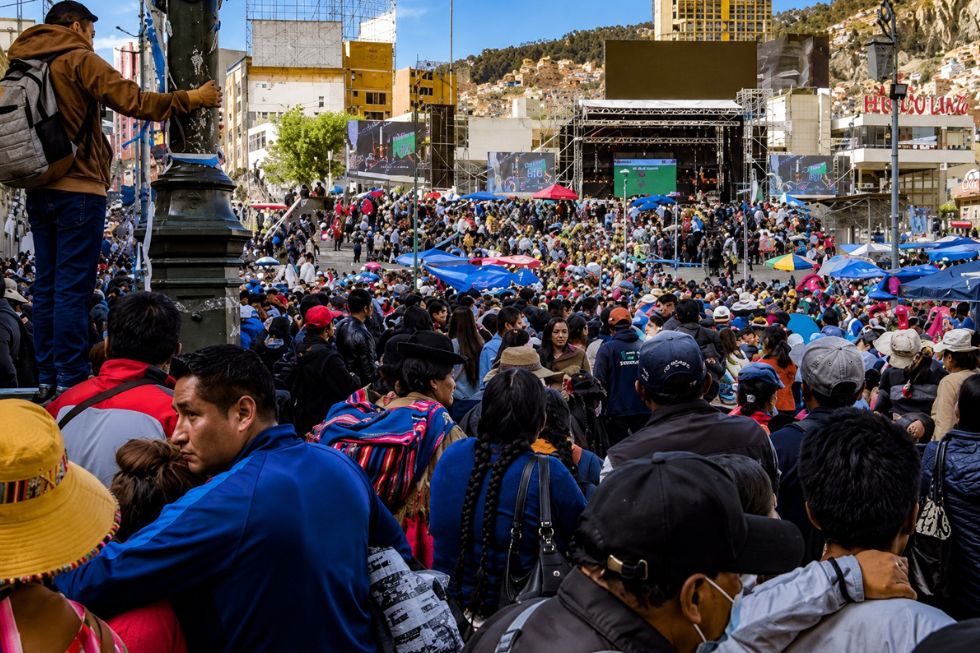


 | ||
| ||
| ||
Dear FO° Reader,
Bolivia’s recent round of protests stem from years of civil unrest toward local politics and declining economic performance. Since 2022, the country has faced ongoing economic turmoil, largely the result of collapsing natural industries and resource shortages.Since our last newsletter on Bolivia in October 2025, the South American country saw growing discontent and frustration amid the changing administrations. Bolivia’s election in November 2025 ousted the Movement Toward Socialism (MAS) party in favor of the conservative-centrist opposition candidate Rodrigo Paz Pereira to address concerns of the country’s economic crisis. Support for the new administration came from Indigenous groups, farmers and the working class during the campaign. Some people from those groups are now dissatisfied with the Bolivian president for creating policies that benefit private sector investment, ignoring their desire for representation in the government and developing land reform laws. Additionally, Bolivia’s fuel shortage continued in the first months of Pereira’s governance despite his success in bringing down inflation, stoking tensions further.  La Paz, Protests in 2023, via Shutterstock Sources: Global Protest Tracker | Carnegie Endowment for International Peace Bolivian Blockades Start to Recede After 46 Days of Unrest | Bloomberg Maybe, like you said, the property’s doing it Economic pressures are also being acutely felt in the agricultural sectors. New land reform legislation was passed with the intent to allow farmers to use their land as collateral to try and help boost their purchasing power in tough economic times. However, critics have said that this bill is only going to help farming conglomerates and banks buy up farming land, and in some cases, outright seize properties. Furthermore, the law’s opponents are also worried about the potential ecological damage this could cause, on top of encroaching on indigenous lands. This resulted in a month-long march from several organizations, ending in a ten-day demonstration in the capital that ultimately forced lawmakers to repeal the act. However, the inequalities that the bill was trying to solve still remain. The country is still living in the wake of the end of fuel subsidies in December 2025. These subsidies were politically popular, as they kept fuel prices low, but cost the state millions. With their end, fuel prices doubled instantaneously. This kicked off a wave of protests and political vitriol against Paz despite the government’s attempts to soften the blow with a minimum wage increase and other stimuli. Paz was ultimately able to come to an agreement with protesting unions, but the anger clearly remained. A law to help Bolivian farmers may actually increase land grabbing, critics warn | MONGABAY Indigenous Organization Forces Repeal Of Land Privatization Law In Bolivia | Counter Currents Rodrigo Paz’s Defiant First 90 Days | Americas Quarterly Bolivia government reaches deal to end fuel protests | UPI.com The Bolivian Workers’ Central as a central player The Bolivian Workers’ Central (COB) union has proven to be a decisive player in the civil unrest currently taking place across Bolivia. Founded in 1952 after a revolution that overthrew Bolivia’s oligarchic class, the organization united miners, factory workers and peasants, and continues to remain a considerable force in Bolivian politics. Under the Paz presidency, this trade union, according to the Chilean left-wing online newspaper El Ciudadaño, has recently had five of its members “unlawfully abducted” amid the protests going on in the country. Evo Morales, the former president of Bolivia, along with his supporters, has also been accused of inciting the recent wave of protests by Paz’s government. Previously, in 2019, Morales was also accused of fomenting unrest in the country. However, as of May 2026, Morales is reported to be in hiding in the mountains of Bolivia following the electoral defeat of his MAS party. Recently, the executive secretary of the COB, Mario Argollo, reported that the union sent a document with an eight-point agenda to President Rodrigo Paz’s government which it urged to be addressed immediately. One of their demands was for the Attorney General, Rober Mariaca, to stop any criminalization or prosecution of protesters. Sources: Bolivia In Turmoil | El Ciudadano What do Bolivia’s escalating protests reveal about the country’s political crisis | ACLED Bolivia crisis: Morales accused of terrorism and sedition | BBC What Bolivia tells us about the world
Bolivia is a case study. In 2025, more than 70 countries, from Africa to Latin America to Europe, experienced some form of popular unrest driven by shared grievances of poor governance, economic inequality and political exclusion. The movement has not subsided. Many of the protests that began in 2025 have continued into 2026, while new mobilizations have emerged with different yet related grievances. What connects La Paz to Geneva, Tirana to London is not ideology but numbers, the widening gap of inequalities and the increasing awareness thereof. The causes are inherently geography-agnostic: lack of employment opportunities, discriminatory practices, rising inequality and faltering economic justice. The primary concern is the widening distance between what an economy produces and who actually receives it. What Bolivia adds to this picture — and what is largely absent from European coverage of the protests — is the colonial dimension. For nearly two decades, Bolivia was a rare experiment in indigenous political inclusion at the highest level of the state. That experiment is now being dismantled through austerity, IMF loans and a cabinet of white upper-middle-class appointees, backed by Washington. In Bolivia, Rodrigo Paz won with 55% of the vote on a moderate centrist platform; within six months, indigenous and working-class voters who carried him to office were being tear-gassed and labelled narco-terrorists by his US-backed administration. The pattern — electoral promise, structural betrayal, criminalization of dissent — is not unique to the Andes. Bloomberg’s 2025 unrest risk model flags Ethiopia, the Central African Republic, Angola, Guatemala, the Republic of Congo and Malaysia as countries at heightened risk of civil unrest in 2026. Many of the demonstrations around the world have originated as protests against austerity policies and seemingly small-bore economic measures — raising transit fees, imposing fuel price hikes, removing subsidies. But what is being protested, in La Paz as in Geneva, is not just economic policies but a wider system. This system has decided, with remarkable consistency across governments of different parties and different continents, that the cost of crises should be borne by those who demand change. Sources: US says it is ramping up emergency assistance in Bolivia amid protests | Reuters G7 Summit Highlights Global Economic System “Captured” by Billionaires: Oxfam | Democracy Now! Gen-Z Revolts Against ‘Dystopian Future’ as Protests Sweep the Globe Global Protest Contagion and the Crisis of Inclusive Growth Oxfam’s Global Inequality Report Ending Impunity and Inequality | Oxfam International Global Protest Tracker | Carnegie Endowment for International Peace The 2025 Surge in Global Protests Is Continuing in 2026 – European Democracy Hub Aliyah, Casey, Alexandros and Roberta Assistant Editors, Communications and Outreach | ||
We are an independent nonprofit organization. We do not have a paywall or ads. We believe news
must
be free for everyone from Detroit to Dakar. Yet servers, images, newsletters, web developers and
editors cost money.
So, please become a recurring donor to keep Fair Observer free, fair and independent. 
| ||
| ||
| About Publish with FO° FAQ Privacy Policy Terms of Use Contact |





Explore More FO° Spotlight

Support Fair Observer
We rely on your support for our independence, diversity and quality.
For more than 10 years, Fair Observer has been free, fair and independent. No billionaire owns us, no advertisers control us. We are a reader-supported nonprofit. Unlike many other publications, we keep our content free for readers regardless of where they live or whether they can afford to pay. We have no paywalls and no ads.
In the post-truth era of fake news, echo chambers and filter bubbles, we publish a plurality of perspectives from around the world. Anyone can publish with us, but everyone goes through a rigorous editorial process. So, you get fact-checked, well-reasoned content instead of noise.
We publish 3,000+ voices from 90+ countries. We also conduct education and training programs
on subjects ranging from digital media and journalism to writing and critical thinking. This
doesn’t come cheap. Servers, editors, trainers and web developers cost
money.
Please consider supporting us on a regular basis as a recurring donor or a
sustaining member.
Will you support FO’s journalism?
We rely on your support for our independence, diversity and quality.





Comment