






The crude oil market disruptions following Iran’s closure of the Strait of Hormuz have been well documented in the media. We hear daily about rising fuel prices, potential shortages of fertilizer and the negative impact this is having on economies worldwide. However, the emphasis is on crude oil. This misses a crucial point. One does not fill up a gas tank or operate machinery on crude oil. Crude oil is not the lifeblood of an economy; the things you make from it are. If an economy collapses because of disruptions in the oil markets, it will not be because of crude oil; it will be because of the products made from it.
There is an even more dangerous transformation happening in the United States “oil-based” economy: Refined products are no longer immune from world supply disruptions. The US is now a major exporter of refined products. If someone else will pay more, US refined products are exported. According to the St. Louis Federal Reserve, prices received for US petroleum products increased 23% from March to May. Supply responds to higher prices, so more is exported.
Daily exports of refined products have increased 15.9% since 2023, and the trend is continuing. The impact of the Strait of Hormuz closure clearly demonstrates that the refined product market in the US has undergone a structural shift, which implies it could literally “run out of gas.”
Refined products
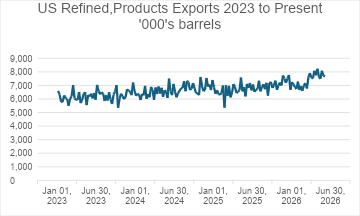
The above chart shows the growth in refined products exports over the past three years. The trend has been increasing, but what is particularly striking is the noticeable increase in exports since the US incursion into Iran, starting on February 28.
This trend is even more apparent when exports from March 2026 until June 2026 are considered:
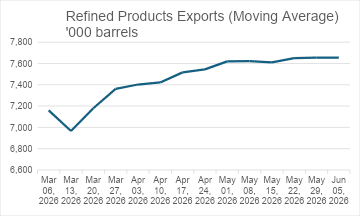
Average exports increased dramatically over this period, from 7.2 million barrels per day to over 7.6 million barrels per day. To put this into context, total refined products consumption in the US is approximately 12 million barrels per day, which means that the US is currently exporting 63% of its consumption.
Inventory levels
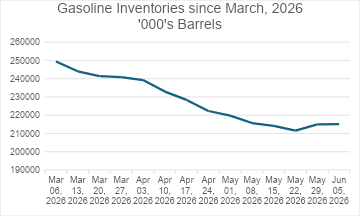
Because of the increase in exports (March 2026 to June 2026), combined with the surprising inelasticity in refined product demand, refined product inventory levels have dropped below the 5-year averages and are the lowest since 2016. Current inventory levels are 25.5 days of demand for motor gasoline and 24.1 days for distillates (which include diesel fuel, heating oil and other fuels). The drop-off in inventories after the Strait of Hormuz closure is dramatic. In contrast, in the period just prior to March 2026, levels were 28.0 days and 29.8 days, respectively.
The same trend is evident for distillate fuels:
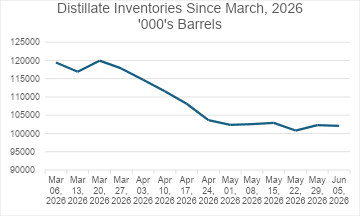
These decreases in inventories happened over three months. In the event of a more prolonged disruption, the impact could be catastrophic. As mentioned earlier, the US has 25.5 days of gasoline and 24.1 days of distillates. Refineries are currently running at a 95.5% utilization rate. This is as high as they can go without risking major mechanical failure. In other words, there may be no new supplies and no inventory.
The issues connected to exports and consumption do not exist in isolation. There is an important downstream impact that must be considered. This is captured by analysis of inventories by Petroleum Administration for Defense Districts (PADD), which describe the US energy markets regionally.
Regional supply issues
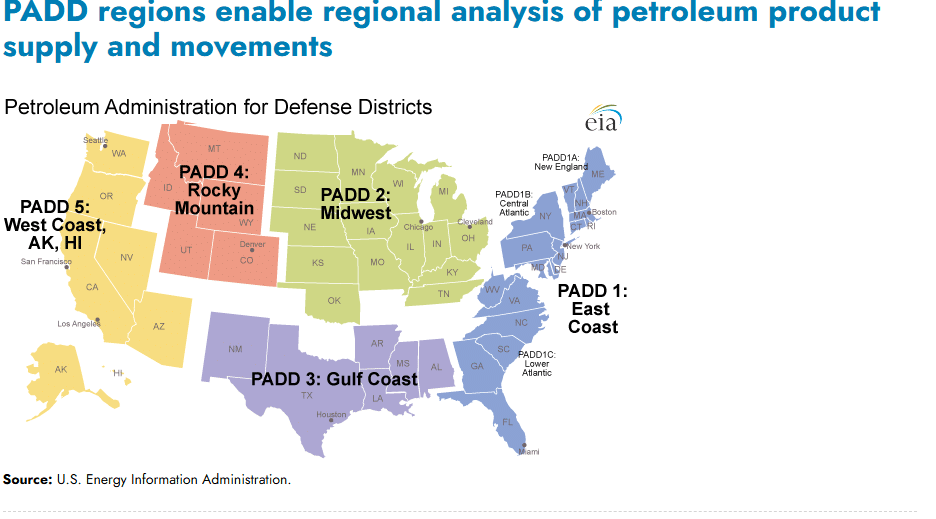
The potential for supply disruption is compounded by regional discrepancies in inventories. Some regions have seen much larger inventory drops than others. This could be majorly disruptive as shifting inventory is not straightforward. Shifts in inventory rely on transportation networks, which (1) are time-consuming and (2) are subject to bottlenecks that prevent easy transfer of product.
| PADD Districts (‘000 Barrels) | |||
| 3/6/26 | 6/5/26 | % Change | |
| PADD 1 | 66,910 | 56,742 | -15.2% |
| PADD 2 | 59,961 | 44,350 | -26.0% |
| PADD 3 | 85,226 | 79,809 | -6.4% |
| PADD 4 | 9,177 | 6,891 | -24.9% |
| PADD 5 | 28,316 | 27,348 | -3.4% |
| PADD Districts (‘000 Barrels) | |||
| 3/6/26 | 6/5/26 | % Change | |
| PADD 1 | 27,324 | 23,097 | -15.5% |
| PADD 2 | 29,037 | 25,264 | -13.0% |
| PADD 3 | 46,412 | 40,054 | -13.7% |
| PADD 4 | 4,623 | 3,445 | -25.5% |
| PADD 5 | 12,035 | 10,241 | -14.9% |
The most at-risk districts are PADD Districts 2 and 4. PADD District 2 is most worrisome, as it represents the Midwestern US — the agricultural heartland. If there is no fuel, there is no harvest.
The US incursion into Iran (and the subsequent closure of the Strait of Hormuz) uncovered hidden vulnerabilities in the US fuel supply chains. These vulnerabilities were exposed after just a three-month period. Longer disruptions would surely be more dramatic (and potentially catastrophic). If these inventory trends continued, US gasoline inventories would drop 55.1% to 8.7 days of inventory by the Spring of 2027. Distillate inventories would drop 67.9% to 8.2 days. This is not sustainable. Yes, the US could conceivably run out of gas in the near future.
[Kaitlyn Diana edited this piece.]
The views expressed in this article are the author’s own and do not necessarily reflect Fair Observer’s editorial policy.
Donroe Doctrine Makes Guyana Key for US Latin America Policy
Oil-rich Guyana is now more secure from Venezuelan aggression and can profit from higher energy prices thanks to the US/Israel–Iran...
FO Exclusive: US–Iran Double Blockade of Hormuz Threatens Global Economy
In this section of the April 2026 episode of FO Exclusive, Atul Singh and Glenn Carle argue that the Iran...
The Iran War Is a Reminder: Decarbonize Fast, But Do Not Gamble with Energy Security
The Iran war has disrupted global energy markets by targeting key infrastructure and closing the Strait of Hormuz, a vital...
Iran Triggers Hormuz Chokepoint Crisis and Risk of Global Stagflation
Iran has blocked the Strait of Hormuz, causing a rise in fuel and fertilizer prices. In turn, these will cause...

Support Fair Observer
We rely on your support for our independence, diversity and quality.
For more than 10 years, Fair Observer has been free, fair and independent. No billionaire owns us, no advertisers control us. We are a reader-supported nonprofit. Unlike many other publications, we keep our content free for readers regardless of where they live or whether they can afford to pay. We have no paywalls and no ads.
In the post-truth era of fake news, echo chambers and filter bubbles, we publish a plurality of perspectives from around the world. Anyone can publish with us, but everyone goes through a rigorous editorial process. So, you get fact-checked, well-reasoned content instead of noise.
We publish 3,000+ voices from 90+ countries. We also conduct education and training programs
on subjects ranging from digital media and journalism to writing and critical thinking. This
doesn’t come cheap. Servers, editors, trainers and web developers cost
money.
Please consider supporting us on a regular basis as a recurring donor or a
sustaining member.
Will you support FO’s journalism?
We rely on your support for our independence, diversity and quality.





Comment