





The Indian government has recently launched a series of measures aimed at increasing the accountability of social media platforms. Such measures include requiring companies to label AI-generated content and remove unlawful content within three hours. While these measures are a step in the right direction towards a more regulated online space, they fall far short of addressing the multifaceted impact of social media on our lives.
The enmeshment of our lives with digital spaces poses a deeper reckoning that cuts to the heart of the world’s basic tenets and norms we aspire to inhabit. Acclaimed author Amitav Ghosh, remarking on the post-pandemic world, stated that “The old world is gone and the new world is still revealing itself.” There are two significant features of our increasingly unraveled new world: widespread access to social media and the celebration of individual mobility, especially female mobility. The problem is not that our world is changing, but our ignorance of whether it is changing in a direction conducive to our Children’s well-being.
We are selectively critical of social media consumption when it comes to harmful content or extreme cases of addiction, as in the tragic case of three teenage sisters in India who committed suicide when their parents withdrew their phone access, preventing them from engaging on social media for a week. However, we fail to reflect on our everyday, uneventful interactions with social media, such as weddings being planned based on what is trending on Instagram, partners jokingly commenting on each other’s Instagram addiction and watching video reels even while driving. Such online behaviors are not innocuous. Instead of pausing to reflect on the short and long-term implications of our online behavior, we have normalized various social media interactions that do not fall on the extreme ends of addiction.
On India’s Republic Day this year, I visited a city park in Noida, Uttar Pradesh, that was bustling with people. While elites were few, the aspirational middle class was large. They were actively using the park not just as a space for leisure and sport, but also as an appealing backdrop for Instagram reels and YouTube shorts. On more than one occasion, my toddler mistakenly interrupted a group of young people attempting to record a video. In my friend group, two people spent almost 20 minutes on the phone during a 2-hour picnic. Today, in large metropolitan cities, when young people get together, the conversation is dominated by the videos they have watched. It is commonplace to see groups of people, young and old alike, on their phones while sitting together.
Social norms that once discouraged phone use in the company of others have broken down, as we quietly acquiesce to living in a digital bubble, a mediated existence. Our world is subsumed by the promise of efficiency and convenience, while actively disincentivizing engagement in complicated human relationships. The overreliance on social media for content consumption elevates individual preferences, making it harder to make the sacrifices needed to build a family and foster a community.
A proactive approach to combating excessive social media use
As India becomes richer, the country’s leadership must learn from the mistakes of other societies that have buckled under the passive adoption of technology. Jonathan Haidt, a leading American psychologist, blames the prevalence of smartphones for the “collapse in young people’s mental health since 2010.” His claims are corroborated by numerous studies asserting that extensive use of social media sites is associated with an increased risk of depression, anxiety and psychological distress. Such reprcutions are exacerbated for young girls, who are more likely to use image-based platforms that perpetuate body image issues.
According to an Indian government press release, 85.5% of Indian households own at least one smartphone. India is home to the second-largest number of smartphone users globally and is an important market for social media and AI companies. It is therefore important that Indian leadership learn from the missteps of the Western world, drawing on its civilizational ethos and cultural dynamism to adopt a more critical approach towards social media consumption.
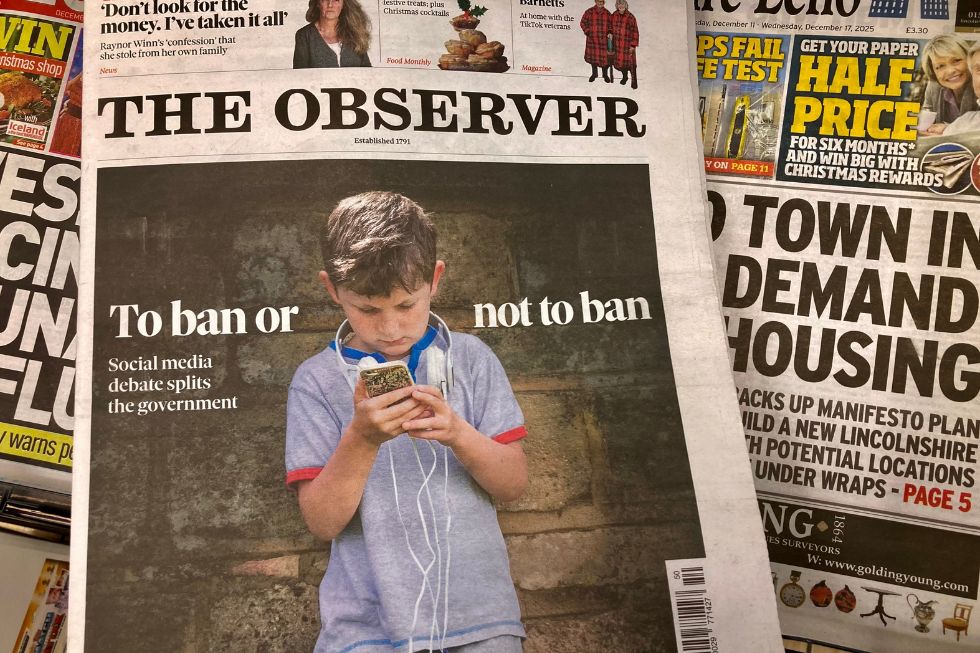
The urgent need to regulate digital technology is rapidly becoming the global consensus position. Countries such as Australia, France, Italy, China and Indonesia have banned social media use for children under 16. In India, the Karnataka government is considering a proposal to ban smartphones for students under 16. Last year, the principal of Mayo College, one of India’s premier boarding schools, instituted a ban on smartphones on campus. Explaining his decision, Saurav Sinha stated that “access to smartphones at a young age can mean constant distraction instead of deep focus,” leading to “social media anxiety at the cost of genuine friendship.”
While restricting social media usage for children at an institutional level is a desirable first step, more action to combat the scourge of social media addiction is needed. Pulling children away from phone screens is not enough. There is an urgent need to provide them with alternative spaces that offer mental, emotional and physical stimulation.
Social media resilience in the Indian city of Rajgir
Haidt emphasized several norms that society must establish to regulate smartphone use. His most significant proposal concerns “unsupervised play and childhood independence,” arguing for the need to provide children with spaces to explore and play freely with peers. These spaces, however, do not emerge spontaneously. They require a connected, secure community where people look out for each other’s children. Away from the homogeneity and hubris of metropolitan cities, India’s vast diversity includes communities that maintain a tenuous relationship with technology, offering a fertile, vibrant space for social and cultural development.
An example of such a space is the ancient city of Rajgir, a quaint city with a small population of 41,000. Rajgir is home to various Buddhist, Jain and Hindu temples and is replete with tourists from India and abroad. Malls and multiplexes are conspicuously absent from the city landscape. Unlike parks in other Indian cities, such as Noida, where digital technology use among visitors is prevalent, Rajgir offers a different lived reality.
In Rajgir, on a warm winter afternoon, large families throng the Pandu Pokhar Eco Adventure park. Mothers in their late thirties can be seen playing badminton while their children tug at them, demanding their attention. At the playground, children occupy the same space as a woman in her early fifties, who tells her husband she is scared to try the swing. The husband encourages her to give it a go, and her adult children join in goading her. She hesitantly sits down on the swing. When her son pushes her, ever so slightly, she begins crying in fear, much to the amusement of her family and other onlookers.
This environment is a far cry from playgrounds of Noida, where anxious parents actively surveil their children, often intervening to break up fights or respond to tantrums. In Rajgir, the parents express a sense of calm reassurance. They also navigate the park differently, as a space of leisure, where digital engagement, while occurring, is not the focal point.
Globally linked but locally rooted
What makes Rajgir fundamentally different from a city such as Noida is that Noida is a large city and a hub for software companies and mobile manufacturing. While this makes Noida economically viable and attractive for migrants, it also dilutes its cultural ethos. The fertile land, once tended by farmers, has been replaced by factories, malls and schools. While benefiting handsomely from the acquisition of their lands, the farmers have been pushed to the fringes of the city.
Moreover, the majority of Noida inhabitants are migrants who moved from all parts of India to build their future. They are highly aspirational and willing to embrace the celebratory narrative of individual mobility that is pervasive on social media. They are also distant from their cultural ethos and less committed to building a community space that privileges the collective over the individual. Without such a space, creating social environments that draw young minds away from screens will be difficult.
In Rajgir, people are unwilling (at least for the moment) to abandon the social environment that provides them with a sense of community warmth. They are comfortable aligning their individual aspirations with what is acceptable for their family unit. This means that the negative ramifications of their digital interactions are offset by the social enrichments of their everyday lives. This allows for an organic balance and contributes to resilient social formations, which, while leaving space for digital connections, prioritize social engagement and belonging. Such a harmonious environment fosters greater tolerance for the untidiness of human interactions, encouraging children to explore and socialize with one another more freely.
Such a space provides a model for remaking the new world in ways that serve our long-term interests and well-being. While India must learn from the experiments of other nations, it should also look inwards to identify spaces of community resilience. The country must calibrate its engagement with technology to foster global connections while preserving its social ties and cultural moorings.
[Omar Abdelrahman edited this piece.]
The views expressed in this article are the author’s own and do not necessarily reflect Fair Observer’s editorial policy.
Own Nothing? Welcome to Technofeudalism
Digital life is monitored and exploited by Big Tech, with every interaction benefiting the companies that control algorithms and harvest...

Australia’s Idiotic Social Media Ban
Australia’s social media ban for children under 16 is set to take effect on December 10 — becoming the world’s...

X versus the Indian Government: Whose Narrative is it Anyway?
Elon Musk’s X has filed a lawsuit against the Indian government, accusing it of arbitrary censorship under the IT Act...

Support Fair Observer
We rely on your support for our independence, diversity and quality.
For more than 10 years, Fair Observer has been free, fair and independent. No billionaire owns us, no advertisers control us. We are a reader-supported nonprofit. Unlike many other publications, we keep our content free for readers regardless of where they live or whether they can afford to pay. We have no paywalls and no ads.
In the post-truth era of fake news, echo chambers and filter bubbles, we publish a plurality of perspectives from around the world. Anyone can publish with us, but everyone goes through a rigorous editorial process. So, you get fact-checked, well-reasoned content instead of noise.
We publish 3,000+ voices from 90+ countries. We also conduct education and training programs
on subjects ranging from digital media and journalism to writing and critical thinking. This
doesn’t come cheap. Servers, editors, trainers and web developers cost
money.
Please consider supporting us on a regular basis as a recurring donor or a
sustaining member.
Will you support FO’s journalism?
We rely on your support for our independence, diversity and quality.
An Educationist’s Take on Early Childhood Development Policy in India: What’s Missing?
A long-time educationist Chittaranjan Kaul spoke about the future of early childhood development in India at the AECED (Association for...

(Il)liberal Gender Ideology Confuses Children and Stifles Discourse
Western culture is confused about transgenderism and children’s place in it. A censorious left-wing ideology stifles discourse and misinforms the...

Social Media Has a Colossal, Horrific Body Count
Two opposite Senate testimonies, by Mark Zuckerberg as Chief Executive and by this author as Chief Algorithm Officer, pit administrative...






Comment