




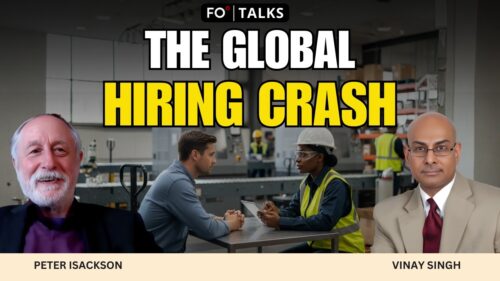
Fair Observer’s Chief Strategy Officer Peter Isackson and Global Civilization Dynamics Founder Vinay Singh discuss a variety of tech subjects, starting with Meta’s decision to track employee keystrokes and mouse movements in order to train AI systems that can “replicate” human work. From there, Isackson and Singh widen the lens, arguing that the same logic driving automation may also undermine the consumer economy on which Western capitalism depends. Modern societies are optimizing for efficiency and consumption while eroding the human capacities — trust, attention and critical thinking — needed to sustain civilization itself.
From workers to data points
Singh opens with reports that Meta is increasing surveillance of employees by monitoring keyboard activity and mouse movements to improve AI agents. The company presents the move as a technical necessity, arguing that AI systems still struggle with many small human tasks. Yet both speakers see the development as symbolic of a deeper shift in management culture.
Isackson argues that workers are increasingly treated not as members of a productive community but as objects to be optimized. He compares the trend to a modern version of Charlie Chaplin’s Modern Times, where human beings become extensions of machines rather than the reverse.
Singh remains skeptical of claims that humans will simply “monitor” AI systems while retaining stable employment. He predicts that companies will eventually reduce headcounts dramatically, leaving only a handful of people supervising vast networks of automated agents. More troubling for him is the wider corporate tendency to imitate whatever large technology firms do. He warns that many executives now assume that if Meta or another tech giant adopts a model, every industry should follow it regardless of whether it fits their own business realities.
Isackson notes that boards, venture capital firms and financial actors often reinforce this pressure. Because they are removed from day-to-day production, they reward short-term efficiency gains without considering how workplace culture or human motivation may deteriorate over time.
The AI layoff trap
Isackson and Singh then turn to an economics paper describing what researchers call the “AI Layoff Trap.” The paper argues that firms are automating labor faster than the broader economy can absorb the consequences, creating a destructive feedback loop. Companies benefit individually from layoffs, but collectively they weaken consumer demand across society.
To illustrate the idea, Singh introduces his “three brothers” analogy. One brother owns a phone company, another a grocery chain and the third a car dealership. When the phone company lays off workers to cut costs, those unemployed workers spend less on groceries. The grocery business then suffers and cuts its own workforce. Those additional layoffs reduce spending on phones and cars, eventually harming the original company that initiated the cuts.
Singh calls this a “circular dynamic” that exposes how interconnected economic systems really are. What appears rational at the level of one corporation becomes destructive at the level of society.
Isackson connects the argument to Henry Ford’s realization that workers needed enough income to buy the products they produced. He notes that the US economy remains overwhelmingly consumer-driven, making large-scale demand destruction particularly dangerous. “When you start doing things that are focused on the logic of production,” he warns, “you may be undermining” the consumer system itself.
Both speakers argue that short-term thinking has become embedded in corporate culture. Firms focus narrowly on immediate efficiency gains while ignoring the wider social consequences of mass automation.
A crisis of trust
The conversation then shifts from economics to politics and social cohesion. Singh cites polling from Harvard Kennedy School showing that only 19% of young Americans trust the federal government to do the right thing most or all of the time. Trust in Congress, the presidency and the Supreme Court is similarly low.
For Singh, the numbers reflect growing financial insecurity and what he describes as a “crisis of community.” Younger generations increasingly struggle to see stable pathways into adulthood, employment or social belonging.
Isackson argues that the phenomenon extends beyond the United States. In Europe, citizens may still trust state institutions more because of stronger welfare systems, but confidence is eroding there as well. He also points to collapsing trust in mainstream media, which historically helped define shared expectations and social norms.
Singh believes generational disconnect worsens the problem. Younger people, he argues, often fail to learn resilience from older generations who experienced earlier economic crises such as the dot-com collapse or the 2008 recession. Social media has weakened those intergenerational relationships and replaced lived experience with digital interaction.
“Digital Doritos” and the loss of attention
The final section explores the cognitive consequences of constant digital consumption. Singh references studies linking short-form video platforms such as TikTok and Instagram to reduced attention spans and weaker concentration. Other research suggests that even the mere presence of a smartphone can impair cognitive performance.
Drawing on author Cal Newport’s idea of “Digital Doritos,” Isackson and Singh compare low-value online content to junk food for the mind. Isackson argues that the solution requires more than personal discipline. “We have to learn how to achieve balance,” he says. Societies must rethink education and culture rather than simply asking individuals to use their phones less.
He argues that the humanities remain essential because they expose people to history, literature and unfamiliar perspectives that cultivate deeper thinking. Standardized education systems increasingly prioritize measurable productivity instead of intellectual breadth or reflection.
Singh closes with an anecdote about watching children at a restaurant sit silently with headsets and tablets instead of interacting with one another. For him, the scene captures the broader danger of replacing lived human experience with digital immersion. The concern is not simply distraction, but the possibility that societies are losing the very habits of thought and social connection that make innovation, trust and civilization possible.
[Lee Thompson-Kolar edited this piece.]
The views expressed in this article/video are the author’s own and do not necessarily reflect Fair Observer’s editorial policy.






































Comment