





Fair Observer’s Editor-in-Chief, Atul Singh, and FOI Senior Partner Glenn Carle, a retired CIA officer who now advises companies, governments and organizations on geopolitical risk, discuss US President Donald Trump’s Russian diesel deal and the political calculations behind it. With fuel prices soaring ahead of the US midterm elections, Trump has turned to Moscow just weeks after signing legislation tightening sanctions against Russia. Atul and Glenn explore why the agreement offers limited economic relief for Americans while handing Russian President Vladimir Putin a significant victory and straining US relations with Europe.
Forget sanctions, Trump wants diesel
On September 18, Trump signed into law the Lindsey O. Graham Sanctioning Russia and Iran Act of 2026, or the Graham Act. This law codifies the existing executive order-based Russia sanctions program, mandates new Russia sanctions and even creates new tariff authorities. Note that the Graham Act also extends the Iran Sanctions Act of 1996 through 2031. In the words of global law firm Holland & Knight, “the Graham Act takes aim at non-U.S. persons and vessels involved in transport of Russian-origin energy commodities, including vessels and their owners, operators and insurers.”
Less than a month later, Trump dropped a political bombshell. On October 9, three weeks after the Graham Act signature, he announced that Russian President Vladimir Putin would sell millions of tons of diesel fuel to the United States. On October 16, Trump issued Executive Order 14436, waiving the sanctions and tariffs authorized by the Graham Act.
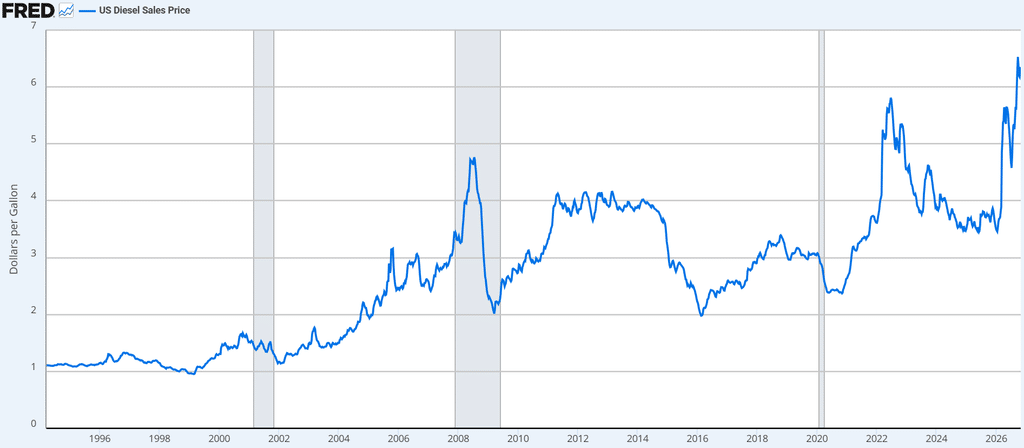
Before the US/Israel–Iran War began on February 28, diesel prices in the US averaged $3.75 per gallon. Before this deal, they had risen to an average of $6.32 to $6.35 per gallon. The US is a diesel exporter, but Trump’s war has triggered a global supply shock and prices have risen even in America. With the midterms due on November 3, Trump has invoked the art of the deal and conjured a rabbit out of his hat to lower diesel prices. He calculates that this should help the Republicans at the polls.
Presidential discretion and American credibility
Now, why are Trump’s actions a problem? First, they illustrate, as Holland & Knight said, “a recurrent tension” between the president and Congress over “the use of and responsibility for the legal tools of economic statecraft.” In keeping with precedent, the president retains significant discretion per the law. Like prior sanctions-related legislation, the Graham Act provides the president this discretion but this diesel deal goes against the spirit of the law. There is also the Ending Importation of Russian Oil Act of 2022, which intends to do pretty much what its name suggests. Many lawyers say Trump might be too close to skirting the law.
Second, Trump’s actions undermine the credibility of the US as a reliable partner. For the last few years, the US has pushed Europe to take a harder line against Russia. In January, US Treasury Secretary Scott Bessent complained that the Europeans were “still sending money to Russia for energy” and “financing the war against themselves.” Now, the US has changed tack dramatically and Putin is Trump’s new best friend.
The deal’s political, international and economic implications
Third, Atul and Glenn look at what this deal means in domestic and international political terms. They examine its economic impact for both the US and Russia. They also explain Trump’s relationship with Russian President Vladimir Putin and with Russia.
Politically, the deal is a propaganda tool before the elections for Trump. He can speak of it in public and tout it as a triumph. The deal is an effort to neutralize his (and the Republican Party’s) greatest vulnerability in the midterm elections: the price of fuel. The cost of a gallon of gasoline or diesel for the average American is inordinately high and Trump wants to be seen as doing something about it.
Internationally, the deal undermines international sanctions, EU sanctions, NATO and both US–NATO, US–Europe relations. The deal demonstrates three key points:
- It liberates, even rehabilitates, Putin and Russia. It ends Russia’s isolation. This is, again, one of Trump’s objectives.
- It demonstrates Trump’s decades-long “ties with” or “affinity for” Russia.
- It demonstrates Trump’s and Putin’s preference for a US–Russia bilateral condominium (joint sovereignty) in Europe and the end of the normative, alliance-structured international order. The deal favors what critics have until now erroneously called the “Post-Yalta world” of great power rule.
Economically, the agreement is empty for the US: It will hardly fill one truck on a highway somewhere in Middle America.
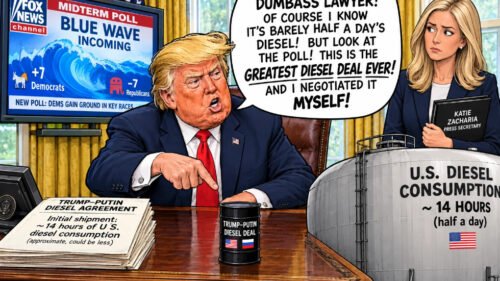
- The agreed-upon amount was 300,000 tons initially, equal to slightly more than half a day’s diesel consumption in the US. The final amount is one million tons, which is supposed to come next year. That is one day’s consumption in the US.
- The agreement at full implementation — in two years or so — is projected then, possibly, to reduce the price of a gallon of diesel by roughly $0.10, perhaps $0.15. Prices since February 26, however, are up over 70%, or $2.63 per gallon: from $3.72 to $6.35.
- The agreement is significant for Russia though, because it relegitimizes Russian international trade.
For Russia, this deal is extremely consequential because 50–57% of Russia’s GDP, when one includes downstream effects, comes from petroleum exports. No less than 60–63% of Russia’s foreign exchange earnings come from the petroleum industry and 20–25% of Russia’s national budget is financed by petroleum exports.
At present, the only real purchasers of Russian oil and gas are China and India, but each will only pay with yuan or rupees, respectively. In fact, sanctions have turned Russia into a de facto Chinese economic satellite but this deal gives Russia hope of breaking the stranglehold on its economy — which is, otherwise, in a death spiral. Russia’s sovereign wealth fund is down to $45 billion, but it is all held in yuan. It cannot finance or cover expenditures even to the end of 2026. Now, Russia can access scarce dollars.
Trump’s deal is a political distraction with no economic substance for the US, but is greatly beneficial economically and politically for Russia.
[Lee Thompson-Kolar edited this piece.]
The views expressed in this article/video are the author’s own and do not necessarily reflect Fair Observer’s editorial policy.
































Comment