




From a Western perspective — by which I mean North America and the European Union — we have entered an era of growing confusion. If we relied solely on the Western mainstream media for information, it would be difficult to understand what is happening with regard to current conflicts.
Western media has failed to point out French President Emmanuel Macron’s utter incoherence on the Russia–Ukraine War. I have always thought that Macron’s patently absurd “at the same time” approach lacked both intelligence and courage. He claims that France supports Ukraine’s war effort and at the same time is not at war with Russia. This is nonsensical because any support of Ukraine involves war with Russia.
In recent months, US President Donald Trump has come up with something even better: He has already won the war against Iran — according to his own statements — a good 50 times over. Never in the history of humanity has anyone, not even Alexander the Great, inflicted so many defeats on Iran in such a short time.
Western democracies’ challenge with geopolitics
In a modern democratic society, unlike in ancient Athens, citizens do not have the time to debate and inform one another because they cannot offload their work onto a multitude of slaves. Modern democratic society is founded not on the deliberation of the “idle” but on a division of labor. While the majority of citizens are tasked with creating national wealth, only a minority devotes itself to public life or to the production and dissemination of information.
This is what is called representative democracy. It can function only if the pact of division of labor is respected. The system can only endure if two conditions are met. First, elected officials honor the mandate entrusted to them by their constituents. Personally, I am in favor of introducing a binding mandate (elected representatives follow the manifesto they promised their voters), but that would lead us into another debate. As it stands today, citizens can only stay informed if the media reports the news clearly, simply, and with respect for the facts. So for the system to endure, the second condition is a fact-based, free media.
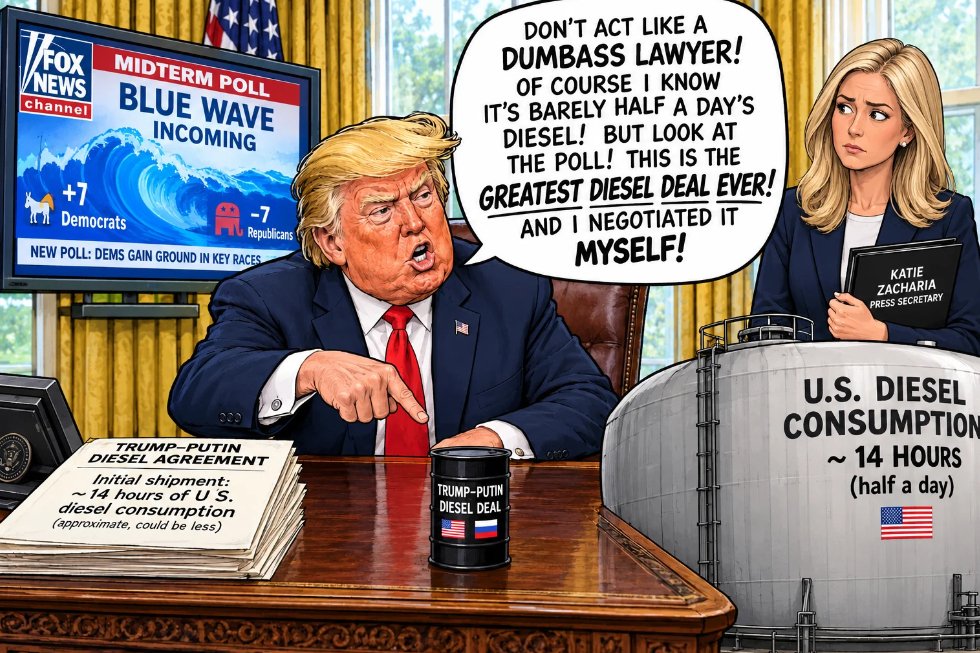
Neither of these two conditions is being met today. Trump promised his voters in particular and the American people in general that he would no longer drag his country into wars. Not only has he launched a war against Iran that has been going on for eight months, but he has also failed to keep one of his key campaign promises: to quickly end the war in Ukraine. The recent agreement on diesel doesn’t really represent a change in course on the war front.
Trump’s diesel deal with Russia has triggered three thoughts. First, Trump needs a dramatic publicity stunt as the polls look bad for Republicans ahead of the midterm elections, which are less than three weeks away. Therefore, it is in his interest to overstate the significance of lifting US sanctions on Russian diesel sales. And Ukrainian President Volodymyr Zelenskyy’s bad mood — even his defiance — suits Trump just fine: He can make it seem as though it’s Zelenskyy’s fault that diesel prices at the pump are so high for ordinary Americans.
Just as Trump benefits from Zelenskyy’s defiance among American voters, so does the Ukrainian leader among his voters. He puts on an air of defying Trump and wanting to continue striking Russia, particularly its refineries. In reality, Zelenskyy’s defiance is merely a public relations exercise. Without support from the US military, NATO and the CIA, the Ukrainians would be unable to target anything at all in Russia.
Second, if “Ukrainian shelling” of Russian targets continues to be effective in the coming days and weeks, it implies continued American support. Clearly, not all elements of the US government agree with the Trump administration and some of them might continue to support Ukraine despite the public pronouncements of the president.
Third, Trump has a strong track record of inconsistency and might reverse his Russia deal. He might double down on sanctions against Russia or might be forced to reinstate them after the midterms by a hostile US Congress.
How are others responding to the West?
Even as Western politicians engage in performative politics to improve their standing among their voters, other powers are responding pragmatically to their actions. In the case of Russia and China, they intend to protect their vital interests but do not want to destabilize the global economy. That is why China has drawn down on its strategic oil reserves in recent months to ease the strain on global demand and prevent oil prices from skyrocketing. Similarly, Russian President Vladimir Putin is making diesel available to the US to mitigate the risk of a meltdown of the global economy, which the American attack on Iran has amplified immensely.
India is following a policy of engaging with everyone and asserting itself as the diplomatic power par excellence, all while safeguarding its own interests. On the sidelines of the BRICS summit, India negotiated an agreement with Iraq, Iran and the United Arab Emirates, which will provide its economy with oil transiting through the Strait of Hormuz. Note that India will be purchasing oil at approximately $75 per barrel at a time when the market price is $100 per barrel.
In a nutshell, the Global South has shown the West tremendous goodwill. At a time when their influence is declining, Western countries should avoid harboring any remaining illusions about their own margin of maneuver. No power outside of the wider transatlantic alliance trusts the word of a Western government. Iran will defend its interests in the Persian Gulf to the bitter end. China reserves the right to impose ever-stricter quotas on the raw materials and rare earth elements that American industry needs. And Russia is no longer willing to compromise to end the war in Ukraine.
Since Trump’s announcement of his diesel deal, Russia has not ceased its strategic strikes on Ukraine. The Russian army has continued to advance on the ground, although at the slow pace characteristic of Russian military operations. Putin continues to wait for Zelenskyy to be replaced before considering serious negotiations to resolve the conflict. In the meantime, the remaining Ukrainian strongholds in the Donbas continue to be dismantled. The Ukrainian territories already enshrined in the Russian Constitution will be definitively conquered. And Moscow will intensify its pressure on Odessa with the aim of formalizing its return to Russia in a future peace settlement.
None of the above tectonic trends have changed. The course of the Russia–Ukraine War or the US/Israel–Iran War has not changed. Trump’s diesel deal is just one of those twists and turns brought about by transient political circumstances. Midterms are the reason for the deal, not geopolitics. Trump wants to avoid a Republican rout in the midterms.
He is not the only politician politicking for electoral gain. Israeli Prime Minister Benjamin Netanyahu is doing everything he can to secure a majority in the Knesset in the October 27 elections at a time when Israel is extremely polarized and suffering from an alarming brain drain. Macron is trying to foment chaos to keep the door open for a centrist candidate in the French presidential election in April–May 2027, even as France is caught “between the barricades and the bond market.”
Clearly, Western governments are losing control both in foreign conflicts and of domestic politics.
[Members of the Young Editors’ Program edited this piece.]
The views expressed in this article are the author’s own and do not necessarily reflect Fair Observer’s editorial policy.
FO Talks: Making Sense of Trump’s Relationship with Russia
In this episode of FO Talks, Cheyenne Torres and Craig Unger examine US President Donald Trump’s connections with Russia, from...

Will the Midterm Elections Restore Normalcy?
Bipartisanship is a healthy institutional measure that strengthens democratic institutions by bringing people with differing views together to pursue common...
Is the United States (Literally) Running Out of Gas?
The closure of the Strait of Hormuz has exposed critical vulnerabilities in the US refined product supply chain, as rising...
Support Fair Observer
We rely on your support for our independence, diversity and quality.
For more than 10 years, Fair Observer has been free, fair and independent. No billionaire owns us, no advertisers control us. We are a reader-supported nonprofit. Unlike many other publications, we keep our content free for readers regardless of where they live or whether they can afford to pay. We have no paywalls and no ads.
In the post-truth era of fake news, echo chambers and filter bubbles, we publish a plurality of perspectives from around the world. Anyone can publish with us, but everyone goes through a rigorous editorial process. So, you get fact-checked, well-reasoned content instead of noise.
We publish 3,000+ voices from 90+ countries. We also conduct education and training programs
on subjects ranging from digital media and journalism to writing and critical thinking. This
doesn’t come cheap. Servers, editors, trainers and web developers cost
money.
Please consider supporting us on a regular basis as a recurring donor or a
sustaining member.
Will you support FO’s journalism?
We rely on your support for our independence, diversity and quality.




Comment