


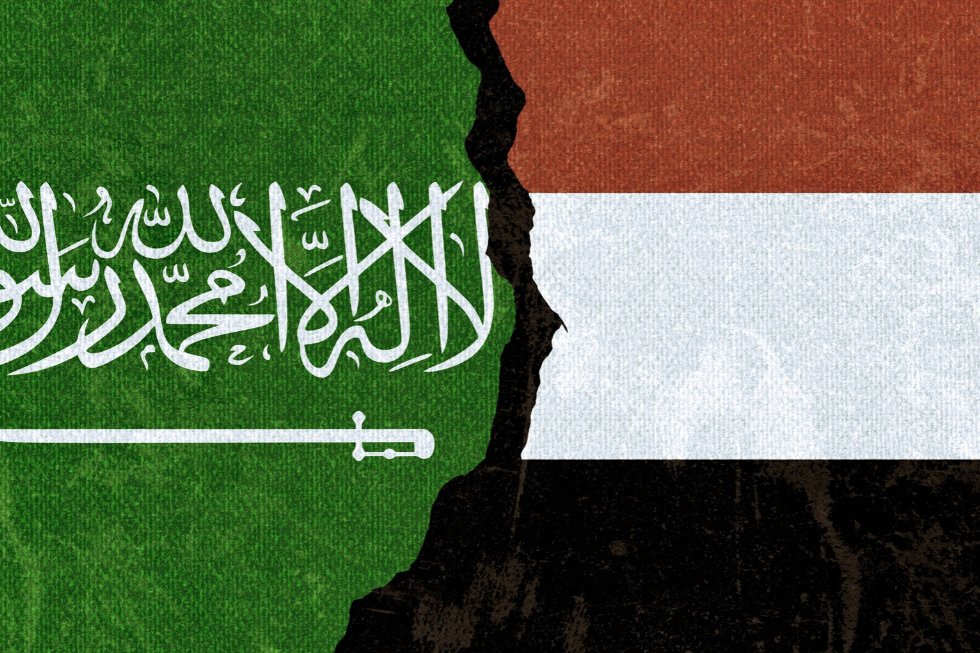



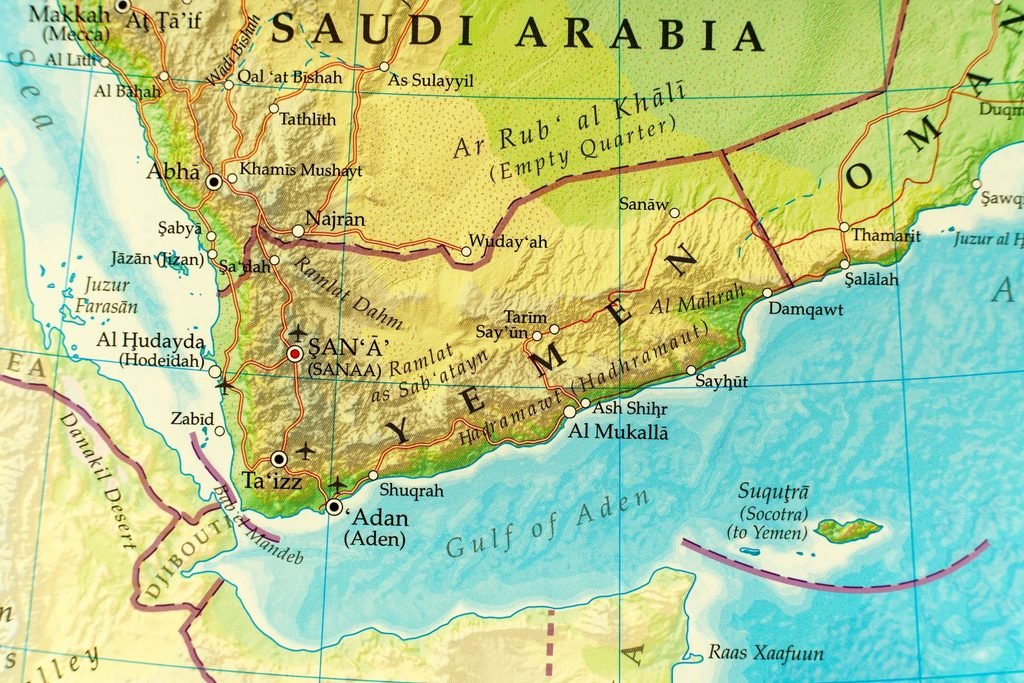
Houthi forces recently launched a rapid offensive along Yemen’s Red Sea coast, capturing the strategically important port of Mocha and advancing toward the Bab al-Mandab Strait. On September 11, Reuters reported that Houthi forces had reached Perim, also known as Mayun, the island situated in the middle of the strait. The advance exposed weaknesses among Saudi-backed Yemeni forces and strengthened the Houthis’ position around one of the world’s most important maritime chokepoints.
The significance of Bab al-Mandab cannot be overstated. The strait connects the Red Sea with the Gulf of Aden and the Arabian Sea and forms an essential link in the maritime route between Asia and Europe through the Suez Canal. At its narrowest, the waterway is approximately 18 miles wide. The US Energy Information Administration (EIA) estimates that about 4.2 million barrels per day of crude oil and petroleum products passed through Bab al-Mandab in the first half of 2025, illustrating its continuing importance to international energy markets.
The latest Houthi offensive should therefore force Riyadh to reconsider some of the assumptions underlying its Yemen policy.
Only months earlier, Saudi Arabia used military and political pressure to reverse the Southern Transitional Council’s (STC) expansion into Hadramaut and Al Mahra. Riyadh regarded the STC’s advance as a threat to its security interests and to the political structure it supports in Yemen. In early January, Saudi-backed forces retook Mukalla, the capital of Hadramaut, after STC forces had seized the city and other territory in the previous month. Militarily, Saudi Arabia achieved its immediate objective. Strategically, however, the outcome is much less certain.
The central question is no longer whether Saudi Arabia can defeat a particular Yemeni faction. It is whether Riyadh can build a sufficiently cohesive Yemeni coalition to prevent the Houthis from controlling Yemen’s most strategically important territory — and, ultimately, from using that geography to increase their political and military leverage over the entire country.
The Hadramaut dilemma
The confrontation with the STC was never simply a military dispute. The STC represents the most powerful political movement advocating the restoration of an independent South Yemen. Its political program is fundamentally different from Riyadh’s preference for maintaining Yemen’s territorial unity. That distinction matters.
The STC did not emerge solely from the current war. It grew out of decades of southern political grievances dating back to Yemeni unification in 1990. For many southerners, the issue is not merely greater autonomy within Yemen but the possibility of restoring a separate southern state. The STC made that objective particularly explicit in January 2026, when it announced a two-year transitional period leading to a referendum on southern self-determination.
When STC-aligned forces expanded into Hadramaut and Al Mahra in December 2025, Saudi Arabia therefore faced a difficult strategic choice. These territories are particularly important to Riyadh: Hadramaut borders Saudi Arabia and provides considerable strategic depth, while Al Mahra occupies Yemen’s easternmost territory along the borders with Saudi Arabia and Oman. Together, the two governorates connect Yemen’s internal political struggle to the wider security environment of the Arabian Peninsula and the Arabian Sea.
The UN reported that STC-affiliated forces expanded their presence in Hadramaut and Al Mahra in December 2025 and that Saudi-backed government forces subsequently moved to reassert control over both governorates. Saudi officials told the Security Council that the STC’s military movements near the Saudi border constituted a threat to the kingdom’s national security.
Riyadh consequently viewed the STC expansion as a direct security concern. Saudi-backed forces moved against the STC and regained significant territory. But military success created a political problem and a military vacuum. By confronting the STC, Saudi Arabia was confronting not simply an armed organization but a political movement with a substantial constituency in southern Yemen.
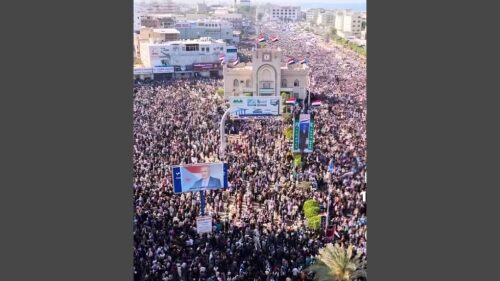
The reaction in Aden illustrated the depth of that political divide. On January 10, thousands of STC supporters rallied in the southern capital, displaying symbols associated with the former South Yemen and demanding independence. Reuters reported that the demonstrations followed the Saudi-backed recapture of territory from the STC and came amid an increasingly serious dispute between Riyadh and Abu Dhabi over Yemen. The lesson is important.
It is too weak to describe the consequence simply as an “erosion of trust.” Saudi Arabia was already dealing with a legitimacy problem among important sections of southern Yemeni society. Its military confrontation with the STC risked deepening that problem. This matters because Riyadh may once again require southern forces to confront the Houthis. A military coalition cannot be sustained indefinitely if its constituent forces do not share a political vision for the country they are being asked to defend.
The Houthis understand the difference
The Houthis have understood this distinction for years.
Since Saudi Arabia launched its military intervention in Yemen in 2015, the Houthis have portrayed the conflict not simply as a Yemeni civil war but as resistance to foreign intervention. The Arabic term adwan — aggression — became a central element of their political vocabulary. This narrative has been one of the Houthis’ most effective political weapons.
That does not mean that all Yemenis accept Houthi ideology or governance. Many Yemenis reject the movement’s political and religious agenda, its relationship with Iran and its attempts to dominate Yemen’s political future. But political narratives do not need universal acceptance to be effective.
The Houthis have repeatedly sought to frame the war as a struggle over Yemeni sovereignty. Their military campaign has been accompanied by a political message that depicts their opponents as dependent on outside powers. Saudi Arabia’s military superiority has therefore not automatically produced a corresponding political victory.
The danger for Riyadh is that its confrontation with southern forces can unintentionally strengthen the Houthi narrative. When Saudi Arabia moves militarily against the STC, the Houthis can argue that Yemen’s political future is once again being determined by external powers. That argument becomes especially powerful when southern political aspirations are treated primarily as a security problem rather than as a political reality that must be negotiated. This is the fundamental contradiction.
Saudi Arabia wants Yemen to remain politically unified because fragmentation could threaten Saudi security. But the southern independence movement considers unity itself part of the problem. The STC does not merely seek a larger share of power within the existing Yemeni state. Its central political objective is independence.
Riyadh therefore cannot resolve the southern question simply by restoring the authority of internationally recognized institutions. International recognition and political influence are not the same thing.
The Presidential Leadership Council (PLC) may possess international legitimacy, but that legitimacy does not automatically translate into local authority. Yemen’s governing institutions remain dependent on a complicated network of political, military and regional actors.
Meanwhile, the STC has developed political, military and social networks that give it substantial influence across parts of southern Yemen. The UN has repeatedly documented the difficulty of unifying Yemen’s multiple armed formations under a single command, while the STC has remained an important component of the political and security landscape in the south. This is Yemen’s central political problem: the gap between formal authority and power on the ground.
Bab al-Mandab changes the calculation
The Houthis’ most recent advance makes this problem much more urgent. Saudi Arabia can defeat the STC in a particular battle and still face a deteriorating strategic position in Yemen. That is precisely what the latest Houthi offensive demonstrates.
The Houthis moved rapidly down the Red Sea coast, captured Mocha and reached Perim Island in the Bab al-Mandab Strait. The significance goes beyond capturing another Yemeni town or island. Bab al-Mandab is strategically important.
The strait is the southern entrance to the Red Sea and forms part of the maritime corridor connecting the Indian Ocean with the Mediterranean through the Gulf of Aden, Red Sea and Suez Canal. The waterway’s importance was demonstrated after Houthi attacks on commercial shipping beginning in late 2023 forced many vessels to take longer routes around the Cape of Good Hope. This month’s offensive has brought the issue back into sharper focus.
The Houthis have demonstrated something Saudi Arabia cannot afford to ignore: They do not necessarily need to defeat every opponent simultaneously. They need to exploit divisions among their opponents and seize territory of sufficient strategic importance. That is why the divisions between Saudi Arabia, the United Arab Emirates (UAE), the STC and other Yemeni forces matter so much.
Saudi Arabia has generally supported Yemen’s internationally recognized political institutions. The UAE, meanwhile, developed a much closer relationship with southern forces, particularly the STC. The result has been a fragmented anti-Houthi camp.
Reuters described the January 2026 crisis as a deepening rift between Saudi Arabia and the UAE, with the two regional powers supporting different Yemeni actors despite their common opposition to the Houthis. The Houthis have repeatedly benefited from such fragmentation.
The latest offensive suggests that the consequences may now extend beyond Yemen’s internal political balance to the security of the Red Sea itself.
Saudi Arabia’s real strategic dilemma
The answer cannot simply be another military operation. Nor can Riyadh return to the political arrangements that existed before the STC’s expansion into Hadramaut and Al Mahra and assume that the underlying problem has disappeared. Those arrangements did not resolve the southern question.
Saudi Arabia must recognize a difficult political reality: It can oppose southern independence without pretending that the independence movement does not exist. That does not require Riyadh to support the STC’s objective. It does, however, require Saudi Arabia to engage with the political forces that actually have influence on the ground. The alternative is to continue treating political differences as security threats and then discover, when the Houthis attack, that the forces needed to confront them are politically divided.
Saudi Arabia also needs to manage its relationship with the UAE carefully. The two countries share important interests, including opposing uncontrolled Houthi expansion and protecting maritime security. But their competing relationships with Yemeni actors have contributed to fragmentation within the anti-Houthi camp. The objective should not necessarily be to eliminate those differences. It should be to prevent them from becoming another source of Yemeni instability.
Riyadh’s response after the January crisis indicated that it understood at least part of this problem. Saudi Arabia announced a $500 million development package for southern Yemen after the UAE’s withdrawal and the displacement of UAE-backed separatist forces. The package included support for hospitals, schools, roads and energy infrastructure.
Economic assistance, however, cannot substitute for political accommodation. Most importantly, Saudi Arabia needs to understand that political legitimacy cannot simply be imported into Yemen. It has to be built among Yemenis.
The battle Saudi Arabia really needs to win
The events of Hadramaut and Bab al-Mandab should be considered together. In Hadramaut, Saudi Arabia demonstrated that it retains considerable military influence. At Bab al-Mandab, the Houthis demonstrated that military influence is not the same as strategic control.
Saudi Arabia may have won the battle against the STC. But the Houthis have shown that the wider struggle for Yemen’s strategic geography remains unresolved. This is the paradox of Saudi policy in Yemen: Riyadh needs reliable southern partners to contain the Houthis. Yet confrontation with the STC risks alienating precisely the political constituency that has developed significant political and military influence across the South.
The Houthis understand this contradiction. They have survived years of military pressure by combining military capability with political messaging. They have portrayed themselves as defenders of Yemeni sovereignty, while their opponents have remained divided over Yemen’s future political structure. The Houthis’ most recent offensive demonstrates the continuing importance of that strategy. The future struggle in Yemen will not be decided solely by missiles, drones or soldiers. It will be decided by politics.
Saudi Arabia does not have to abandon its interests in Yemen. Nor does it have to accept every demand made by the STC. But it does need to recognize that military victories are temporary when the political foundations beneath them are weak. The battle for Hadramaut may have demonstrated Saudi Arabia’s military power. The battle for Bab al-Mandab demonstrates the limits of that power.
Riyadh’s real strategic challenge is creating a political coalition strong enough, legitimate enough and cohesive enough to prevent the Houthis from turning Yemen’s internal divisions into control of the country’s most important strategic geography. That requires something more difficult than military dominance: a political settlement capable of accommodating Yemen’s competing visions of statehood.
The question Saudi Arabia now faces is whether it can build the political trust necessary to win the war that follows.
[Kaitlyn Diana edited this piece.]
The views expressed in this article are the author’s own and do not necessarily reflect Fair Observer’s editorial policy.
FO Live: The Red Sea Crisis — Power Struggles in Yemen and Sudan
In this episode of FO Live, Atul Singh, Fernando Carvajal and Abdul Galil Shaif examine how Islamist factions obstruct political...

Saudi Arabia’s Strategic Dilemma in Yemen
Saudi Arabia’s military intervention in Yemen, particularly its recent push against the Southern Transitional Council in Hadramaut, highlights a persistent...
Aden’s Mass Rally: A Test of Popular Legitimacy and Political Reality
The recent rally in Aden in support of the Southern Transitional Council, amid a fragmented political landscape, highlights demands for...
FO Talks: Is the Gulf Splitting? Saudi Arabia–UAE Power Struggle Intensifies
In this episode of FO Talks, Rohan Khattar Singh and Fernando Carvajal discuss the emerging rivalry between Saudi Arabia and...

Support Fair Observer
We rely on your support for our independence, diversity and quality.
For more than 10 years, Fair Observer has been free, fair and independent. No billionaire owns us, no advertisers control us. We are a reader-supported nonprofit. Unlike many other publications, we keep our content free for readers regardless of where they live or whether they can afford to pay. We have no paywalls and no ads.
In the post-truth era of fake news, echo chambers and filter bubbles, we publish a plurality of perspectives from around the world. Anyone can publish with us, but everyone goes through a rigorous editorial process. So, you get fact-checked, well-reasoned content instead of noise.
We publish 3,000+ voices from 90+ countries. We also conduct education and training programs
on subjects ranging from digital media and journalism to writing and critical thinking. This
doesn’t come cheap. Servers, editors, trainers and web developers cost
money.
Please consider supporting us on a regular basis as a recurring donor or a
sustaining member.
Will you support FO’s journalism?
We rely on your support for our independence, diversity and quality.





Comment