


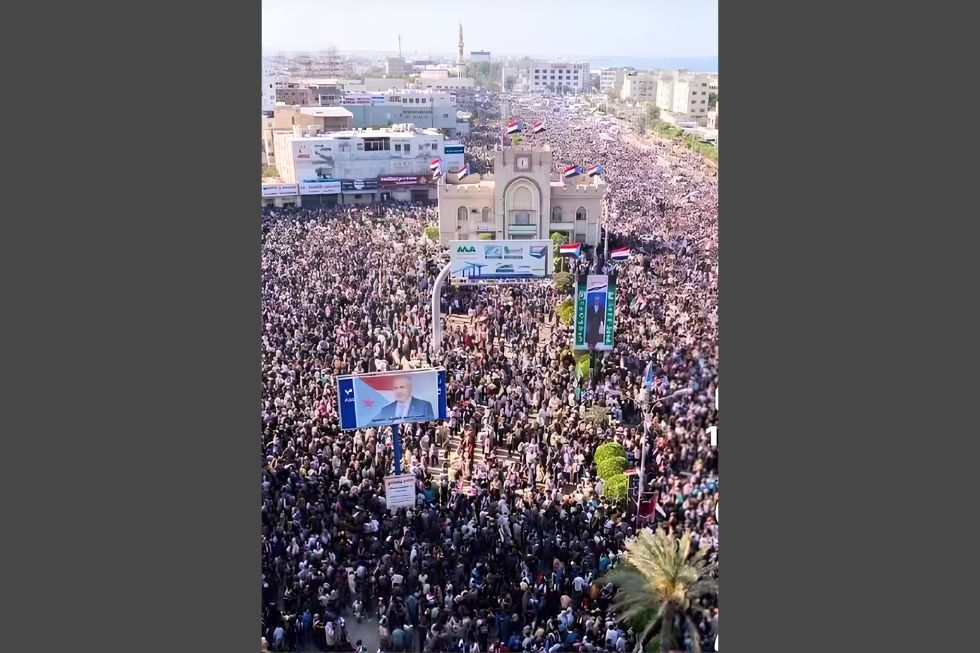



The large public rally held in Aden on May 4 reflects more than a moment of political mobilization; it highlights a deeper question at the heart of Yemen’s ongoing conflict — namely, the relationship between formal political arrangements and legitimacy on the ground.
According to recent reporting, hundreds of thousands gathered in Aden’s Al-Oroudh Square to express political demands tied to the future of southern Yemen. While precise crowd estimates vary, such mobilizations are consistent with earlier demonstrations documented by Reuters, where significant numbers have rallied in support of the Southern Transitional Council (STC). These developments take place within a highly fragmented political landscape.
Competing claims to legitimacy
Yemen’s prolonged conflict has produced multiple centers of authority, with the STC emerging as a significant actor in the south alongside the internationally recognized government and the Houthis. As noted in a Council on Foreign Relations analysis, competing claims to legitimacy remain one of the central challenges to resolving the conflict.
From an analytical perspective, the Aden rally can be interpreted in two ways. On one hand, it represents a clear expression of grassroots political sentiment among constituencies advocating for southern self-determination. On the other hand, scholars of conflict caution that public mobilization alone does not necessarily translate into institutional or inclusive legitimacy, particularly in fragmented political environments.
This duality is important when assessing claims of political mandate. The rally underscores that the STC retains a meaningful base of support, yet it operates within a broader, contested political field. Yemen’s recent trajectory demonstrates that authority remains fluid, shaped by both local dynamics and regional influences.
Enduring political grievances and regional dynamics
At the same time, the persistence of such mobilization points to enduring political grievances. Calls for self-determination in the south are rooted in historical divisions, as well as perceptions of marginalization within the Yemeni state. These underlying drivers continue to influence political behavior and public engagement.
For international stakeholders, these dynamics present both a challenge and a responsibility. The UN-led peace process has consistently emphasized inclusivity, yet progress has been constrained by fragmentation and competing agendas. In this context, the recent rally highlights the importance of grounding diplomatic efforts in observable realities.
It also raises a more specific consideration regarding the role of the UN Special Envoy to Yemen, Hans Grundberg. As the principal mediator in the peace process, his approach has faced growing criticism from segments of southern constituencies who feel that their political weight and aspirations are not adequately reflected in current frameworks. While such criticism is part of the broader contestation inherent in peace processes, it underscores the need for continuous reassessment of assumptions underpinning mediation efforts.
The path forward: inclusivity and diplomacy
Incorporating developments such as the Aden rally into diplomatic calculations does not imply endorsement of any single actor. Rather, it reflects the practical necessity of engaging with all relevant sources of influence and legitimacy. A durable political settlement is more likely to emerge from processes that are perceived as representative and responsive to realities on the ground.
Ultimately, the events in Aden should be understood as part of a wider pattern in Yemen’s conflict, where local mobilization, regional interests and international diplomacy intersect. Whether such demonstrations translate into lasting political outcomes will depend not only on their scale, but on how effectively they are integrated into an inclusive and credible peace process.
[Kaitlyn Diana edited this piece.]
The views expressed in this article are the author’s own and do not necessarily reflect Fair Observer’s editorial policy.
Bullets Against Dissent: Deadly Crackdowns and the Failure to Silence Southern Yemen
Recent protests in southern Yemen, led by supporters of the Southern Transitional Council, have been met with lethal force and...

South Yemen at a Crossroads: Saudi Arabia’s Risky Political Gamble
Saudi Arabia’s growing dominance in southern Yemen follows the United Arab Emirates’ withdrawal, sidelining the influential Southern Transitional Council (STC)...

The Houthis’ Southern Ambition: A Threat the International and Regional Community Must Never Ignore
The international push for a unified Yemen risks empowering the Houthis at the expense of southern aspirations and regional stability....

Support Fair Observer
We rely on your support for our independence, diversity and quality.
For more than 10 years, Fair Observer has been free, fair and independent. No billionaire owns us, no advertisers control us. We are a reader-supported nonprofit. Unlike many other publications, we keep our content free for readers regardless of where they live or whether they can afford to pay. We have no paywalls and no ads.
In the post-truth era of fake news, echo chambers and filter bubbles, we publish a plurality of perspectives from around the world. Anyone can publish with us, but everyone goes through a rigorous editorial process. So, you get fact-checked, well-reasoned content instead of noise.
We publish 3,000+ voices from 90+ countries. We also conduct education and training programs
on subjects ranging from digital media and journalism to writing and critical thinking. This
doesn’t come cheap. Servers, editors, trainers and web developers cost
money.
Please consider supporting us on a regular basis as a recurring donor or a
sustaining member.
Will you support FO’s journalism?
We rely on your support for our independence, diversity and quality.





Comment