





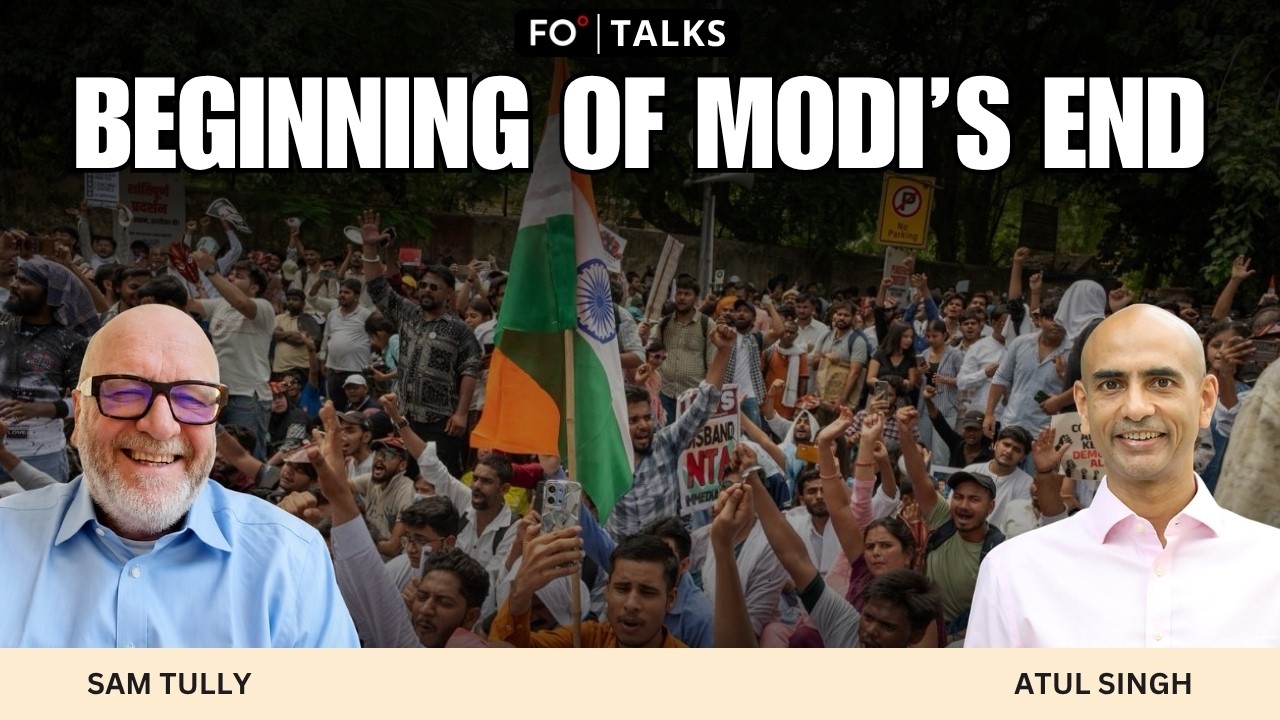
Editor-in-Chief Atul Singh and senior finance professional Sam Tully examine the discontent behind India’s Cockroach Janta Party (CJP) protests. They discuss the collapse of the education system, widespread graduate unemployment and declining trust in public institutions. Singh believes the movement marks the beginning of the end for Indian Prime Minister Narendra Modi, weakens his Bharatiya Janata Party (BJP) and damages their Hindu nationalist political project.
A traumatic education system
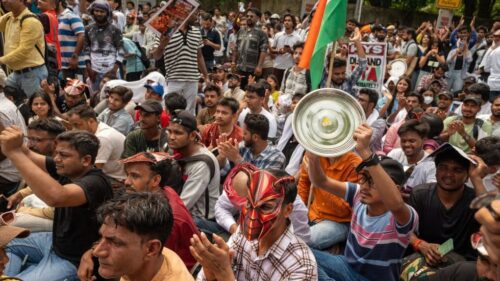
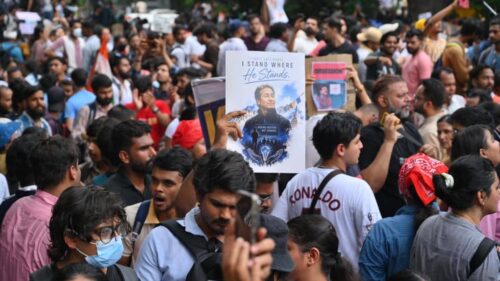
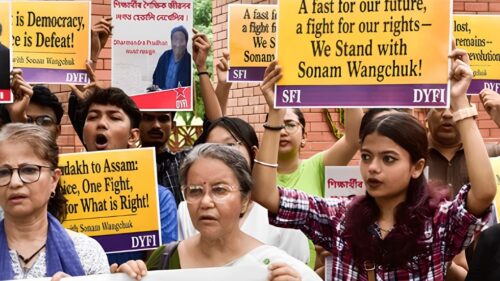
Singh explains that repeated exam paper leaks triggered the protests. Students competing for a limited number of university places discovered corruption; questions were being sold — thanks to leaks of entrance exam papers from the dysfunctional National Testing Agency (NTA) — to those willing to pay. Police subsequently cracked down on demonstrations in Delhi but protesters did not back down. Eventually, Dharmendra Pradhan, the minister of education, resigned.
These exams carry enormous weight because access to elite institutions often determines whether young Indians can find good jobs. Private coaching companies now receive more money than India’s national education budget. Students may study from morning until midnight at private coaching facilities while schools falsely record their attendance. This “dummy attendance” fosters a culture of breaking the law from an early formative age among Indians.
Singh describes this system as traumatic. He recalls running away from home at 17 after failing his entrance exams because of social disgrace and family pressure. Government schools have failed. Teachers often collect their salaries but fail to show up to teach. Even poor families with limited incomes try to place their children in private English-medium schools. This extremely unequal system hardbakes inequalities in Indian society. Education has become, as Singh phrases it, a “modern caste system.”
A demographic dividend becomes a demographic disaster
India has 360 million people between 15 and 29, while two-thirds of its population is under 35. This enormous youth population has traditionally been viewed as an economic advantage. Tully warns, however, that the demographic dividend could become a demographic disaster when rising aspirations collide with limited employment opportunities.
In 1983, 4% of Indians aged 20–29 were graduates and 13% of them were unemployed. By 2023, 23% were graduates but approximately 67% were unemployed. Singh says graduate unemployment has remained around 35–40% for 25 years, exposing how India’s jobless growth fails to benefit hundreds of millions.
The scarcity of jobs intensifies competition for university places. Private coaching companies supply the demand for success at entrance exams. These companies earn millions of dollars and have the incentive to bribe poorly paid officials and/or contractors at NTA to leak exams. This creates a pay to play system where merit no longer matters. Exam leaks are not isolated administrative failures but fundamentally unfair attacks on young people’s prospects. They have become a potent symbol of an economy unable to reward education or effort.
The CJP echoes earlier movements
Tully asks whether the CJP represents a new kind of political engagement or echoes previous Indian protest movements. Singh sees similarities with the student movement of the 1970s, the anti-reservation protests of 1990–1991 and the Anna Hazare anti-corruption movement that helped propel both Modi and Aam Aadmi Party (AAP) leader Arvind Kejriwal to power.
Yet the CJP lacks the ideological program of earlier movements. It began online after Chief Justice Surya Kant described unemployed students as “cockroaches” as a satirical Instagram page. Young activists appropriated the insult and turned it into a symbol of defiance.
Singh considers the movement nihilistic because it expresses anger without presenting substantial institutional reforms. It does not ask for institutional reform. Like everything else, the education system is run by officers of the Indian Administrative Service (IAS) who know nothing but run everything. Because the IAS is the heaven-born colonial service administering the country, IAS officers are completely unaccountable. The protesters have not asked for NTA to be headed by an educationist, not an IAS officer. The officer who heads NTA today presided over the chaotic AI summit in Delhi last year. He has never been involved in education before. Earlier IAS officers who have presided over repeated exam leaks have never faced investigation or punishment. More importantly, the NTA is legally established and registered as an autonomous society under the colonial Societies Registration Act, 1860. Note that the Modi government did not incorporate the NTA through an act of the Parliament of India. The NTA is neither accountable nor auditable. Sadly, protesters do not highlight these institutional weaknesses.
In a nutshell, the CJP movement fails to provide an agenda of change. Protesters have yet to demonstrate deep thinking. Note that the CJP’s leaders previously worked with the AAP but have adopted a more cynical outlook after that party failed to fulfill its reformist promises of curbing corruption and increasing grassroots democracy. Despite the many weaknesses of the CJP, protests are likely to persist because the underlying youth discontent with Modi and his utterly incompetent government is not going away.
Has the BJP lost its base?
Singh states that the protests represent a major political rupture. The young urban Hindu middle class was central to the BJP’s rise, but it is now rebelling against the Modi government. He predicts that many young voters will never support the party again.
For Singh, this makes the protests the beginning of the end for Modi, weakens the BJP and damages the Hindu political project itself. Atul explains that Modi is a master of marketing, campaigning and political messaging, but lacks substance, ideas and competence. The prime minister has completely failed to address India’s institutional weaknesses.
Tully challenges this bleak assessment by pointing to improvements in infrastructure, economic growth and the growth of the middle class. Singh acknowledges this progress and points to increased life expectancy since India won independence in 1947. However, he argues that India's colonial model of governance has failed its people. Per capita income has only reached $2,800. Stunting among children is 35%, which is higher than Somalia’s 25%. Note that the US has a stunting rate of 3.4%, Germany 1.7% and Sweden’s figure is negligible. Modi, the BJP and IAS officers, India’s new superbrahmins, have failed their people.
Crisis could create an opportunity
Singh argues that the Indian republic and the Indian state are in crisis. Institutions are failing. The executive, legislature and judiciary are not doing what they are supposed to do. Modi’s authoritarian government has centralized power crazily and made favored IAS officers even more powerful than their counterparts during imperial British rule. This unaccountable lot now specializes in stealing taxpayer money. Indian legislatures, whether the national parliament or state legislatures, do not draft laws anymore, debate issues or hold the executive’s feet to the fire. The judiciary has also become corrupt, nepotistic and dysfunctional. Court cases remain pending for decades. Therefore, police officers engage in extrajudicial killings called encounters to control crime.
Despite the grim state of affairs in the country, the protests offer hope. At least, people are standing up to an autocratic and incompetent government. If protests lead to some deep thinking and the creation of an agenda for change, their protests could lead to legal reform of the NTA and parliamentary oversight of national exams. It might also lead to regulation of coaching companies and the investigation followed by conviction of corrupt officials. In particular, IAS officers responsible for persistent failures might finally face action for their incompetence, negligence and corruption.
Tully compares the present moment to India’s 1991 economic crisis, which forced the government to liberalize. Singh agrees. He points out that, like most other countries, India generally reforms during crises. He predicts another major economic shock for the country and expresses the hope that this crisis would catalyze another 1991-style set of reforms.
[Lee Thompson-Kolar edited this piece.]
The views expressed in this article/video are the author’s own and do not necessarily reflect Fair Observer’s editorial policy.








































Comment