





India is proudly democratic but also prone to charismatic leaders who enchant the public into hero worship. Under the personality-centric leadership of Prime Minister Narendra Modi, to seem anti-regime in the slightest has become so taboo that it risks being labeled anti-national altogether. India’s declining press freedom recently came under scrutiny during the prime minister’s visit to Oslo in May, when a Norwegian journalist asked why he did not “take some questions from the freest press in the world.” For many Indian viewers like me, his habitual silence reflected a reality we have become resigned to: Great leaders are not answerable to the commonfolk.
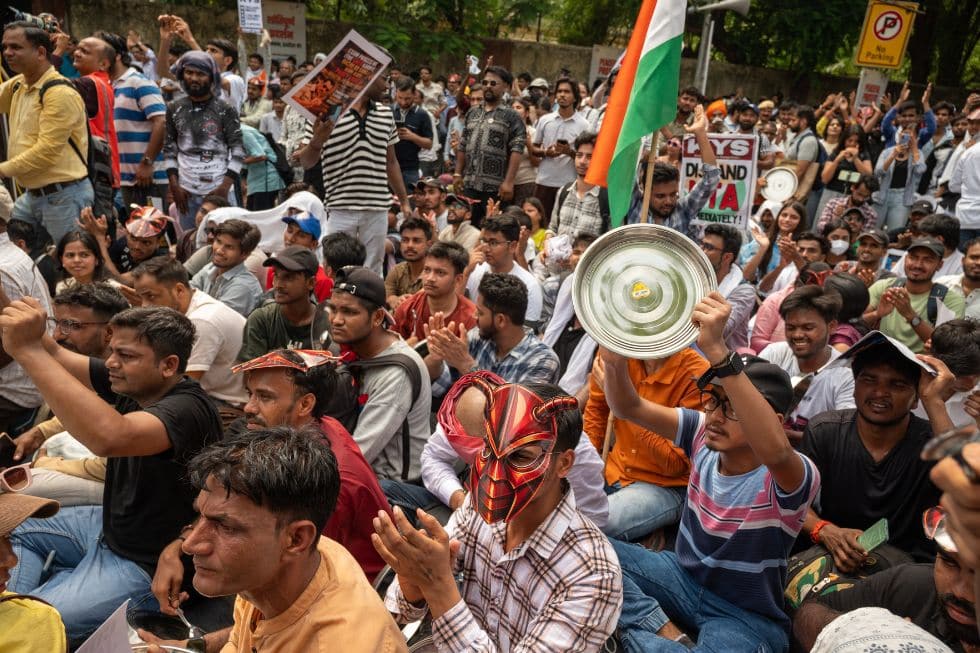
That same week, the Cockroach Janata Party (CJP) had emerged — a viral online parody party created as a satirical response to comments made by Indian Chief Justice Surya Kant comparing some unemployed Indian youngsters to “cockroaches.” Two months later, the CJP is now challenging the norm against questioning authority: It has mobilized tens of thousands to protest for public accountability in the national capital. What is more, the protesters have succeeded in their aim of getting a government minister to resign, an unprecedented outcome in all 12 years of the Modi government.
With its use of mockery, humor and mostly young “cockroach” supporters, the seemingly farcical movement has led to one of the largest and most consequential expressions of dissent in recent years. This dichotomy reminds me of the court jester, who, despite an outwardly silly facade, spoke truth to power. At a time of diminishing press freedom, the court-jester-like spirit of the CJP phenomenon can play an important role in reviving political accountability in India.
The court jester’s license to criticize needs a comeback
I grew up fascinated by stories of sparkling, audacious wit: from legends of Tenali Rama, a jester for King Krishnadevaraya in South India, to North India’s Birbal, a skilled advisor in the court of Mughal Emperor Akbar. Later, while studying the fool Feste in William Shakespeare’s Twelfth Night, I realized why such figures have long captured the public imagination: They are irreverent in the face of power.
Historically and globally, court-jester-like figures used humor to mock and convey uncomfortable truths about rulers, all while, crucially, enjoying immunity from offense. Their freedom to criticize was in the public interest, holding leaders to account in otherwise autocratic, monarchical regimes. The court jester was an embodiment of reason in motley garb.
As democracy has spread as a form of government, the importance of the court jester would appear redundant. Rather than being contained within a single figure, the ability to criticize has spread to the general public as a fundamental right. However, democratic institutions and the freedoms they protect are disturbingly fragile, especially with the turn towards cult-of-personality politics.
One of the clearest examples of this is the attack on comedian Kunal Kamra last year. He shared a video of himself parodying a song in which he called Maharashtra’s Deputy Chief Minister Eknath Shinde a “traitor,” referring to Shinde’s rebellion within his own party to create a rival faction. In response, a mob of the Minister’s political supporters stormed into The Habitat (the comedy club that Kamra had performed in) and vandalized the venue — throwing chairs, breaking light fixtures — all while recording and sharing the assault online as a threat intended for Kamra.
To attack a comedian for mocking those in power is to outright reject the spirit of the court jester. Continuing the court jester’s tradition, comedians joke and satirize (Kamra even sang), often holding a mirror up to society. The court jester finds his successor in the stand-up comedian. However, the attack on Kamra highlights that we cannot take this equivalence for granted.
Far from having the license to criticize, Kamra was told to apologize by the Chief Minister of Maharashtra, who asserted that insulting leaders in this way “cannot be tolerated at all.” As legend goes, even Akbar, one of the most powerful emperors in Indian history, had the courage to be outwitted by Birbal. It is telling that India’s current political culture increasingly sees elected representatives as above jokes.
This is precisely the danger of personality cults. They deliberately glorify leaders to legitimize their power, instilling a tendency to hero-worship and demonstrate unconditional loyalty. In such circumstances, the spirit of the court jester and the freedom to criticize that it symbolizes erodes.
In democratic societies that are susceptible to glorifying politicians in power, the right to mock might even be the duty to do so. For effective governance, criticism is constructive, and accountability is necessary. With India’s deferential media ecosystem, however, that has become rare. The need for an alternative democratic watchdog thus becomes important.
The Cockroach Janata Party as a turning point
Studies have found that satire is uniquely qualified to cut through political rhetoric and expose its contradictions. Political critique voiced through satirical humor, with its entertaining use of irony and ridicule, is particularly effective at engaging the public. The virality of The CJP seems to support these findings: it immediately gained over 20 million followers on Instagram, far surpassing even the ruling Bharatiya Janata Party’s account, which has nine million.
A metaphor for how many young Indians feel treated by the system, the CJP reclaimed the derogatory moniker of “cockroaches” to shed light on the need for reform of India’s sociopolitical structures. While the CJP’s eligibility requirements are deeply satirical, requiring aspiring members to be “overqualified,” “politically frustrated” or “financially confused,” its five-point manifesto touches on some of the most serious issues of the day, from voter deletions to women’s representation in parliament.
To channel social media momentum into real-world impact, the CJP began organizing protests in Delhi focused on accountability. They called for the education minister to take responsibility and resign over the paper leaks and exam cancellations that have affected millions of students. These protests initially struggled to gain attendance and were easily ignored by the government. When the CJP announced plans for a march to Parliament on July 20, many speculated that online virality would not translate to actual numbers on the ground. But on the day of the march, tens of thousands showed up. Many of them were young Indians protesting for the first time.
India’s Generation Z has driven the movement’s irreverent spirit. Despite a brutal police crackdown during the march, protests continued with renewed vigor and spread to other cities like Mumbai. On Instagram (the key platform for the movement among young Indians), reels about the protests, imbued with internet humor and rousing rap music, have garnered millions of views. I have seen it all across my own feed: from “Get-ready-with me’s” about wearing a “spine” to the protest to videos of outrunning baton-wielding police being like a real-life Subway Surfers game.
If the severity of the crackdown was intended to scare, India’s youth seems to have laughed away the fear. Using irony and humor to express their democratic right to dissent, they are being celebrated online for being a generation of unseriously serious people. In this way, the movement captures the paradoxical essence of the court jester, who is at once both farcical and wise.
The education minister has now resigned. What started as an online joke has delivered an unprecedented tangible outcome. Yet this victory for the movement is greater than the changing of ministers: It is a sign of a shifting zeitgeist. The expectation of accountability has been renewed, and the appetite for daring, subversive humor in Indian political discourse is reviving.
Mockery is anathema to worship. Movements like the CJP can help remind the public that powerful leaders are neither above questions nor above ridicule, undermining the idolization that drives personality cults. At a time when mainstream media and political inner circles turn sycophantic, the humble court jester might be all we have to rely on. After all, “Better a witty fool, than a foolish wit.”
[Kaitlyn Diana edited this piece.]
The views expressed in this article are the author’s own and do not necessarily reflect Fair Observer’s editorial policy.
Wangchuk, Sharmila and a Tale of Two Hunger Strikes in India
Scientist and activist Sonam Wangchuk ended his 26-day hunger strike after Delhi Police forcibly hospitalized him. Days later, Education Minister...
Will the Gen Z-Fueled CJP Achieve What It Set Out To Do?
Education reform campaigner Sonam Wangchuk’s 20-day hunger strike and forceful evacuation by Delhi police have further catalyzed the Cockroach Janta...
India’s Exam System Under Fire as NEET and CBSE Controversies Grow
India’s National Eligibility cum Entrance Test and Central Board of Secondary Education examinations are facing severe crises due to paper...

Support Fair Observer
We rely on your support for our independence, diversity and quality.
For more than 10 years, Fair Observer has been free, fair and independent. No billionaire owns us, no advertisers control us. We are a reader-supported nonprofit. Unlike many other publications, we keep our content free for readers regardless of where they live or whether they can afford to pay. We have no paywalls and no ads.
In the post-truth era of fake news, echo chambers and filter bubbles, we publish a plurality of perspectives from around the world. Anyone can publish with us, but everyone goes through a rigorous editorial process. So, you get fact-checked, well-reasoned content instead of noise.
We publish 3,000+ voices from 90+ countries. We also conduct education and training programs
on subjects ranging from digital media and journalism to writing and critical thinking. This
doesn’t come cheap. Servers, editors, trainers and web developers cost
money.
Please consider supporting us on a regular basis as a recurring donor or a
sustaining member.
Will you support FO’s journalism?
We rely on your support for our independence, diversity and quality.





Comment