





[This is the fifth part of a five-part series adapted from Dr. Noa Gafni’s report, The New Five Forces: A Blueprint for Business in an Uncertain World. To read more, see Parts 1, 2, 3 and 4 here.]
In the fourth installment of this series on the New Five Forces, we examined how environmental pressures have evolved into operational and strategic business risks. But every force ultimately converges in the same place: the economic decisions companies make. The New Five Forces framework argues that organizations must navigate the convergence of Technology, Geopolitics, Society, Environment and Economy, all of which increasingly exert pressure from outside traditional industry boundaries.
We now turn to Economy before concluding with further lessons on navigating the forces and building organizations for an increasingly volatile world.
The fifth force: Economy
The Economy force is the underlying element for every business decision. The other forces eventually express themselves in economic terms: the cost of technological adaptation, the tariff and trade implications of geopolitical realignment, the consumer behavior and workforce consequences of societal shifts or the physical and regulatory costs of environmental exposure. And economic conditions are now incredibly volatile.
We no longer live in a world of relative economic stability. The 2008 financial crisis invalidated risk models, balance sheet assumptions and revenue forecasts of entire industries. The Covid-19 pandemic compressed structural economic change into 18 months. And the ongoing reconfiguration of global trade relationships represents economic consequences that have not yet been realized. We are witnessing a new economy, one where volatility is a feature of the operating system.
This requires a fundamentally different approach to economic planning. Central forecasting built around the most likely economic scenario was a reasonable approach in a world where the range of outcomes was narrow. Now, all corporations need to move toward business models that remain viable across a wide range of economic conditions. Revenue diversification across geographies, customer segments and business lines reduces the risks that make organizations vulnerable. Capital structures designed for resilience, with lower leverage, higher reserves and more flexible cost bases, sacrifice some returns but preserve optionality. This is a dramatic shift from the logic that previously dominated corporate decision-making.
Economic resilience through diversification
Nigeria’s economic history is an example of every principle embedded in the Economy force. Crises have characterized the operating environment for decades. United Bank for Africa was founded in Nigeria in 1949 and traditionally operated as a large domestic bank in that volatile context.
In 2005, United Bank for Africa (UBA) began to transform from a large Nigerian bank into one that operated in 20 African countries. The geographic expansion was not only a growth strategy but also an Economy force response. It was a choice to reduce the bank’s structural dependence in an uncertain economy. That diversification proved particularly effective during Nigeria’s downturns and currency devaluations. The bank’s operations in East Africa, West Africa and diaspora markets provided a hedge.
The broader lesson applies beyond emerging markets. In an era of structural economic volatility, the organizations that endure are not necessarily the ones with the strongest positions in their core markets. Rather, they are the ones that have deliberately built diversification into their architecture, in terms of geography, revenue sources and economic conditions.
The Economy force demands financial flexibility and operational adaptability. These enable companies to function effectively across a meaningful range of economic conditions. This means asking whether the margins make sense if conditions change. And it involves rapid resource reallocation when conditions shift and accepting that extreme optimization is less favorable than resilience. For many corporations, this would mark a fundamental shift and require not only the education of the C-Suite, but also investors.
Key takeaways
- Volatility is not a temporary condition. The 2008 crisis, Covid-19 and the current trade reconfiguration are evidence that the economy is now a permanently turbulent operating system.
- Revenue diversification builds resilience. UBA’s expansion across 20 African countries was an Economy force hedge. It cushioned Nigerian downturns and, at the same time, created opportunities for growth.
- Extreme optimization is a vulnerability. Capital structures designed for maximum returns often sacrifice resilience. In this era, companies are better off with lower leverage, higher reserves and flexible cost bases that preserve optionality.
- Investors must be educated on trade-offs. Boards and C-suites need to make the case that resilience sometimes means sacrificing near-term optimization. That requires investors who support that logic.
e.l.f. Beauty: purpose, pricing and force intersection
e.l.f. Beauty is unique among cosmetics companies because it is the brand of choice for budget-conscious consumers as well as one of the most purpose-driven companies in its category. This combination reflects the thoughtful navigation of multiple forces.
On the Environment force, e.l.f. Beauty has been consistently ahead of the industry. It was the first major cosmetics company to achieve both PETA cruelty-free and vegan certification across its entire product line, and it has pursued supply chain transparency at a pace that larger competitors found difficult to match. These commitments were structural choices that aligned the company with the values of its consumers before that alignment became a competitive necessity.
In terms of the Society force, e.l.f. Beauty built one of the most sophisticated TikTok strategies in consumer goods, recognizing the platform as a distribution and community-building mechanism. For example, its original TikTok sound generated over five billion views. It also leaned into diversity, equity and inclusion at the peak of the DEI retreat.
The sub-ten-dollar price points proved resilient when inflation rose from 2021 onwards. Where e.l.f. Beauty succeeded, premium beauty brands saw volume declines as consumers traded down. e.l.f. Beauty reported seven consecutive years of net sales growth as of 2026, highlighting its resilience with the Economy force. And its successful $1 billion acquisition of celebrity Hailey Bieber’s Rhode brand highlights e.l.f. Beauty’s continued investment in Generation Z.
This case illustrates a competitive advantage that appears when there is genuine alignment between stated values and structural business decisions. Companies that articulate social and environmental commitments without embedding them create reputational exposure. e.l.f. Beauty’s commitments were credible because they were consistently maintained.
e.l.f. Beauty also illustrates a point that is easily missed in discussions of purpose-driven business, which is that values alignment is more powerful when it is also economically structural. When looking at e.l.f. Beauty’s environmental and social commitments, it did not trade off against price positioning. Instead, they reinforced their low-cost strategy, attracting a consumer base whose values and economic constraints aligned with the company. Those consumers were primarily from Generation Z, and deeply influential. That coherence across Environment, Society and Economy separated e.l.f. Beauty’s authentic force navigation from the performance of others in the same category.
Mindset shifts for turbulent times
The gap between analytical understanding and organizational capability is where most strategic frameworks fail in practice. The New Five Forces framework does not change behavior. The behavior requires a genuine shift in how leaders and organizations understand their own strategic threats.
The inputs into the New Five Forces are readily available. Climate risk data, geopolitical scenario analysis, technology adoption curves, consumer sentiment research and economic volatility indicators are out there. The challenge is which signals to treat as strategic inputs and which are noise, as well as whether the organization is able to act.
Three fundamental shifts in organizational mindsets are required to navigate the New Five Forces effectively. Each represents a departure from assumptions of a more stable environment.
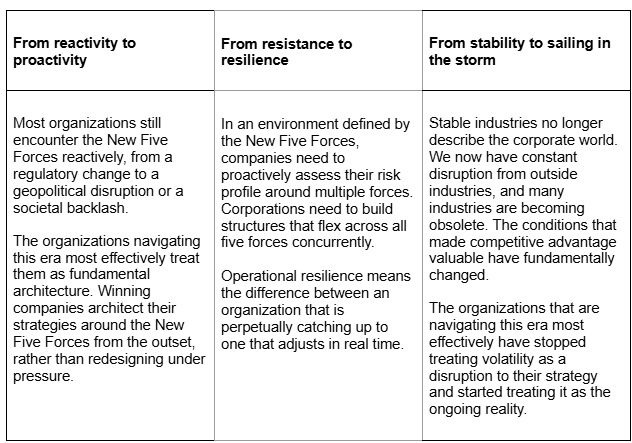
These three shifts are mutually reinforcing. An organization that has built operational flexibility is better positioned to redesign proactively. An organization that redesigns proactively is better positioned to sail in the storm because it has already stress-tested against the macro conditions. An organization that has genuinely internalized volatility is likely to build flexibility and proactive redesign in the first place. The companies that embody all three, and the cases examined in this series, illustrate what that looks like in practice. These companies are not simply better managed but built for a different set of conditions. That is what sustainable competitive advantage looks like in an era defined by the New Five Forces.
Building for a volatile world
Traditional strategic frameworks were built on the assumption of stability. Technological progress was manageable, geopolitics was a background condition, societal change was slow, the environment was an externality and economies moved in cycles. However, these assumptions do not hold anymore. The organizations that will navigate the coming decade successfully are the ones that recognize that those conditions are gone and that they need the organizational capacity to build for this new era.
The New Five Forces framework is a tool for asking better questions about what is happening. Technology, Geopolitics, Society, Environment and Economy are not just risks to be managed but the new operating standard. The leaders that internalize that distinction will build organizations that endure.
The implications of this shift are different for different kinds of organizations, but certain principles apply universally. For large enterprises, the primary challenge is structural. Organizations built for stability have planning processes, governance structures and incentive systems to optimize known conditions. The companies most at risk are the ones whose competitive positions feel secure enough to delay.
For small and mid-sized businesses, the challenge is prioritization. Smaller organizations often lack the dedicated resources to monitor and respond. But size is also an advantage because smaller organizations can reconfigure faster, build community relationships more authentically and make structural changes without the same amount of inertia.
For entrepreneurs, this framework remodels existing strategic frameworks. The entrepreneurs who will build the most consequential organizations of the next decade are those who read force convergence as the origin of new markets in the same way that Nubank and e.l.f. Beauty did. The New Five Forces create the conditions for new companies and industries to emerge.
Organizations that build the systems, relationships, capabilities and cultures to respond to the New Five Forces are not the ones who predict the future. They are, however, best equipped to act regardless of which future arrives. That is what it means to build for a volatile world.
[Lee Thompson-Kolar edited this piece.]
The views expressed in this article are the author’s own and do not necessarily reflect Fair Observer’s editorial policy.
FO Talks: Will AI, Gold and Dedollarization Reshape Global Markets in 2026?
In this episode of FO Talks, Rohan Khattar Singh and Devina Mehra discuss why markets often detach from geopolitics, even...
Dollar Milkshake Theory Is Still Useful
Despite rising debt and excessive money printing, US Treasuries remain the ultimate safe haven for investors worldwide. No other alternatives...
FO° Exclusive: US Dollar Will Continue to Lose Value
In this September 2025 episode of FO° Exclusive, Atul Singh and Glenn Carle examine why the US dollar continues depreciating...

FO° Exclusive: Global Markets Are Now Extremely Nervous
Global markets are growing increasingly uncertain, due to concerns over US economic instability, political gridlock and rising gold prices. Despite...

How Volatility Makes Closely Held Firms Misallocate Money
Closely held companies more reactive to volatility in their stock price than other firms. When they anticipate volatility, they tend...

Support Fair Observer
We rely on your support for our independence, diversity and quality.
For more than 10 years, Fair Observer has been free, fair and independent. No billionaire owns us, no advertisers control us. We are a reader-supported nonprofit. Unlike many other publications, we keep our content free for readers regardless of where they live or whether they can afford to pay. We have no paywalls and no ads.
In the post-truth era of fake news, echo chambers and filter bubbles, we publish a plurality of perspectives from around the world. Anyone can publish with us, but everyone goes through a rigorous editorial process. So, you get fact-checked, well-reasoned content instead of noise.
We publish 3,000+ voices from 90+ countries. We also conduct education and training programs
on subjects ranging from digital media and journalism to writing and critical thinking. This
doesn’t come cheap. Servers, editors, trainers and web developers cost
money.
Please consider supporting us on a regular basis as a recurring donor or a
sustaining member.
Will you support FO’s journalism?
We rely on your support for our independence, diversity and quality.





Comment