


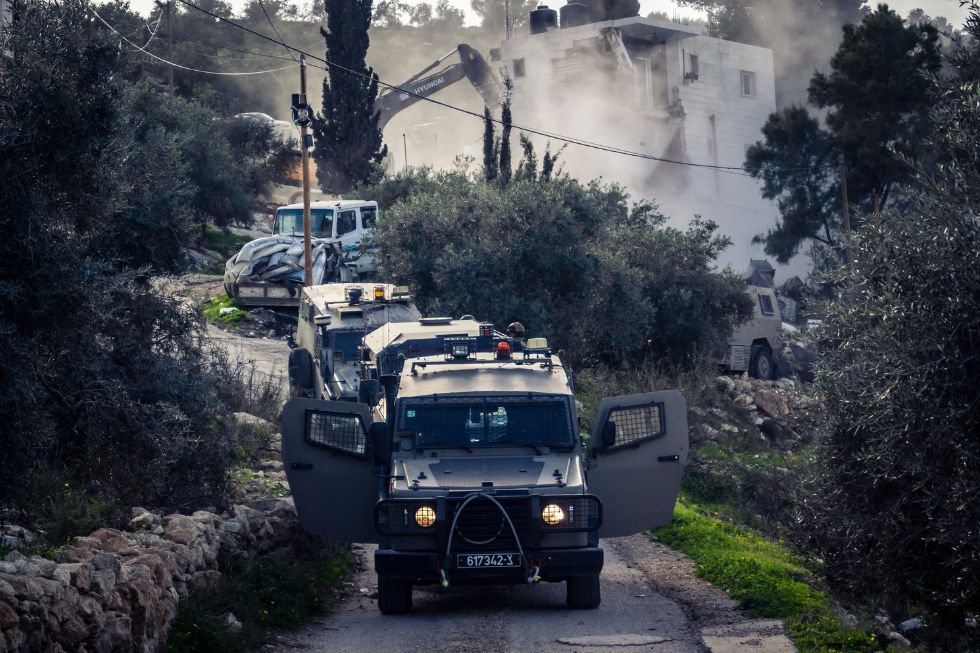



On March 15, in an incident that garnered international attention, two Palestinian children, aged five and seven, and their parents were shot to death in the head and face by Israeli forces in the West Bank while driving home to their village of Tamoun from a family outing “to buy Eid necessities” in the city of Nablus in the West Bank. One of the surviving children told journalists that he overheard Israeli forces involved in the killing say, “We killed dogs.” According to media reports, while an investigation was “completed”, the authorities decided not to question the officers because their account of events — that they acted because they felt under threat — was deemed credible. Commenting on the shooting, Yitzhak Kroizer, a lawmaker from the ultranationalist Otzma Yehudit party, told Knesset members that there are “no innocent civilians or innocent children” in Jenin.
Earlier in March, two Palestinians, Fare’ Jawdat Abu Nurah (57) and Thaer Faruq Hamayel (30), were shot and killed by Israeli settlers and soldiers across the West Bank in the span of a single day. A third victim, Muhammad Jawdat Abu Nurah (55), died after suffering cardiac arrest. A survivor of a recent settler attack in Khirbet Humsa told the media that he was subjected to sexual violence and acts of brutality. Other members of his family and foreign activists were also physically assaulted.
There have also been repeated instances of settler violence in the village of Tayasir in the north of the West Bank, where Israeli settlers have been setting up outposts. At the end of March, a CNN team on the ground was detained by the Israeli military, and a photojournalist was attacked.
These events are the latest in a long trajectory of violence. Data collected by the UN Humanitarian Office (OCHA) indicates that between October 7, 2023, and June 5, 2026, more than 1,100 Palestinians were killed by Israeli forces and settlers in the West Bank, including East Jerusalem, and over 12,000 others were injured.
The UN Human Rights Office (OHCHR) has expressed “alarm” over a further sharp escalation in violence since the outbreak of hostilities between the US, Israel and Iran on February 28. In Gaza, according to the Ministry of Health, more than 1,000 Palestinians have been killed since the entry into force of the tenuous ceasefire on October 10, 2025, bringing the official toll since October 7, 2023, to just under 73,000.
A deeply entrenched culture of impunity
Accountability for acts of violence has long remained elusive for Palestinians. According to the Israeli human rights organization B’Tselem, out of more than 700 complaints filed against Israeli soldiers between 2000 and 2015, only around 3% resulted in criminal charges. In many cases, no investigation was opened at all. For incidents that took place between 2017 and 2021, this figure is reportedly less than 1%, according to rights group Yesh Din.
In fact, the first response of Israeli authorities to high-profile allegations of misconduct is often denial and evasion of responsibility. In an emblematic case, the Israeli military first surmised that a “Palestinian gunman” may have fatally shot Palestinian-American journalist Shireen Abu Akleh while reporting from Jenin refugee camp in May 2022, notwithstanding unequivocal witness testimonies that she was shot by Israeli forces.
According to B’Tselem, a video depicting a Palestinian gunman shared by the Israeli military in the immediate aftermath of Shireen’s killing was taken at a different location. When several probes by media outlets and OHCHR similarly concluded that an Israeli soldier was likely responsible, including that Abu Akleh may have been intentionally targeted, the military eventually apologized, but maintained that her death was “accidental.” Until today, “[n]o one was ever held to account for Shireen’s killing.” Days after her death, Israeli police attacked crowds at her funeral procession in Jerusalem, including mourners carrying her coffin.
Even undeniable evidence of the most serious crimes yields lenient punishment at best. In 2016, in a well-known incident, Israeli soldier Elor Azaria was caught on camera shooting and killing a Palestinian man, Abdul Fattah al-Sharif, who had stabbed an Israeli soldier in Hebron. The graphic video clearly shows al-Sharif lying on the ground, injured and motionless, posing no threat.
Having avoided murder charges, Azaria initially received an 18-month sentence for manslaughter, which was subsequently reduced to 14 months. He was released from prison after serving only nine months to an enthusiastic reception by his family and supporters, who reportedly threw him a celebration. Azaria also became a cause célèbre for right-wing politicians, who lobbied tirelessly for his release. He has never publicly acknowledged guilt or remorse for his actions, and in 2024 was sanctioned by the Biden administration.
Since the onset of the hostilities in Gaza following the brutal October 7, 2023, attacks by Hamas-led armed groups, a considerable number of Israeli soldiers have similarly been recorded, or filmed themselves, committing acts of vandalism, property damage and abuse of Palestinian detainees.
Specific incidents that are extensively documented include the killing of 15 Palestinian paramedics and emergency workers in the Tal al-Sultan area of Rafah in March 2025 (in a harrowing video, taken by one of the paramedics, heavy and sustained gunfire can be heard while the victim recites the Shahada); the multiple attacks on a staircase at Nasser Hospital in Khan Younis in August 2025, in which several journalists and first responders were killed (Israeli Prime Minister Benjamin Netanyahu spoke of a “‘mishap’”); the January 2024 killing of 5-year-old Hind Rajab in Gaza City, whose heart-wrenching final call with rescue workers was recorded and turned into a documentary; and the shooting in November 2025 of two Palestinian men in Jenin who had surrendered to Israeli forces in an incident reminiscent of al-Sharif’s killing, which was also captured on video.
Yet, such evidence has not propelled the Israeli authorities to action. Human rights lawyer Michael Sfard, who serves as a legal advisor for Yesh Din, wrote in March this year that “[m]ore than 1,500 complaints related to soldiers’ conduct [in Gaza] since October 2023 have so far yielded only two indictments.” In August 2025, UK-based Action on Armed Violence found that out of 52 cases (connected to both Gaza and the West Bank, including East Jerusalem) “in which the Israeli military either acknowledged investigations or where serious allegations of civilian harm were reported,” 88% were “stalled or closed without findings.” The Israeli military has reportedly tightened media regulations in a bid to shield soldiers from prosecution abroad.
As in the case of Azaria, the sparse criminal probes that have been launched recently involve prolonged legal battles, reluctant authorities and often a measure of public support for the defendants. For example, in July 2025, Masafer Yatta resident and activist Awda al-Hathaleen was shot and killed in his native village of Umm al-Khair. Yinon Levi, an internationally sanctioned settler and far-right agitator, was arrested over his death and placed under house arrest, but soon allowed to go free. Only when a video emerged depicting the killing — recorded by al-Hathaleen himself — a new investigation was opened, and earlier this year Levi was “charged with reckless homicide.”
Far-right Knesset member Limor Son Har-Melech reportedly attended Levi’s court hearing; whether he will be convicted, and if so, what sentence he will receive, remains to be seen. The Israeli authorities initially withheld al-Hathaleen’s body, and the family had to fight for permission to bury him in Umm al-Khair. (Har-Melech previously described Israeli settler Amiram Ben-Uliel, who in 2015 firebombed the home of the Dawabsheh family in the village of Duma near Nablus, killing an 18-month-old infant and his parents, as a “holy” and “righteous” man.)
Furthermore, when the military investigated an instance of torture and sexual violence reportedly inflicted upon a Palestinian detainee at the Sde Teiman camp, a group of far-right demonstrators, including high-ranking politicians, stormed the premises in protest. Hanoch Milwidsky, a member of the Knesset for the Likud, said in a public debate that in case someone belongs to Hamas’ Nukhba force, “everything is legitimate to do.” A video depicting the abuse was leaked to the public (as it later turned out, at the hands of Israel’s former Military Advocate-General, Yifat Tomer-Yerushalmi).
When some of the accused reserve soldiers appeared in court – wearing caps, sunglasses and masks to conceal their identity – they were welcomed like heroes with applause, hugs and chants of support (including “We are all Unit 100”). On March 12, 2026, the criminal charges were dropped, allegedly in light of “exceptional circumstances.” The Office of Prime Minister Netanyahu released a statement welcoming the decision, referring to the criminal investigation as a “blood libel.”
A similar reaction was forthcoming in response to an article published in the New York Times by veteran journalist Nicholas Kristof on May 11, which contains harrowing testimonies by Palestinians of rape and other forms of sexual violence they suffered at the hands of “soldiers, settlers, interrogators in the Shin Bet internal security agency and, above all, prison guards.” On May 14, Netanyahu’s office announced on social media that his government would seek defamation proceedings against the outlet.
Draconian punishment for Palestinians
This climate of near-total impunity for Israeli soldiers and settlers, and even apparent support for violent crimes by a segment of society, stands in sharp contrast to Israel’s approach to enforcement of the law vis-à-vis Palestinians. Israeli military courts in the West Bank reportedly have a conviction rate of up to 99%. They have been criticized inter alia on the grounds that criminal proceedings do not comply with fair trial guarantees; defendants are held in remand detention and pressured to enter into plea bargains; reports of torture and ill-treatment are discounted; and sentences imposed that are harsher than those handed down by civilian courts for similar crimes committed by Jewish Israelis.
Even children are regularly arrested and brought before special military courts (according to B’Tselem, as of December 2025, 351 Palestinian children were being detained by the Israel Prison Service). Palestinians can also be held in administrative detention, without having been charged or being tried, for extended periods of time (a measure that is currently not applied to Jewish Israelis per a decision of Israeli Defence Minister Israel Katz).
According to HaMoked, as of June 2, 2026, 9,361 Palestinians are being detained by the Israel Prison Service, of which more than 3,300 are administrative detainees, and more than 1,300 are Palestinians from Gaza held under the so-called “Unlawful Combatants Law.” This excludes hundreds who may still be detained by the Israeli military, including in camps like Sde Teiman (following international scrutiny and a court order, detainees were reportedly moved to other locations where concerns about ill-treatment also abound). An investigation revealed that, according to Israeli military intelligence, three-fourths of detained Palestinians from Gaza are civilians.
It is well-documented that since October 7, 2023, the already precarious conditions for Palestinians in Israeli detention have deteriorated further amidst reports of systematic torture and ill-treatment, including sexual violence, as well as denials of family visits, access to legal representation and visits by the International Committee of the Red Cross (whether a recent decision by Israel’s Supreme Court will change the latter remains to be seen). Physicians for Human Rights-Israel has documented the deaths of at least 94 Palestinians detained by Israel between October 2023 and August 2025.
Last year, reports also emerged of an underground prison in Ramla where detainees are kept without access to natural light. Israel’s ultranationalist National Security Minister Itamar Ben-Gvir has personally prided himself on imposing inhumane detention conditions, which include endless renditions of the Israeli anthem for purposes of sleep deprivation.
In September 2025, Israel’s Supreme Court found “[i]n a highly rare” instance of judicial intervention that detainees were not being given sufficient food; several months later, little has reportedly changed. Earlier this year, a judgment by an Israeli court found that 17-year-old Walid Ahmad, who died in detention in March 2025, suffered from starvation. The investigation was nonetheless closed on the grounds that the cause of death could allegedly not be definitively established.
There is also a long history of the Israeli authorities inflicting apparent collective punishment upon Palestinian communities, such as punitive home demolitions, as well as access and movement restrictions. Since October 7, 2023, including during the hostilities between Israel and Iran, these restrictions have been tightened even further, confining residents to ever-smaller areas.
This draconian approach to (alleged) wrongdoing by Palestinians is set to take an even more extreme turn: On March 30, 2026, the Knesset passed legislation providing that anyone “who intentionally causes the death of a person” by means of “an act of terrorism” (as defined in Israel’s “overly broad and exceedingly unclear” Counter-Terrorism Law of 2016) be punished by death under the military law that Israel applies to Palestinians in the West Bank; the alternative of life imprisonment is available in case of “special circumstances.”
At the same time, the bill makes it possible for judges to impose a sentence of “death or life imprisonment” on anyone “who intentionally causes the death of a person with the aim of negating the existence of the State of Israel” pursuant to Israeli domestic law. Human rights organizations, UN Special Rapporteurs, and commentators have warned of the broad wording and discriminatory nature of these legislative amendments, which are set to be enforced almost exclusively against Palestinians.
Other concerns include a lack of fair trial standards as well as objections to the death penalty on principled grounds, amongst others. A number of States and the European Union have also condemned the adoption of the law.
When the Knesset first voted on a different version of the bill in November 2025, Ben-Gvir reportedly handed out sweets to those in attendance. He has been seen wearing a noose-shaped pin alongside other lawmakers from his extreme right-wing Otzma Yehudit party; Knesset member Limor Son Har-Melech, who was among those who introduced the bill, shared a photo and a video on her X account that depict her holding a syringe for lethal injection and a noose — apparently a costume for the Purim holiday.
Following an hours-long session, Son Har-Melech announced the results of the final Knesset vote on 30 March (62-48, one abstention). Ben-Gvir and other proponents of the death penalty — including Heritage Minister Amihai Eliyahu, Zvika Fogel and Yitzhak Kroizer — clapped enthusiastically; Ben-Gvir triumphantly hoisted a bottle of what appears to be sparkling wine into the air, which was later opened in celebration. In May, Ben-Gvir received a cake depicting a noose for his 50th birthday.
The road ahead
Escalating violence by soldiers and settlers across the occupied Palestinian territory is largely met with silence by the Israeli authorities, and at times actively endorsed by the far right and its supporters; the prospect of justice recedes ever further into the distance.
Remarkably, given the prevailing lawlessness, former Israeli Prime Minister Ehud Olmert — who oversaw both the 2006 Lebanon war and the 2008–2009 Gaza war — told The Guardian that the ICC should prosecute systematic attacks by settlers, which he likened to “pogroms.”
Meanwhile, the legislation on the death penalty — a punishment objectionable in all circumstances as a matter of principle — stands to further enshrine in law the highly disparate approach to law enforcement vis-à-vis Palestinians. Justitia’s scales — already heavily tilted and stained with blood — are about to be replaced with the executioner’s noose.
[Alex Ouzounis edited this piece.]
The views expressed in this article are the author’s own and do not necessarily reflect Fair Observer’s editorial policy.
FO Live: US Surrenders to Iran, Leaving Israel in the Dark
In this episode of FO Live, Atul Singh, Lauren Dagan Amoss and Josef Olmert discuss the reported US–Iran memorandum of...

The Velocity of Violence: How Technology Is Outpacing Human Command
The US/Israeli–Iran War is outpacing intelligence. Assumptions about missile ranges, stockpiles and tactics are proving wrong as strikes extend farther,...
FO Talks: Economy, Sanctions and Oil — Why Iran Could Not Sustain This War
In this episode of FO Talks, Rohan Khattar Singh and Sinem Sonmez examine how the US-led blockade in the Strait...

After the Ceasefire: Power, Limits and the Future of Global Order
The Iran war will shape global politics, exposing limits of military power while disrupting energy flows and security dynamics. The...
Support Fair Observer
We rely on your support for our independence, diversity and quality.
For more than 10 years, Fair Observer has been free, fair and independent. No billionaire owns us, no advertisers control us. We are a reader-supported nonprofit. Unlike many other publications, we keep our content free for readers regardless of where they live or whether they can afford to pay. We have no paywalls and no ads.
In the post-truth era of fake news, echo chambers and filter bubbles, we publish a plurality of perspectives from around the world. Anyone can publish with us, but everyone goes through a rigorous editorial process. So, you get fact-checked, well-reasoned content instead of noise.
We publish 3,000+ voices from 90+ countries. We also conduct education and training programs
on subjects ranging from digital media and journalism to writing and critical thinking. This
doesn’t come cheap. Servers, editors, trainers and web developers cost
money.
Please consider supporting us on a regular basis as a recurring donor or a
sustaining member.
Will you support FO’s journalism?
We rely on your support for our independence, diversity and quality.





Comment