






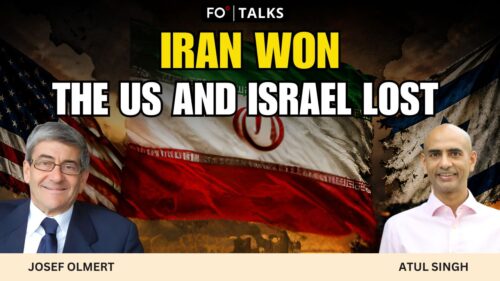
Editor-in-Chief Atul Singh speaks with Lauren Dagan Amoss, a senior researcher at the Begin-Sadat Center for Strategic Studies, and Josef Olmert, a former Israeli government official and Middle East scholar, about the reported memorandum of understanding between the United States and Iran. They focus on whether the agreement represents a strategic retreat by Washington and what that could mean for Israel’s position in the Middle East.
Amoss and Olmert view the reported deal as a turning point. The US appears increasingly focused on avoiding economic disruption and regional escalation rather than pursuing earlier goals such as regime change in Iran or the dismantling of Tehran’s broader regional network. For Israel, the consequences extend beyond Iran itself and raise deeper questions about national strategy, diplomacy and relevance.
A perceived defeat for Israeli strategy
Olmert says the agreement reflects Washington’s determination to avoid a wider confrontation. He contends that concerns about global economic stability, particularly the vulnerability of the Strait of Hormuz, pushed the Trump administration toward compromise. In his view, key issues that previously justified confrontation with Iran have largely been set aside.
The result is a sense of strategic disappointment in Israel. Amoss describes the situation as a “disaster” and a “big failure” of Israeli strategy. Nearly three years after the infamous October 7 attacks, Israel still lacks clear resolutions regarding Hamas, Hezbollah or Iran.
The discussion repeatedly distinguishes between tactical and strategic success. Both guests acknowledge Israel’s military effectiveness and intelligence capabilities. However, they argue that operational achievements have not translated into lasting political gains. As Amoss puts it, “We don’t have strategy, we don’t know where we are going.”
Netanyahu and the limits of dependence on Washington
Olmert criticizes Israeli Prime Minister Benjamin Netanyahu’s management of the US–Israel relationship. Olmert argues that Netanyahu made a fundamental mistake by relying too heavily on Trump and narrowing Israel’s diplomatic options.
Drawing on his experience working with former Israeli Prime Minister Yitzhak Shamir, Olmert contrasts previous Israeli leaders’ willingness to negotiate forcefully with Washington against what he sees as Netanyahu’s excessive dependence. He argues that Israel has lost leverage by assuming that its interests would automatically align with those of the Trump administration.
The guests also discuss changing perceptions across the Middle East. Regional actors increasingly recognize that major decisions are made in Washington rather than Jerusalem. According to Olmert, this reality weakens Israel’s diplomatic standing and encourages countries to focus their attention on the US instead.
Singh broadens the discussion by highlighting shifting attitudes toward Israel in the US. He notes growing criticism from both the political left and right. Concerns about Palestinian rights, prolonged conflict and Israeli influence on US policy have combined to erode what was once broad bipartisan support.
Regional challenges from Gaza to Lebanon
Then, Amoss examines Israel’s wider regional position. She argues that neither Lebanon nor Syria can be addressed effectively without resolving the situation in Gaza. She states that the region remains trapped in overlapping crises that reinforce one another.
Olmert is particularly critical of US policy toward the Lebanese Islamist paramilitary group, Hezbollah. He argues that Washington missed opportunities to weaken the group more decisively by prioritizing regional stability over military outcomes. Though military operations cannot eliminate ideologies, they can significantly weaken the organizations promoting them.
Both Amoss and Olmert express frustration with what they see as a lack of strategic clarity. Israel remains engaged across multiple fronts while struggling to define long-term objectives. Amoss uses the Hebrew word balagan, meaning “mess” or “chaos,” to describe the situation.
Additionally, Amoss touches on Israel’s declining ability to explain its position internationally. Israeli public diplomacy has become increasingly ineffective as global perceptions harden. The challenge, she suggests, is not simply communication but the absence of a convincing strategic vision.
Competing visions for Israel’s future
Despite their shared concerns, Amoss and Olmert offer different prescriptions for the future.
Amoss emphasizes economic integration and regional connectivity. She points to the India–Middle East–Europe Economic Corridor as a potentially transformative project that could strengthen ties among Israel, India, the Gulf states and Europe. By becoming an essential hub for trade, energy and technology, Israel could regain strategic relevance through cooperation.
Olmert supports greater regional engagement but focuses more heavily on demographic and societal renewal. Rising anti-Semitism in Europe and North America could encourage increased Jewish immigration to Israel. He believes such an influx would bring new energy, ideas and leadership to a society struggling with political stagnation.
The discussion concludes with a notable contrast in outlook. Olmert remains optimistic that the crisis can generate renewal and that Israel can adapt to changing circumstances. Amoss is less convinced, expressing skepticism that large numbers of people will choose to relocate to a country facing persistent security challenges and political uncertainty.
Amoss and Olmert portray Israel at a crossroads. The reported US–Iran agreement serves not only as a test of regional diplomacy but also as a reminder that Israel’s future may depend less on military victories than on its ability to develop a coherent long-term strategy in an increasingly multipolar world.
[Lee Thompson-Kolar edited this piece.]
The views expressed in this article/video are the author’s own and do not necessarily reflect Fair Observer’s editorial policy.


































Comment