





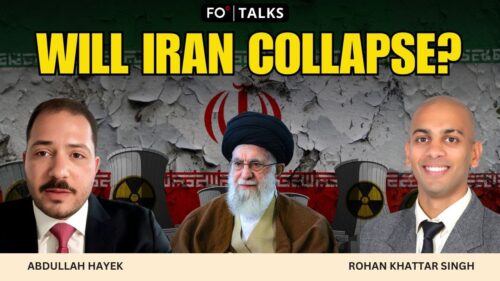
Fair Observer’s Video Producer Rohan Khattar Singh speaks with Abdullah O Hayek, a Middle East analyst and senior contributor at Young Voices, about a ceasefire that appears stable on the surface but remains deeply fragile underneath. The pause in hostilities between the United States, Israel and Iran reflects not resolution, but a temporary alignment of pressures — military fatigue, economic disruption and diplomatic intervention. The central question is not whether the ceasefire holds, but what kind of conflict it is merely postponing.
A ceasefire in name, not in substance
Hayek argues that the current arrangement should not be mistaken for a durable peace. As he puts it, the ceasefire is “fundamentally temporary and transactional rather than… strategic or durable.” It emerged not from resolved disputes but from converging constraints: battlefield exhaustion, global economic strain and mounting diplomatic pressure.
The underlying drivers remain intact. Iran’s nuclear trajectory continues. Israel’s objective of dismantling Iran’s regional network of proxies is unresolved. The US, meanwhile, has intensified coercive measures, including sanctions and an expanded maritime blockade that effectively restricts Iranian trade. Even within the ceasefire framework, conflict persists in other forms. Israeli operations in Lebanon continue, while Iran maintains leverage through asymmetric tools such as naval mines in the Strait of Hormuz.
For Hayek, this produces a situation where the ceasefire holds only in a narrow, technical sense. Beneath it lies what he describes as a pattern of “managed instability,” marked by periodic escalation, signaling and limited confrontation.
Battlefield dominance, strategic ambiguity
Khattar Singh turns to the 41 days of fighting that preceded the ceasefire, highlighting the scale of US and Israeli military operations. The destruction of Iranian military infrastructure was extensive, including the majority of its missile production capacity, naval assets and air force capabilities. Senior leadership figures were also eliminated.
Yet Hayek cautions against equating military success with strategic victory. “Wars of this kind… are decided by whether political objectives and agendas are achieved,” he explains. By that measure, the results are far less clear.
The US entered the conflict without a clearly defined end state. Israel’s stated objective of regime change in Iran remains unmet. Iran, despite suffering heavy losses, has not collapsed. Instead, it has adapted, reframing survival itself as a victory while shifting the conflict into economic and geopolitical domains.
The disruption of the Strait of Hormuz illustrates this shift. By targeting a chokepoint through which roughly a fifth of global energy flows, Iran imposed costs far beyond the battlefield. The result is a conflict that has expanded into global markets, where energy prices, shipping routes and trade flows become instruments of pressure.
The Gulf’s calculus of survival
The war has drawn in the Gulf states not as active participants, but as exposed stakeholders. A significant majority of Iranian strikes targeted Gulf infrastructure, underscoring their vulnerability despite attempts to remain on the sidelines.
Hayek describes their response as a calibrated strategy rooted in survival. They can launch relatively inexpensive drones in large numbers, but interception systems cost exponentially more. Economically, the disruption of the Strait of Hormuz directly threatens their core lifelines in oil and gas exports.
Politically, the Gulf states face a more complex dilemma. Alignment with the US and Israel offers security guarantees, but the war has exposed their limits. Simultaneously, open confrontation with Iran carries unacceptable risks.
The result is a hedging strategy. Gulf governments continue to rely on US partnerships while expanding diplomatic engagement, including support for mediation efforts involving countries such as Pakistan, Turkey and Egypt. Yet they maintain communication channels with Iran, even as tensions persist. This dual approach reflects an effort to contain the conflict rather than resolve it.
Time horizons and political pressure
Khattar Singh shifts the focus to domestic dynamics, contrasting the political constraints faced by Washington and Tel Aviv with Tehran’s longer strategic outlook. Hayek frames this as a clash of time horizons.
Iran operates on what he describes as a doctrine of endurance, where survival and gradual cost imposition are sufficient to claim success. In contrast, the US and Israel face immediate political pressures. Rising energy prices, war fatigue and electoral cycles constrain decision-making in Washington. In Israel, ongoing conflict, civilian casualties and internal political challenges place additional strain on leadership.
This asymmetry complicates the path forward. While Iran can absorb prolonged pressure, its adversaries must demonstrate tangible results within shorter timeframes. The absence of clear political victories raises questions about the sustainability of current strategies.
A region reshaped by instability
Khattar Singh and Hayek conclude by examining how the conflict is altering regional perceptions and alignments. Public sentiment in the Gulf has grown more critical of Israel, which is increasingly viewed as a source of instability. In the US, skepticism is rising, driven less by ideological opposition and more by concerns over cost and strategic clarity.
At the leadership level, however, pragmatism persists. Cooperation with Israel remains conditional and interest-based, while normalization efforts remain tied to unresolved issues such as Palestinian statehood. This divergence between public opinion and elite strategy is becoming a defining feature of the post-war landscape.
Hayek sees no clear winner. Instead, the war has left the region more unstable than before. The ceasefire may pause the violence, but it does not resolve the underlying tensions. If anything, it sets the stage for a conflict that continues in new forms, with escalation controlled not by resolution, but by calculation.
[Lee Thompson-Kolar edited this piece.]
The views expressed in this article/video are the author’s own and do not necessarily reflect Fair Observer’s editorial policy.
































Comment