




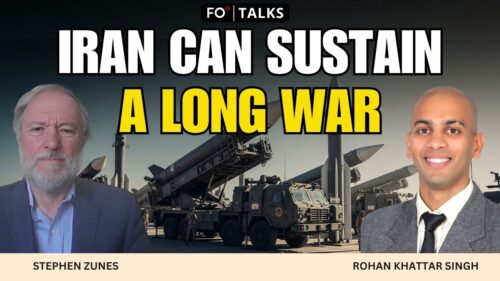
Fair Observer’s Video Producer Rohan Khattar Singh speaks with Stephen Zunes, professor of politics and director of Middle Eastern Studies at the University of San Francisco, about a war that was meant to be short but is becoming something far more complex and open-ended. What began as the United States and Israel’s targeted campaign against Iran’s leadership is now revealing deeper strategic limits, unintended consequences and a growing absence of clear objectives. As the conflict expands, the central question becomes whether military force is achieving anything at all — or simply prolonging the crisis.
A war built on flawed assumptions
Khattar Singh opens by challenging the premise of the campaign. It was framed as a swift operation aimed at regime change and nuclear rollback has instead turned into a prolonged and uncertain conflict. Zunes responds bluntly, arguing that the outcome was foreseeable from the start. As he puts it, “I really don’t know any serious strategic analyst… who thought that air power alone could end up with a regime change.”
Despite the killing of senior clerical and military figures, Iran’s political system has not collapsed. In some respects, it has adapted and even strengthened. Repression has increased, opposition has been contained and the state has shifted into survival mode. Rather than triggering internal revolt, the campaign appears to have reduced the space for dissent.
This exposes a recurring pattern in modern warfare: the assumption that precision strikes can produce political transformation. In this case, that assumption is proving deeply flawed.
Adaptation and the logic of resistance
Zunes explains that Iran anticipated such an attack and prepared accordingly. Its leadership structure has been decentralized both politically and militarily, making it harder to dismantle through targeted strikes. While this has created coordination challenges, it has also ensured continuity.
The result is a shift toward asymmetrical warfare. Iran continues to deploy drones and missiles across the region, maintaining pressure despite sustaining heavy losses. The conflict, in his view, has become an “existential struggle,” one in which the regime is willing to endure significant costs.
Khattar Singh highlights how this dynamic complicates traditional measures of success. Damage inflicted does not necessarily translate into victory. As Zunes notes, overwhelming firepower can coexist with strategic failure if the adversary remains capable and willing to fight.
From military targets to civilian infrastructure
A key turning point in the discussion is the expansion of targets. The targets, initially just military assets, have broadened to include infrastructure such as bridges, schools and industrial facilities. Zunes calls this shift “a war on the population.”
Rather than weakening the regime, these attacks appear to be producing the opposite effect. Khattar Singh points to interviews with Iranian civilians who, despite opposing the government, express willingness to defend their country against foreign bombing. We now see national identity and historic pride becoming unifying forces.
Zunes reinforces this point by emphasizing the symbolic dimension of the strikes. Damage to culturally significant sites and urban infrastructure is not just material but psychological. It deepens resentment and reduces the likelihood of compromise, making the conflict more intractable.
A widening conflict with global consequences
The war’s impact extends far beyond Iran. Khattar Singh highlights the disruption of the Strait of Hormuz, a critical artery for global trade in oil, gas, fertilizers and even helium. The blockage threatens supply chains, energy markets and food security.
Zunes notes that while Iran’s actions may violate international norms, they are also part of a broader strategy to impose costs on the global system. Simultaneously, other powers show reluctance to intervene militarily, both because of the risks involved and a perception that the crisis was avoidable.
This widening scope underscores the absence of a coherent endgame. Even if the US or Israel declare victory, there is no guarantee that Iran will deescalate. The conflict risks becoming self-sustaining, with each side reacting to the other in an ongoing cycle.
No clear path to resolution
The conversation closes with a sobering assessment of the war’s trajectory. Khattar Singh raises the possibility of further escalation, including a ground invasion, but Zunes outlines the practical constraints: Iran’s size, mountainous terrain and limited US troop presence make such an option highly unlikely and costly.
He also dismisses more speculative scenarios, such as seizing nuclear facilities, as unrealistic. Meanwhile, the risk of catastrophic consequences, such as radiation leaks from damaged reactors, adds another layer of danger. Sites like Natanz, Iran’s main uranium enrichment facility, are deeply buried and difficult to strike, while Bushehr, its only nuclear power plant, poses the risk of a wider environmental disaster if hit.
Ultimately, the core problem remains the lack of clear objectives. As Zunes observes, the goals of the war are “all over the map,” contributing to confusion both domestically and internationally. Without defined aims or a political settlement, military action alone cannot produce a stable outcome.
The result is a conflict drifting without direction — one that risks entrenching the very forces it set out to weaken.
[Lee Thompson-Kolar edited this piece.]
The views expressed in this article/video are the author’s own and do not necessarily reflect Fair Observer’s editorial policy.




































Comment