


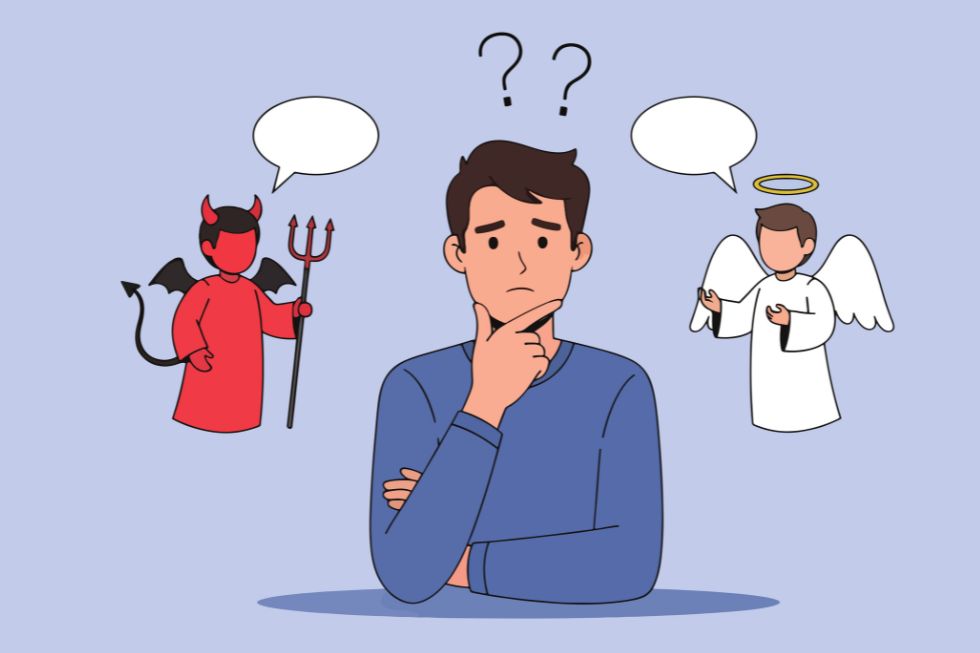



We in the West — and especially those in the New World who ignore history — blindly believe in the simplistic notion that good always triumphs over evil. Childhood fairytales and comics, and adulthood Hollywood have taught us that; think of everyone from Snow White to Batman to Clint Eastwood’s nameless hero in iconic spaghetti westerns. We further propel this belief with the corollary that, ergo, whoever wins must be good. And we carry this naïve, hopeful and lazy notion with us into the real world.
The complications of reality
There are, however, four very basic counterarguments to this myth.
Firstly and historically, winning is usually based on power, not on goodness. There are many examples of bad winning over good, of the powerful winning over the weak. For centuries, slave traders won over the slaves, the imperialists won over the colonized and men won over women.
Secondly, it is largely the victors who get to tell their stories to the world, and they naturally position themselves as the good ones. Former British Prime Minister Winston Churchill is famous for transparently saying, “History will be kind to me, for I intend to write it.” And he did, because he was an excellent writer and a powerful man. Other powerful men of yore asked others to write for them. Nowadays, they can simply control the media. The result is that we see and hear the spin that the powerful want us to.
Third, not everyone has bought into these fairy tales, even to begin with. While the winners saw themselves as good and righteous, others did not. Ask the indigenous peoples of North America and Australia, who had their lands taken away from them, and now largely live in isolated reserves with little basic resources. Ask the millions of Africans who were brought to the New World as slaves, and never saw their families or homes again. Ask the multitudes in the Global South who were subjugated by colonialism for generations and did not see any justice in their lifetimes. Ask the countless women who have been killed due to domestic abuse and can no longer tell their stories. They certainly did not see the winners as good.
Fourth, to complicate things further, good and bad are not static states; sometimes good guys turn into bad guys. The individual does not necessarily change, but the story about them changes — either because of new evidence, hearing the voice of previously marginalized groups, shifting moral standards or the long-term consequences of their actions becoming clearer.
Falls from grace
History abounds with such individuals whose images have changed from good to bad. In some instances, the fall happened in their own lifetimes — as with Roman Emperor Julius Caesar and British Major General Benedict Arnold. In others, it took longer. While some still view Italian explorer Christopher Columbus as a brave discoverer, many now see him as a symbol of colonialism. While English politicians still love to compare themselves to Churchill, historians now look at him with more doubtful eyes, knowing his derogatory views on the colonized and his role in the Bengal Famine, which killed some three million people.
The present also offers many examples. Nobel laureate Aung San Suu Kyi fell sharply from grace after her refusal to stand up for the persecution of the Rohingya in Myanmar. Football star O.J. Simpson’s murder of his wife and her lover ruined his reputation and sent him to jail. Blade-runner and Paralympic poster-boy Oscar Pistorius was convicted of murdering his girlfriend. Entertainer Bill Cosby, darling of the media and Dr. Huxtable to all, was disgraced and jailed after multiple sexual assault incidents surfaced. Successful financier and sex offender Jeffrey Epstein was courted, supported and forgiven by the global elite until his papers were released.
Even Hollywood can sometimes reflect reality — the most famous example being the fall of The Godfather’s Michael Corleone, who journeyed from a young war hero surrounded by a large, loving family to a murderous, aging mafioso who died all alone.
Falls from grace not only apply to individuals; they can also apply to countries and peoples.
Who’s good in this war?
This current war between Israel and America on one side and Iran on the other gives us a chance to apply these counterarguments.
Firstly, since the powerful win, we like to believe that power confers goodness. But are America and Israel good because they are more powerful militarily and economically? Are America and Israel good because they have nuclear arms? Because Jews were persecuted during World War II (WWII), is Israel now so good that it is exempt from international rules of conduct? Are America and Israel good because they are largely white and Judeo-Christian countries? Is Iran bad because it is a Muslim country, it has been consistently supporting the long-persecuted Palestinians and it does not yet have nuclear arms? It may be important to ask these questions.
Secondly, the stories we hear about the war largely favor the West. Often, the powerful place the mantle of good on their own shoulders — even if they are the ones who started the war or effected the regime change. They claim to have done so only out of humanitarian concern — only to free a people from tyranny, to restore their human rights and to bring them democracy. Or to protect the rest of the world from imminent danger. They also claim that God is on their side — and God would only be on the side of the good.
As Ambassador Chas Freeman says, “the physical war is accompanied by an information war”. Who is good and who is the winner is strongly influenced by propaganda. Currently, from much of the mainstream Western press, we get pro-American and pro-Israeli, but anti-Iranian, perspectives. And therefore, our evaluation of good, bad and the situation at large is skewed. To get more balanced and complete news and analysis, we also need to hear independent media voices (e.g., Glenn Diesen, Jeffrey Sachs, Alexander Mercouris, Yanis Varoufakis, Douglas Macgregor).
Third, many are no longer buying into the American-Israeli propaganda — not even their erstwhile allies. Americans and Israelis think they are undoubtedly on the side of good. They see Iran as not just bad but downright evil: ‘the biggest danger to world peace’. However, much of the world, and especially the Global South, does not agree with this presentation. They see Iran as a revered ancient civilization that has been manipulated, robbed, interfered with and sanctioned for decades by the West — and a country that is now retaliating in response to repeated attacks from Israel and the US.
And fourth, the characters are changing. America and Israel have fallen from grace. They no longer hold the moral high ground. Since WWII, the world has seen Israel occupy Palestine, displace Palestinians, perpetrate a genocide in Gaza and currently persecute Muslims in the West Bank. It has noted Israel’s numerous assassinations, repeated meddling in the region, double-tapping of civilian targets, as well as its ambitions to expand far beyond its borders. The world has seen America give Israel arms, diplomatic coverage and unconditional support in all its ventures. It has learned how America has instigated wars and effected regime change in multiple countries for its own advantage. As Italian journalist Michele Serra quipped, “Americans are very lucky — because wherever they go to bring freedom, they find oil.”
The comforts of fantasy
Of course, most of us know that there are, by and large, no innately good or bad people; only our circumstances (i.e., skin color, religion, nationality, economic condition, suffering, etc.) and our actions make us so.
But despite knowing the complicated reality, we prefer to revert to our simplistic fantasy. We like fairy tales and Hollywood movies because there is no ambiguity. We like to know who to love and who to hate. And if someone else can tell us that, that’s even better. We want a grand yet quick battle where we are not injured, a definitive victory and flawless heroes to celebrate at the end.
Maybe it soothes our souls, eases our conscience, and appeals to our innate intellectual laziness to assume that good always triumphs and therefore, those who triumph are good. That way, we don’t have to spend time and effort rummaging through the dirty gray areas, trying to judge individual actions, dealing with the messiness of the ambiguous and feeling unsettled by it all. We don’t have to question the “winner,” the process or the results because good always wins. Right?
[Kaitlyn Diana edited this piece.]
The views expressed in this article are the author’s own and do not necessarily reflect Fair Observer’s editorial policy.
FO° Talks: Did the US and Israel Lie About Iran Building Nuclear Weapons?
In this episode of FO° Talks, Peter Isackson and Nicolas J. S. Davies examine Israel’s latest strikes on Iran. Davies...

How Do You See Iran’s Attacks on Israel?
Despite deep animosity over Israel’s decades-long mistreatment of Palestinians, Iran has shown considerable restraint. Nevertheless, Israel lashed out, killing three...
The Lies the United States and Media Told About Iran
The media amplifies US government narratives on Iran, hindering objective perspectives and potentially shaping public opinion towards conflict. That is...
Support Fair Observer
We rely on your support for our independence, diversity and quality.
For more than 10 years, Fair Observer has been free, fair and independent. No billionaire owns us, no advertisers control us. We are a reader-supported nonprofit. Unlike many other publications, we keep our content free for readers regardless of where they live or whether they can afford to pay. We have no paywalls and no ads.
In the post-truth era of fake news, echo chambers and filter bubbles, we publish a plurality of perspectives from around the world. Anyone can publish with us, but everyone goes through a rigorous editorial process. So, you get fact-checked, well-reasoned content instead of noise.
We publish 3,000+ voices from 90+ countries. We also conduct education and training programs
on subjects ranging from digital media and journalism to writing and critical thinking. This
doesn’t come cheap. Servers, editors, trainers and web developers cost
money.
Please consider supporting us on a regular basis as a recurring donor or a
sustaining member.
Will you support FO’s journalism?
We rely on your support for our independence, diversity and quality.





Comment