





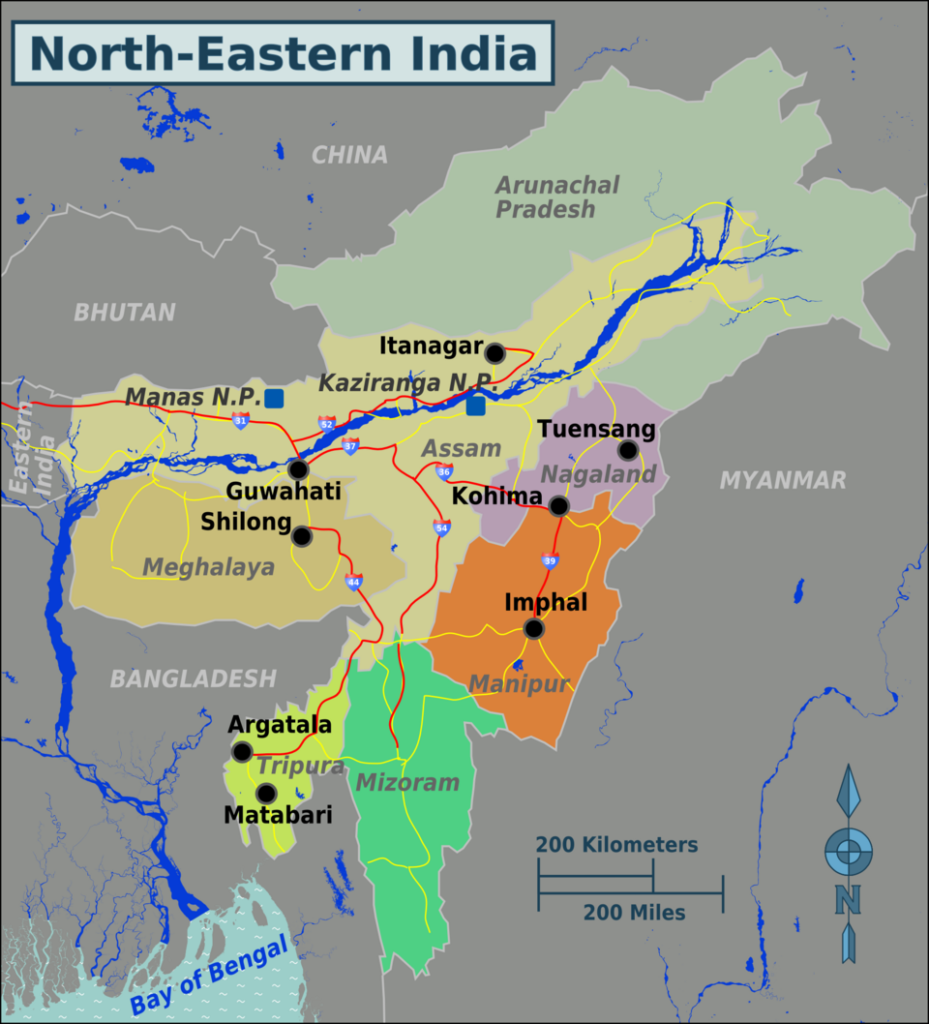
Not many in the world have heard of Nagaland, a state in India’s northeast, bordering Myanmar. China lies not too far away to the north. Khonoma, one of the villages in Nagaland and the focus of this interview, is situated west of Kohima, the capital of Nagaland. Bangladesh is also not that far away, either, and lies southwest of Nagaland.
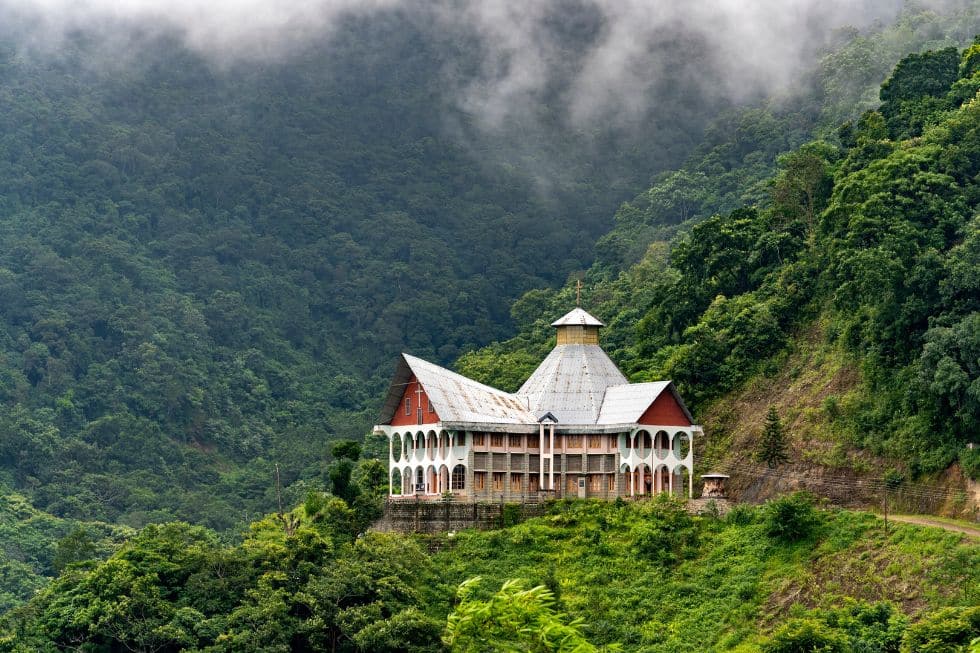
Khonoma is a village of Angami Nagas. The Angamis are a major Naga ethnic group who were the first of the Nagas to come into contact with the British. The Angamis are known for building terraced fields on hill slopes. Like most of Nagaland, most of them are now Christians, the vast majority now belonging to the American Baptist Church.
What I found remarkable, reading Charles’s book, is the success of Khonoma’s reconciliation process among clans and families in the village. Conflict began within the village with the British occupation of Nagaland and the subsequent handover to the Government of India in 1947. Some clans and families accepted British and Indian rule, started working with or in the state apparatus, while others resisted or rebelled.
Nagas had obtained a promise from the British that their land would become autonomous, but that promise was lost when the Government of India took over. This caused a divide; some Nagas thought that they needed Indian support before they could create their own state and infrastructure, while others believed they should fight for independence from the start. This divide led to violence that engulfed the village. Fast forward to 2000, and over the course of ten years, the Khonoma Public Commission facilitated face-to-face meetings between perpetrators’ families and victims’ families. The reconciliation process addressed 22 of the killings, decades of blood feuds and deep clan divisions, leading to forgiveness, restitution and renewed unity. We asked Charles Chasie what made this possible.
Roberta Campani: Explain the conflict that happened in Khonoma and why this made the reconciliation process necessary? How did it begin? How did it unfold?
Charles Chasie: Khonoma had long been a warrior village whose clans were bound by codes of honor in which the duty of revenge passed down generations without time limit. This tradition of revenge tore apart the very fabric of the Naga national movement. When Angami Zapu Phizo and Theyiechüthie Sakhrie — both from Khonoma, both believers in Naga sovereignty — fell out over means rather than ends, the village found itself at the epicenter of a conflict that was at once political and intensely personal. When Sakhrie was abducted and killed in January 1956, this became the first fratricidal killing of leaders in the Naga national movement history, triggering ancient instincts and splitting the Khonoma into armed camps along clan and khel (cluster of clans) lines.
What followed were years of mutual siege, displacement and accumulating grief. The Indian Army burned Khonoma to the ground more than once. Those who went underground starved in the forests, and those who remained behind faced blockade and harassment. When the fighting subsided, the four khels did not return together but settled in separate locations, living effectively as four villages for nearly a decade. The wounds did not heal with time. It was only when a younger generation, tired of having their elders remind them of hatreds they had not chosen, asked to be given their future back, that the village resolved to face what it had buried.
Roberta Campani: What triggered Khonoma’s need for reconciliation after such a long and bloody conflict?
Charles Chasie: The immediate trigger for reconciliation in Khonoma was a request made by the young men of the village asking the elders to “Give us our future.” In the wake of the Naga National Movement — as the struggle for autonomy/independence from India came to be known — and the resulting division, many intra-village killings had taken place, which continued to poison the life of the village over many decades. Every time the young people wanted to do things together as fellow villagers, they were reminded of old enmities.
Over time, the young became fed up with this continued bitterness and wanted the elders to heal these divisions. The village elders felt they could not ignore such a request from the younger generations. This led to a three-day seminar on the theme Healing the Soul of Khonoma. This seminar enabled the participants to take a frank look at where the village stood. The areas of division were drawn up, and the young men wrote to the village authorities to help heal these divisions. The authorities set up the Khonoma Public Commission (KPC) to go into each of these divisions with the objective of achieving healing and reconciliation through forgiveness so that the future of the village could be secured.
Roberta Campani: The KPC took on 22 cases of killings, plus numerous other instances of social divisions. What surprised you most about how people responded when they finally sat face-to-face after decades of enmity? Can you describe the process and the reconciliation sessions?
Charles Chasie: We, the members of the KPC, were representing our individual clans as well. We sat down with our clansmen who had either committed or suffered wrongs to hear their stories. In each case of wrongdoing, KPC members would examine the past with the involvement of clan members themselves. In other words, KPC members who met a victim’s family included those who were from the victim’s clan. Likewise, those meeting a perpetrator’s family included KPC members representing the perpetrator’s clan.
The NPC reviewed each case thoroughly, examining the background, the details of the events and the legacy passed down. Where actual perpetrators or victims were no longer alive — in some cases, about half a century had elapsed since the events — the stories relied on the testimonies of women and elders who knew what had happened in the past. In each case, the story would be reviewed minutely with the family concerned. Only with their readiness and full consent would the case be taken to the next step.
The KPC also met and reviewed each case to see if the stories from the two opposing families found commonality. In the event of common ground, expression of genuine sorrow and readiness to forgive, the KPC would proceed to set up meetings of the concerned families for reconciliation. Usually, the KPC would facilitate meetings in the family home of the victim. We prayed together before kicking off such meetings.
When families of victims and perpetrators met, each would tell their side of the story. Often, such a retelling was not necessary, as the KPC members would have informed each party of the other side’s story, and an expression of sorrow was enough. The perpetrator’s family would ask for forgiveness and the victim’s family, in turn, would pronounce forgiveness. The two families would then have a cup of tea together, which symbolized a full and proper reconciliation. In Khnoma’s social code, partaking of food or drinks together for the two families was taboo because of the family feud. A cup of tea in this context means much more than mere tea. In fact, it is an outcome of a peace process and symbolizes the end of a simmering feud.
At such meetings, both families signed a simple written agreement that was drafted by the KPC, declaring an end to the feud and a promise not to raise the issue again. KPC members representing both families/clans would vouch for their family/clan members and bring closure to the feud. Traditionally, one’s word was enough in Naga society. The KPC took the extra step of a written agreement to ensure the peace settlement was binding. We would end the meeting with another prayer together, asking God’s blessings for one another.
The process usually took many meetings, both at the family/clan levels and at the KPC level. Sometimes, the process took several years, especially when the concerned perpetrators/victims were dead and the fog of time had made their stories unclear. Yet what usually stood out in our reconciliation process was that everyone demonstrated goodwill. Once people sat face-to-face, there were usually no surprises, and the final formal act of reconciliation took place smoothly. They usually shook hands. Where those reconciling were Christians, they sometimes exchanged the Bible as well.
The experience was different for each reconciliation. For me, the genuine act of contrition and the deep desire of each family to leave behind a legacy of peace stood out, especially given the fact that these families had done unspeakable things to one another in the past. It took them tremendous courage to squarely confront past facts and painstakingly examine them to ensure a better future freed from the toxic legacies of bygone feuds.
Roberta Campani: You write about how the traditions of Khonoma Village made it almost impossible to reconcile issues such as clan feuds. But you mention other traditions that were helpful and how the KPC drew on these to begin the reconciliation process. What were some of these customs and traditions?
Charles Chasie: Although killings and clan feuds were never reconciled because vengeance was considered a filial duty, the notion of reconciliation always existed in Khonoma. As a community-based society, people in Khonoma practiced forgiveness in daily life.
In Khonoma, social ostracism instead of laws or the police is the main way norms are enforced. The threat of being excluded from social, economic and civic life is very real. In the past, such was the high level of trust among the Angami Nagas of Khonoma that homes had no locks on doors, the village had no jails and family granaries were often outside village precincts because there was no fear of theft.
The Angamis lived for their progeny and future generations. The family tree was key, and people did what they could to keep that tree healthy. Angamis would inherit their home and fields from their father, but these were to be held in trust for future generations. The Angamis could not sell them. Villagers could use their homes and fields to make a living and feed their families. There was an expectation from Angami villagers to improve both their homes and their fields for the benefit of their inheritors. This sense of immovable multigenerational property not only gave Khonoma Angamis a sense of belonging but also identity. This strong sense of identity and community made reconciliation possible.
Furthermore, Khonoma Angamis are devout Christians, and religion forms the warp and woof of life. Villagers say the Lord’s Prayer on a daily basis, in which they ask God to forgive their trespasses and promise to “forgive them that trespass against us.” This facilitated reconciliation as well.
In addition to their Christian faith, pre-Christian beliefs helped with reconciliation, too. Khonoma Angamis believe in life after death. Per tradition, those who live a good life are rewarded by becoming shining stars in the night sky. Living a good life has great rewards in the afterlife. So, forgiveness and reconciliation are good deeds.
In a nutshell, a strong sense of community, the Christian faith and traditional beliefs all helped Khonoma Angamis achieve reconciliation.
Roberta Campani: Traditional Angami culture required blood vengeance: “life for life” with no time limit. Yet Khonoma villagers broke this cycle. Did Christianity help in breaking this cycle of vengeance, which traditionally had been held to be a sacred duty?
Charles Chasie: It is true that traditionally, vengeance was considered sacred and a filial duty that was passed down the generations from father to son. British colonials compared the Angami blood feuds to Corsican vendettas or worse.
[Roberta Campani’s Note: The Corsican vendetta was a deeply entrenched tradition of inter-family and inter-clan blood revenge on the island of Corsica, particularly in the 18th and 19th centuries. A killing obligated the victim’s family to kill in return, which would then oblige the other family to do the same, and so on. These cycles could persist for generations and devastate entire communities. The Corsican tradition became so notorious across Europe that the word “vendetta” (originally just the Italian/Corsican word for “revenge”) became synonymous in English with this specific kind of prolonged, hereditary blood feud. By the 19th century, it was a stock reference in European writing — Prosper Mérimée wrote about it and so did Alexandre Dumas — so very much part of the cultural vocabulary of British colonial officers.]
However, it is important to note that reconciliation did exist in Angami culture. It was extremely rare, though, and only occurred after the intervention of a third party, usually after both sides had exhausted themselves!
As mentioned above, Christianity helped, but so did tradition. At the KPC, we drew on both faith and tradition to end the culture of vendetta.
Roberta Campani: You describe a crucial moment — the village-wide day of silence in August 2004, when even the animals seemed to fall quiet. What shift did that silence cause among the people of Khonoma that made reconciliation possible?
Charles Chasie: “Speak Lord, for Thy Servant Heareth” is the prayer of Samuel in the Bible. There is a certain quality to prayerful, or even reflective, silence that only practitioners understand. Explanations cannot capture the effect of reflective silence to those who do not cultivate the practice.
In August 2004, we observed a day of silence, and it had a profound effect. “Even the animals seemed to sense something solemn was happening and had fallen quiet,” said one villager after another.
There were cases of individuals being moved by the silence to put things right in their own lives, things that did not necessarily fall within the mandate of the KPC. For some, it was just a period of quiet repose and nothing more. For others, it was a time to renew their faith. People did not work in the fields, did not talk to strangers and spent time in communion with God. But what seemed clear was that this collective silence set a certain mood in the community, creating an openness where people were willing to do what was right instead of trying to find excuses or justifications for past actions.
The apology of Sebi Dolie, the eldest son of the Dolie Clain, is a case in point.
Roberta Campani: Tell us more about Sebi Dolie, an 88-year-old, nearly blind man taking moral responsibility for his clan’s role in the assassination of the legendary leader Theyiechuthie Sakhrie. Sebi’s apology on behalf of his clan was pivotal. What enabled him to do what political leaders often refuse to do?
Charles Chasie: Sebi Dolie’s time of quiet has already been described in the book, Healing the Soul of Khonoma, in his own words. On the morning of the period of silence, Sebi later told a younger friend, when he got up and opened his door, he noticed “the silence and the absence of the pigs, chicken, dogs, etc., usually scavenging for any eatables lying around. He felt goose bumps and his hair standing on end, and he thought God had surely come down to our village today.” With this thought, Sebi went to the nearby church to pray and reflect. He also decided to rededicate his life to God.
The relationship between Sebi’s clan, called Dolie, and the Sakhrie clan had become estranged ever since Theyiechuthie Sakhrie, or T. Sakhrie, was assassinated in January 1956. T. Sakhrie was the general secretary of the Naga National Council (NNC) while Phizo of Dolie clan was the president. The NNC fought for Naga self-determination. Sakhrie was widely acknowledged as the ideologue of the movement, while Phizo was the charismatic figure who managed to establish direct emotional touch with the people.
Sadly, their beliefs in the means to achieve the Naga goal differed. Sakhrie was a staunch believer in nonviolence, while Phizo was more focused on keeping up the momentum of the Naga struggle by using arms to fight. At a meeting in the village, Phizo described Sakhrie as a hurdle to the Naga goal. Sebi, who had witnessed this as a young man, had felt Phizo had gone too far. When Sakhrie was assassinated by unknown gunmen, people recalled Phizo’s words. Phizo, even as the president of the NNC, failed to own his moral responsibility for Sakhrie’s killing. Sakhrie’s clan had already decided to forgive his killers, but the silence from Phizo and the rest of the Dolie clan prevented proper rapprochement between the two clans.
Now, fifty years later, as the eldest in the Dolie clan, Sebi felt it was his responsibility to set things right. Note that Khonoma also has the institution of the khel, a cluster of clans, and comprises three khels. At a meeting of their khel, Sebi expressed that he would have felt exactly what the Sakhries had felt all this time. He not only apologized but also asked to be told, in friendship, of any unspoken hurts his clan may have caused. Sitting in the same meeting was the eldest person from the Sakhrie clan, who got up and said, “Sebi, I have to shake your hand. We have stopped thinking your side will say anything like this that you have said today.”
This magnanimous gesture of shaking hands by the two eldest persons from the embittered clans and khels rolled away years of bitterness. Later, when the eldest person from the Sakhrie clan was asked about the incident, he replied, “Situze,” meaning that is exactly what happened.
What may need to be mentioned here is that the matter of Sakhrie’s assassination had also led to the first division among the Naga people and in the NNC. The rapprochement in the matter of Sakhrie’s killing, thus, was not only an inter-clan or intra-village matter but had wider ramifications. Later, Khonoma village put up a stone memorial for Sakhrie in the village, which was unveiled by the president of the Naga Hoho, a federation of Naga tribes from four Indian states, namely Arunachal Pradesh, Assam, Manipur and Nagaland, and some parts of Myanmar.
Roberta Campani: You write that reconciliation worked in Khonoma but has failed elsewhere in Nagaland. What specific conditions or particular choices made Khonoma different?
Charles Chasie: There was nothing especially different about Khonoma except the collective determination of villagers to put the past behind them. Some other villages had also tried reconciliation in their own way, but most had failed. What made Khonoma succeed was that villagers completely rooted out the causes of hate and bitterness so that division and vendetta never reappeared again.
Today, Nagas are devout Christians, and Christianity is all about reconciliation between God and man. Sadly, Christians often have an inadequate understanding of reconciliation. One easy example is the saying, “forgive and forget,” which is often used as a mere punchline. By removing contrition and restitution, which are vital parts of reconciliation, this saying thwarts true reconciliation. For that, there has to be genuine forgiving and a clear sense of being forgiven. If somebody is not sorry, where is the point of forgiveness?
As Nichaloas Frayling has pointed out, such forgiveness is bad theology and does not happen in real life. People can forgive, but they do not forget. Neither are they meant to. Instead, Frayling recommends “forgive and remember” (pardon and peace) so that the same mistake is not repeated.
Also, quite frequently, many who pray to God do little or nothing to further their own prayers. As I pointed out earlier, the Lord’s Prayer says, “forgive us our trespasses as we forgive those who trespass against us.” If you pray for peace and leave it to God alone, peace will not fall from heaven unless you do your part in putting right the wrong and upholding justice. The difference between Khonoma and other villages is the fact that people here had the courage to face the past and set things right so that future generations will not have to face the same problems again. Thus, a legacy of peace won the day.
In Khonoma, we experimented with one more step. The people not only reflected upon the mistakes they made, or the wrongs they suffered, but they also reflected on when and how they might have provoked others to do wrongs to them. This exercise in empathy helped the people to walk in the shoes of the other person!
Roberta Campani: Every conflict feels unique to those who are trapped in it, yet you suggest Khonoma’s experience holds lessons beyond Nagaland. What would you say to communities elsewhere, whether in Northeast India, Myanmar or beyond, who are trapped in cycles of revenge and counter-revenge?
Charles Chasie: True, every conflict is different, as are the cultures of the people who find themselves trapped in various conflicts. This is why we should be very careful about passing quick comments or judgments. But human nature is also the same everywhere. It is only the trappings of modernity or what have you that are different. I must be able to recognize that I have the same abilities to commit the heinous crimes that others have committed. Such realizations should make us humble. For instance, the colonial British came with their canons and ability to kill in great numbers from a distance, behaving as if everything belonged to them. Seeing our spears and daos (machete), they called us “barbaric” because they felt superior.
In the story of the British Empire, colonial forces trampled upon the rights of others and killed large numbers. Our people were killed indiscriminately with no sense of who or what was right or wrong. The Naga Peasant Revolt of 1879 is a classic example of British oppression. Yet we Nagas have to remember that we have the same human capacity to inflict violence and oppression.
Whether it is Khonoma or Palestine or Ukraine, human suffering is the same. What worked here, I believe, will work elsewhere too. If you are willing to forgive and actually take steps to do so, you may find that your enemy, too, is only human! Sadly, the perspectives we see in the world today are topsy-turvy. People demand respect and subservience from others. The saying that there is enough in the world for everyone’s needs but not for everyone’s greed is almost a cliche, but, unfortunately, too real. It is this lust for revenge, power and greed that we have to avoid.
In the context of reconciliation, Maya Angelou’s message that “history despite its wrenching pain cannot be unlived” is true, but I would add that history faced with courage need not be lived again. This worked for us, the people of Khonoma. I am confident it will work for others, too, who are willing to try it.
I end with a poignant story about a man from Khonoma village, who had decided and even attempted to exact vengeance for his cousin’s killing. After agonizing for many months, he said, “If I can have the courage to kill a man, why can’t I also have the courage to love him enough to make him a different man?” This man then went to his intended victim and asked forgiveness for his bitterness. The two went on to become friends. In a nutshell, attaining the courage to forgive is the challenge for every man of good conscience.
The uniqueness of a grassroots-led reconciliation in Khonoma reconciliation
The Khonoma experience resonates within a broader global tapestry of truth and reconciliation efforts. Similar efforts include South Africa’s landmark Truth and Reconciliation Commission (TRC) under Archbishop Desmond Tutu; Liberia’s post-civil war healing process; Rwanda’s community-based justice system, gacaca; and Colombia’s transitional justice mechanisms.
Khonoma is unique when it comes to truth and reconciliation efforts because the village relied on a bottom-up, grassroots-led process. In South Africa, the TRC was state-sponsored. Almost all truth and reconciliation have been state-sponsored, even if they have community involvement. Khonoma pioneered a community-driven and a community-led truth and reconciliation process rooted in indigenous social structures. This process relied greatly on both the villagers’ devout Christian faith and intergenerational dialogue.
While national commissions often grapple with political constraints and institutional inertia, Khonoma demonstrates that meaningful reconciliation can emerge organically when ordinary people choose to confront their shared history with honesty and courage. The lessons from Khonoma complement, rather than replace, other frameworks for truth and reconciliation frameworks. In particular, Khonoma offers a model that is replicable in settings where formal institutions are absent or distrusted.
However, for this knowledge to truly serve as a blueprint for others, it must be documented, shared and critically examined alongside similar experiences. We invite other communities — whether in Northeast India, Myanmar, Sri Lanka, Colombia, Rwanda, banlieues in France, inner cities in the US and elsewhere — to record their own reconciliation journeys. Are there other villages — grey zones, suburbs or any other living communities — that feel stuck in broken cycles of vengeance or violence? What methods worked, and what failures taught hard lessons? By collecting these stories through interviews, oral histories and community archives, we can build a living repository of peacebuilding wisdom that transcends borders and cultures.
To the readers of this interview: If your community has walked a similar path, we encourage you to share your experience. Your story may be the catalyst another village needs to find its own way out of the shadow of the past. As Charles Chasie reminds us, “history faced with courage need not be lived again” — but this is only possible if we take the time to listen, learn and pass on what we have learned from the past.
The views expressed in this article are the author’s own and do not necessarily reflect Fair Observer’s editorial policy.







Join the conversation
Share your perspective
Log in to share your thoughts and take part in the discussion.