


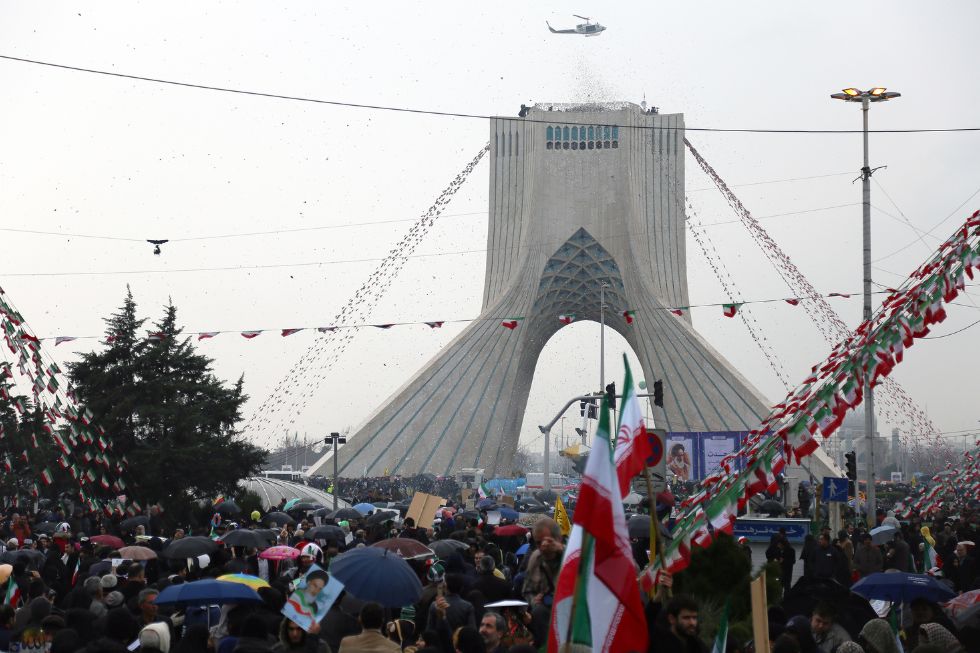



Just five days into the US-Israeli bombing campaign against Iran, signs of mission creep — a military mission reaching beyond its initial goals — had already begun emerging. What began as a limited military operation now appears to be expanding toward a far riskier objective: destabilizing the Iranian state itself.
Reports that Washington is considering arming Iranian Kurdish groups point toward a familiar and dangerous strategy of proxy regime change — one that rests on a fundamental misreading of Iran’s demographic and political realities and carries potentially catastrophic risks not only for the US, but for the wider region and beyond.
A geographic misunderstanding
To begin with, the strategy appears poorly informed about Iran’s internal political and demographic realities. Iran’s Kurdish population represents a relatively small minority of the country’s roughly 90 million people. Most estimates place their numbers between 8% and 10%.
They are concentrated largely in the mountainous northwest of the country along the borders with Iraq and Turkey, hundreds of miles from the political and economic center of gravity around Tehran. By contrast, the majority of the population is ethnically Persian, around 60%, with a long and deeply rooted sense of national identity stretching back more than two millennia. Two factors further make the idea even more problematic.
First, most Iranian Kurds are Sunni Muslims in a country where more than 90% of the population is Shia. That sectarian divide is not trivial. Sunni–Shia tensions have shaped Middle Eastern politics for centuries and continue to structure alliances and rivalries across the region. Arming a small Sunni Kurdish minority in the hope of toppling a Shia Persian state suggests a fundamental misreading of the country’s ethnic and sectarian realities by US national security advisers.
Second, the largest Kurdish population in the region is not in Iran at all but in southeastern Turkey, where Kurdish groups have fought a bitter insurgency against Ankara, in the capital of Turkey, for more than 40 years. During the Syrian Civil War, the US armed and supported Syrian Kurdish forces as part of its campaign against the Islamic State.
Once that mission was largely accomplished and American support began to recede, Turkey intervened militarily to weaken those same Kurdish forces, fearing they would embolden its own Kurdish minority. In other words, Kurdish proxy strategies rarely remain neatly contained within national borders.
Poor strategizing and underestimating
There is also a broader strategic risk. Attempts to overthrow regimes from the outside often produce the opposite of the intended effect. Rather than weakening the government in Tehran, overt foreign support for insurgent groups could encourage Iranians, many of whom are critical of their own leadership, to rally around the flag in the face of external intervention.
Iran also possesses far stronger state cohesion than many outsiders assume. While the regime faces significant domestic dissent, as evidenced by the widespread protests in recent months, the Iranian state itself has proven resilient, surviving a war with Iraq, decades of sanctions and sustained external pressure.
The alternative scenario may be even worse. Iran is a country of 90 million people, geographically larger than Texas and California combined, with a complex ethnic mosaic and a long history of regional power politics. If the state were to fragment into civil war, the conflict would almost certainly draw in outside powers. Russia and China, both of which maintain strategic relationships with Tehran, could support competing factions to counter American influence.
History offers few examples where external powers successfully engineer regime change through minority proxies. Far more often, such strategies produce fragmentation, civil war and prolonged instability. Pursuing that path in Iran risks turning one of the Middle East’s largest and most historically cohesive states into the next Syria, only vastly larger and far more dangerous.
[Zania Morgan edited this piece]
The views expressed in this article are the author’s own and do not necessarily reflect Fair Observer’s editorial policy.
Turkey Doubles Down on Hard Power
Turkey’s strategic victory in Nagorno-Karabakh will not help it to achieve a sustainable future within its neighborhood.


Support Fair Observer
We rely on your support for our independence, diversity and quality.
For more than 10 years, Fair Observer has been free, fair and independent. No billionaire owns us, no advertisers control us. We are a reader-supported nonprofit. Unlike many other publications, we keep our content free for readers regardless of where they live or whether they can afford to pay. We have no paywalls and no ads.
In the post-truth era of fake news, echo chambers and filter bubbles, we publish a plurality of perspectives from around the world. Anyone can publish with us, but everyone goes through a rigorous editorial process. So, you get fact-checked, well-reasoned content instead of noise.
We publish 3,000+ voices from 90+ countries. We also conduct education and training programs
on subjects ranging from digital media and journalism to writing and critical thinking. This
doesn’t come cheap. Servers, editors, trainers and web developers cost
money.
Please consider supporting us on a regular basis as a recurring donor or a
sustaining member.
Will you support FO’s journalism?
We rely on your support for our independence, diversity and quality.





Comment