Login

    Sections
    Search

    • Politics
    • Economics & Finance
    • Business & Entrepreneurship
    • Art & Culture
    • Science & Technology
    • Environment & Climate Change
    • World
    • World Leaders
    • The Americas
    • Europe
    • Middle East & North Africa
    • Africa
    • Asia
    • United States
    • India
    • China
    • Russia
    • About
    • Authors
    • Publications
    • Events
    • Multimedia
    • Videos
    • Podcasts
    • Events
    • Russia
    • Publications
    • Authors
    • About
    Fair Observer

    MULTIMEDIA

    The Indian Subcontinent’s Hindu-Muslim Divide

    Fair Observer

    VIDEOS

    When the CIA Stopped Lying, The New York Times Stopped Reporting

    Fair Observer

    PODCASTS

    The Dialectic: Narendra Modi’s Vegetarian Stalinism Has Ruined the Indian Economy

    PUBLICATION

    Fair Observer Monthly: January 2026

    Support Fair Observer

    We rely on your support for our independence, diversity and quality.

    Donate
    Search
    Fair Observer Logo
    • Donate
    Fair Observer Logo
    Central & South Asia

    FO° Podcasts: Myanmar Votes During a Civil War: Why This Election Could Tear the Country Apart

    In this episode of FO° Podcasts, Rohan Khattar Singh and Asanga Abeyagoonasekera examine Myanmar’s December 28 elections against the backdrop of civil war, humanitarian collapse and shrinking military control. They argue the vote is designed to manufacture legitimacy rather than reflect public will. Far from stabilizing Myanmar, the election risks deepening national fractures and regional insecurity.
    By Asanga Abeyagoonasekera & Rohan Khattar Singh
    Follow
    Follow
    Asanga Abeyagoonasekera, Rohan Khattar Singh
    @Rohan_KSingh
    SHARE
    January 06, 2026 07:24 EDT
    Check out our comment feature!

    Saved Successfully.

    This article saved into your bookmarks. Click here to view your bookmarks.

    My Bookmarks

    Fair Observer’s Video Producer Rohan Khattar Singh and Asanga Abeyagoonasekera, the Executive Director of the South Asia Project at the Millennium Project, discuss Myanmar’s elections, which have been held since December 28, 2025. They examine why the military junta is pressing ahead with a vote amid an intensifying civil war, widespread humanitarian collapse and the near-total exclusion of opposition forces. Rather than restoring stability, the election risks entrenching military rule while deepening Myanmar’s national fractures.

    LISTEN ON:
    ALSO AVAILABLE ON:
    • Spotify Spotify
    • apple-podcasts Apple Podcasts
    • YouTube Podcasts
    • Amazon Amazon Music

    A country at war with itself

    Abeyagoonasekera begins by outlining the reality on the ground since the February 2021 coup d’état. More than 6,000 people have been killed, over 3.5 million displaced and roughly half the population pushed into poverty. According to United Nations estimates, nearly 20 million people now require urgent humanitarian assistance due to hunger and disease linked to the conflict. This devastation forms the backdrop to an election taking place in a “completely dismantled” country. 

    Militarily, the junta faces a coordinated, nationwide resistance. People’s Defense Forces operate across much of the country, local defense formations mobilize at the village level and long-established ethnic armed organizations such as the Kachin Independence Army and the Karen National Union have expanded their territorial control. The junta now holds about 15% of Myanmar’s landmass, with resistance forces controlling much of the rest. The state’s authority has collapsed across wide swathes of the country, raising questions about how a nationwide election can even be conducted.

    Elections as political theater

    Against this backdrop, Khattar Singh presses Abeyagoonasekera on why the military is holding elections now, at what appears to be its weakest moment since the coup. Abeyagoonasekera states that the vote functions less as a democratic exercise than as a tactical maneuver. It is a “political pause button,” he says, intended to buy time and manufacture international legitimacy after major territorial and economic losses.

    The election will be conducted in phases, with voting possible in only about 200 of Myanmar’s 300 districts due to active fighting. The military has stacked the election commission with former officers, imposed severe restrictions on campaigning and jailed or silenced all meaningful opposition figures. Under these conditions, Abeyagoonasekera argues, the process is designed “not to reflect the people’s will, but to exhaust it.” Rather than signaling consent, the election reinforces the military-dominated 2008 constitution, which guarantees the armed forces veto power over reform.

    Silenced leaders and excluded politics

    A central theme of the discussion is the total exclusion of Myanmar’s opposition. Former civilian leader Aung San Suu Kyi remains under house arrest, alongside many other political figures. Drawing on his personal experience meeting her in Thailand in 2012, shortly after her release from detention, Abeyagoonasekera recalls her careful reflections on reconciliation among Myanmar’s deeply divided ethnic communities. He notes that reconciliation, while often invoked rhetorically, carries unique and unresolved challenges in Myanmar’s political context.

    Abeyagoonasekera draws a parallel with former Pakistani Prime Minister Imran Khan, whom he also met and who is now imprisoned. In both cases, incarceration has not erased the relevance of their political insights. However, neither Suu Kyi nor any other opposition actor can participate legally, politically or even symbolically in the current election. Meanwhile, the National Unity Government, ethnic armed organizations and resistance networks exist entirely outside the electoral process and have rejected the vote as illegitimate.

    Regional fallout and the limits of stability

    The consequences of Myanmar’s conflict extend far beyond its borders. Over a million Rohingya refugees remain in Bangladesh, while migration, illicit arms flows, drug trafficking and scam networks affect Thailand, India and the wider region. Myanmar’s instability has become a regional security problem, compounded by competition over critical mineral resources in areas such as Kachin State, drawing in China, India and the US.

    He argues that US President Donald Trump’s administration adopted a more pragmatic approach by engaging the junta rather than ignoring it, while also warning that Myanmar risks becoming a proxy of China and Russia due to its mineral wealth. Still, Khattar Singh and Abeyagoonasekera agree that an election conducted amid civil war cannot stabilize the country. As Abeyagoonasekera puts it, an imposed vote “does not heal a fractured nation — it deepens the fractures.”

    We are a nonprofit, truly independent media organization committed to delivering diverse, fact-based global analysis. If you like what you are reading, sign up for our free newsletters now.

    Looking ahead, he outlines three prerequisites for any genuine stabilization: inclusive dialogue with resistance and ethnic groups, sustained international pressure and accountability, and credible regional mediation through the Association of Southeast Asian Nations. Drawing on Sri Lanka’s own 30-year civil war, he suggests that Myanmar faces similar nationalist fears of international involvement and deep constitutional fault lines tied to military dominance. While he remains cautiously hopeful that regional cooperation could eventually produce a solution, he is clear that this election will not.

    [Lee Thompson-Kolar edited this piece.]

    The views expressed in this article/podcast are the author’s own and do not necessarily reflect Fair Observer’s editorial policy.

    LISTEN ON:
    ALSO AVAILABLE ON:
    • Spotify Spotify
    • apple-podcasts Apple Podcasts
    • YouTube Podcasts
    • Amazon Amazon Music

    Comment

    Login
    Please login to comment
    0 Comments
    Newest
    Oldest Most Voted
    Inline Feedbacks
    View all comments

    Commenting Guidelines

    Please read our commenting guidelines before commenting.


    1. Be Respectful: Please be polite to the author. Avoid hostility. The whole point of Fair Observer is openness to different perspectives from perspectives from around the world.

    2. Comment Thoughtfully: Please be relevant and constructive. We do not allow personal attacks, disinformation or trolling. We will remove hate speech or incitement.

    3. Contribute Usefully: Add something of value — a point of view, an argument, a personal experience or a relevant link if you are citing statistics and key facts.

    Please agree to the guidelines before proceeding.

    Related Reading

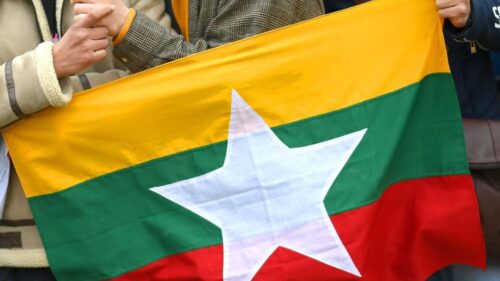
    Reconciliation in a Broken State — Myanmar’s Civil War and the Illusion of Elections

    Myanmar has been gripped by civil war, leading to widespread suffering, poverty and displacement since the military coup in 2021....
    by Asanga Abeyagoonasekera, December 25, 2025
    Fair Observer

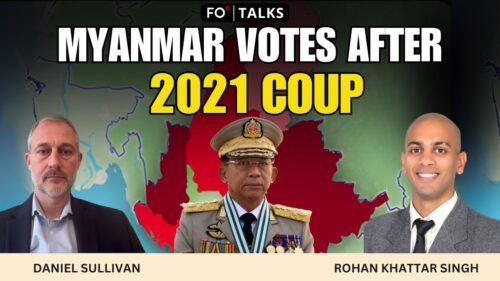
    FO° Talks: Is Myanmar’s Junta Using Elections to Consolidate Power?

    In this episode of FO° Talks, Rohan Khattar Singh and Daniel Sullivan examine Myanmar’s December 28 election and why it...
    by Daniel Sullivan & Rohan Khattar Singh, December 23, 2025
    Fair Observer

    ASEAN’s Myanmar Strategy, Slow But Steady

    Despite repeated urgency for stronger action, ASEAN recognizes that coercive strategies are not effective in seeking a final resolution in...

    by Tzyy Wei Siu, December 21, 2021
    Fair Observer

    More Episodes

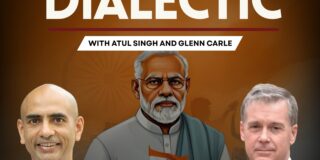
    The Dialectic: Narendra Modi’s Vegetarian Stalinism Has Ruined the Indian Economy

    In this episode of The Dialectic, Atul Singh and Glenn Carle explain how India’s current leader has rolled back the...
    Glenn Carle & Atul Singh, February 12, 2026
    Fair Observer

    FO° Podcasts: Maduro, the War on Drugs and Trump’s Revival of the Monroe Doctrine

    In this episode of FO° Podcasts, Atul Singh and Benjamin Delille examine US President Donald Trump’s confrontation with Venezuela, questioning...

    Benjamin Delille & Atul Singh, January 18, 2026
    Fair Observer

    FO° Podcasts: The Forbidden C-word, Class in America

    In this episode of FO° Podcasts, Atul Singh and Kent Jenkins Jr. discuss how class shapes US identity and political...

    Kent Jenkins Jr. & Atul Singh, December 29, 2025
    Fair Observer

    The Dialectic: France: The Eternal Crisis Strikes Again. What Now?

    In this episode of The Dialectic, Atul Singh and Glenn Carle examine France’s deepening polycrisis. Rising debt, political paralysis and...

    Glenn Carle & Atul Singh, December 13, 2025
    Fair Observer

    Must Listen

    The Dialectic: Can Germany Outgrow Its Postwar American Model?

    In this episode of The Dialectic, Atul Singh and Glenn Carle explore how Germany faces acute economic, political and social...

    by Glenn Carle & Atul Singh, December 2, 2025
    Fair Observer

    FO° Podcasts: The Right to Play: How Women Fought and Won the Battle for Equality in Sports

    In this episode of FO° Podcasts, Atul Singh and Lauren Greenberg explore how Title IX reshaped women’s sports and personal...

    by Lauren Greenberg & Atul Singh, November 26, 2025
    Fair Observer

    FO° Podcasts: Enemy of the Sun — How Palestinian Poetry Became a Weapon of Resistance

    In this episode of FO° Podcasts, Atul Singh and Edmund Ghareeb trace the unlikely journey of the Palestinian poetry anthology...

    by Edmund Ghareeb & Atul Singh, November 19, 2025
    Fair Observer

    FO° Podcasts: Why is the US Deporting Illegal Migrants to a Tiny African Nation Called Eswatini?

    In this episode of FO° Podcasts, Rohan Khattar Singh and Zweli Martin Dlamini examine the secret deportation deal between the...

    by Zweli Martin Dlamini & Rohan Khattar Singh, November 16, 2025
    Fair Observer

    The Dialectic: Can Germany and France Make Europe Great Again?

    In this episode of The Dialectic, Atul Singh and Glenn Carle examine Europe’s rise from Renaissance brilliance to post-World War...

    by Glenn Carle & Atul Singh, October 17, 2025
    Fair Observer

    Project 2025 and Donald Trump’s Dangerous Dismantling of the US Federal Government

    In this episode of The Dialectic, Atul Singh and Glenn Carle dissect US President Donald Trump’s destruction of federal institutions....

    by Glenn Carle & Atul Singh, September 9, 2025
    Fair Observer

    FO° Podcasts: Why Has Trump Deployed Thousands of National Guard Troops in Washington, DC?

    In this episode of FO° Podcasts, Atul Singh and Ankit Jain examine US President Donald Trump’s interventions in Washington, DC....

    by Ankit Jain & Atul Singh, September 8, 2025
    Fair Observer

    FO° Podcast: The Story of Millions of Syrian Refugees and Why They Can Never Return Home

    In this episode of FO° Podcasts, Atul Singh and William McChesney examine why millions of Syrian refugees remain in exile...

    by William McChesney & Atul Singh, August 30, 2025
    Fair Observer


    Fair Observer, 461 Harbor Blvd, Belmont, CA 94002, USA

    Sections

    • Politics
    • Economics & Finance
    • Business & Entrepreneurship
    • Art & Culture
    • Science & Technology
    • Environment & Climate Change
    • World Leaders
    • World
    • The Americas
    • Europe
    • Middle East & North Africa
    • Africa
    • Asia
    • United States
    • India
    • China
    • Russia
    • Events
    • Publications
    • Authors
    • About
    • Publish
    • Contact
    • Login
    Fair Observer

    MULTIMEDIA

    The Indian Subcontinent’s Hindu-Muslim Divide

    Fair Observer

    VIDEOS

    When the CIA Stopped Lying, The New York Times Stopped Reporting

    Fair Observer

    PODCASTS

    The Dialectic: Narendra Modi’s Vegetarian Stalinism Has Ruined the Indian Economy

    PUBLICATION

    Fair Observer Monthly: January 2026

    Support Fair Observer

    We rely on your support for our independence, diversity and quality.

    Donate
    © Fair Observer All rights reserved
    Designed, Developed and Maintained by Netleon IT Solutions
    Fair Observer Education Logo Fair Observer Leadership Academy Logo

    BOOKMARK

    Want to save this post?
    Click to Login

    Support independent, crowdsourced, nonprofit journalism.

    Fair Observer is a 501(c)(3) independent nonprofit. We are not owned by billionaires or controlled by advertisers. We publish nearly 3,000 authors from over 90 countries after fact-checking and editing each piece. We do not have a paywall and anyone can read us for free. With your vital donations, we can continue to do our work.

    Please make a recurring (or even one-time) donation today. Even $1 goes a long way because a million donors like you mean one million dollars. Thank you for keeping us independent, free and fair.

    One Time Monthly Yearly

    Sign into your Fair Observer Account

    • Lost your password?
    Forgot Password

    Forgot Password

    Enter your registered email address or username. You will receive a link to create a new password via email.

    Please enter your username or email address. You will receive an email message with instructions on how to reset your password.

    • Log in

    Or
    Return to Login

    Forgot Password

    We have sent a link to your registered email address to reset your password.

    Back to Login

    Become a Member & Enjoy Exclusive Benefits!

    • Access to comments feature
    • Bookmark your favorite articles
    • Exclusive invitations to FO° Talks & FO° Live
    • Access to all of our e-publications
    Explore Membership
    Return to Login

    NEWSLETTER

    Make Sense of the World

    Unique Insights from 2,500+ Contributors in 90+ Countries

    NEWSLETTER

    Make Sense of the World

    Unique Insights from 2,500+ Contributors in 90+ Countries

    Fair observer

    Make Sense of the World

    Unique Insights from 2,500+ Contributors in 90+ Countries

    We Need Your Consent
    We use cookies to give you the best possible experience. Learn more about how we use cookies or edit your cookie preferences. Privacy Policy. My Options I Accept
    Privacy & Cookies Policy

    Edit Cookie Preferences

    The Fair Observer website uses digital cookies so it can collect statistics on how many visitors come to the site, what content is viewed and for how long, and the general location of the computer network of the visitor. These statistics are collected and processed using the Google Analytics service. Fair Observer uses these aggregate statistics from website visits to help improve the content of the website and to provide regular reports to our current and future donors and funding organizations. The type of digital cookie information collected during your visit and any derived data cannot be used or combined with other information to personally identify you. Fair Observer does not use personal data collected from its website for advertising purposes or to market to you.

    As a convenience to you, Fair Observer provides buttons that link to popular social media sites, called social sharing buttons, to help you share Fair Observer content and your comments and opinions about it on these social media sites. These social sharing buttons are provided by and are part of these social media sites. They may collect and use personal data as described in their respective policies. Fair Observer does not receive personal data from your use of these social sharing buttons. It is not necessary that you use these buttons to read Fair Observer content or to share on social media.

     
    Necessary
    Always Enabled
    These cookies essential for the website to function.
    Social Media
    These cookies are used to enable sharing or following of content that you find interesting on our website. These settings apply to third-party social networking and other websites.
    Performance & Functionality
    These cookies are used to enhance the performance and functionality of our website. They provide statistics on how our website is used and help us improve by measuring errors. Certain functionalities on our website may become unavailable without these cookies.
    Analytics
    SAVE & ACCEPT

    Total Views: