




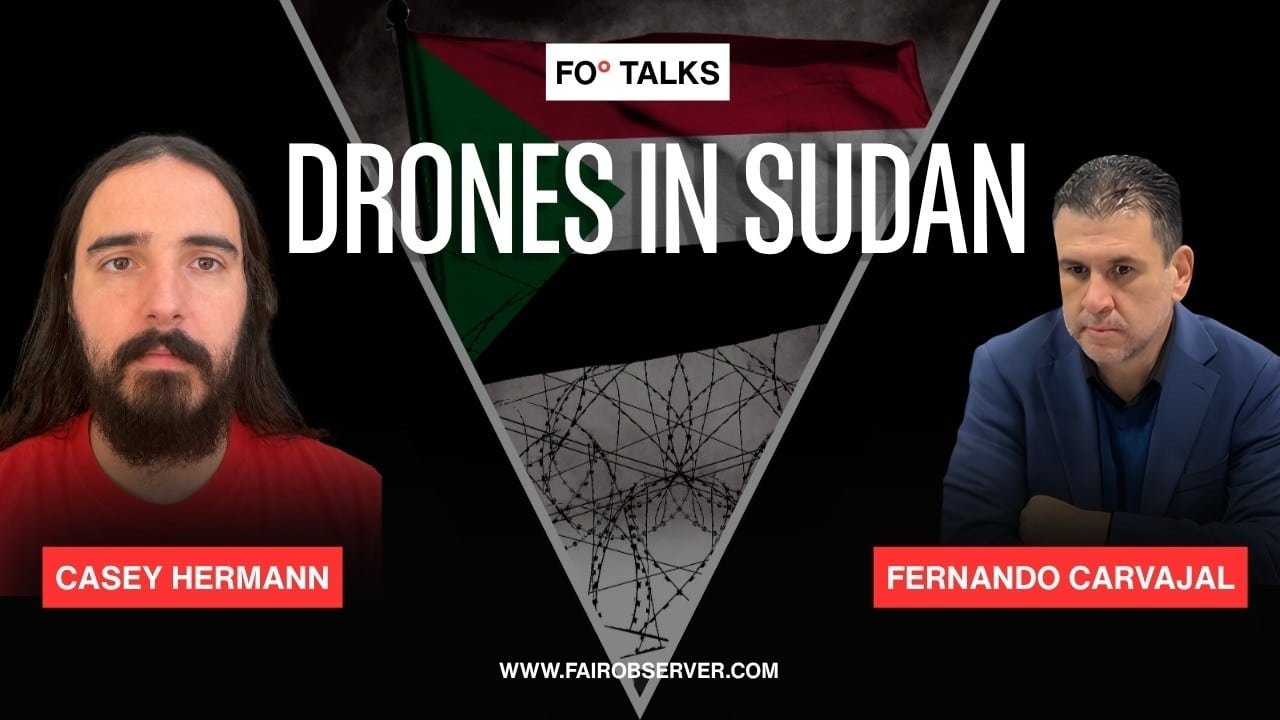
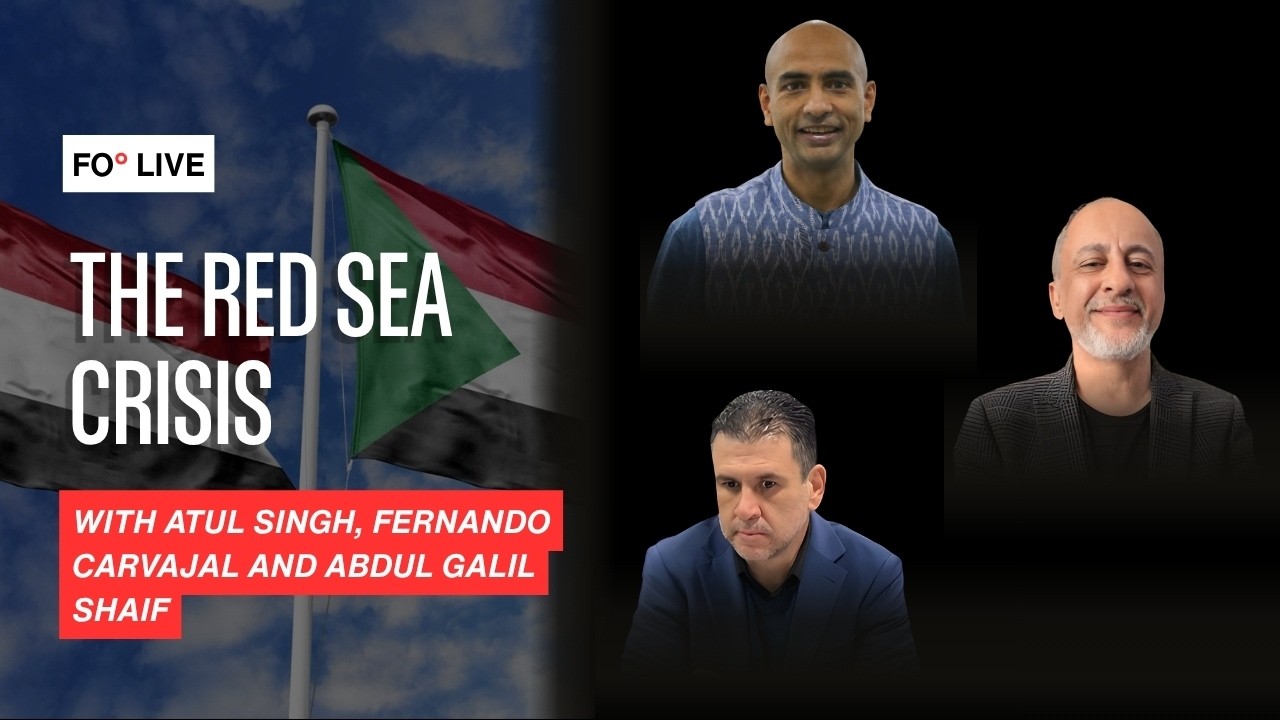
Fair Observer’s Video Producer Rohan Khattar Singh and Fernando Carvajal, the executive director of the American Center for South Yemen Studies, discuss Sudan’s devastating civil war. Their conversation moves from the origins of the SAF–RSF rupture to the broader structure of Sudanese society, showing why this war cannot be reduced to two men fighting over a palace. Carvajal portrays a country where rival militaries, ideological networks and regional patrons overlap, producing a conflict that is both local in texture and international in consequence.
The war in Sudan
Khattar Singh opens by asking how the war began. Carvajal links it to Sudan’s unresolved political rupture. The Sudanese Armed Forces (SAF), led by General Abdel Fattah al-Burhan, and the Rapid Support Forces (RSF), commanded by Mohamed Hamdan Dagalo (better known as Hemedti), once coexisted uneasily within the post-coup transitional council. Their rivalry is rooted in the era of former Sudanese President Omar al-Bashir and intensified after the 2021 military coup crushed hopes for a democratic transition. From the perspective of Sudanese civil society, Carvajal says the coup “was really a betrayal of the December revolution” from 2018, when protestors demanded economic reform and Bashir’s resignation from office.
When the SAF and RSF fell out in April 2023, the struggle for power escalated into a destructive nationwide war. The prospect of a civilian-led transition receded further into the distance.
Who controls Sudan?
Carvajal stresses that Sudan’s battlefield is far more fragmented than the media portrays. Sudan is tribal, sectarian and sharply regional, with politics shaped by the east, south, center, Nile corridor and Darfur region. Tribal militias, Islamist brigades and local factions have taken sides or broken away entirely, often shifting loyalties based on survival rather than doctrine.
On the SAF side, hardline Islamist groups have reemerged as decisive actors. Many Sudanese analysts, Carvajal notes, “really credit the Islamist factions … as really being behind … the transitional council.” The RSF, meanwhile, has expanded across western Sudan, exploiting local grievances and the collapse of state authority. Both forces claim legitimacy, yet neither governs effectively or credibly.
The Darfur crisis
The western Darfur region now hosts the war’s most extreme violence. The RSF has seized major towns while the SAF leans heavily on Islamist militias and courted tribal defectors to expand its manpower. Sudan has become the world’s largest internal displacement crisis: more than 12 million people uprooted and nearly half the population needing aid. After two years of conflict, Carvajal says Sudan “unfortunately takes on that title,” surpassing Yemen as the worst humanitarian disaster.
Aid delivery has nearly collapsed. UN convoys have been struck, officials expelled and access blocked. Confusion over attacks, with SAF supporters alleging the convoys carried weapons and UN agencies insisting they carried food, has paralyzed relief operations. If the RSF continues consolidating the region, it will be forced to prove it can secure roads and airports, not merely win battles.
Role of the UAE and Egypt
Multiple foreign powers have deepened the conflict. Egypt has aligned with the SAF, supplying equipment and flights and, according to some reports, intelligence or drone support. The Egyptian capital of Cairo fears spillover violence and illicit weapons flows.
Saudi Arabia is alarmed by potential Houthi expansion along the Red Sea and is pressing Washington to accelerate a ceasefire before a vacuum enables Iran-linked forces to establish new coastal footholds. The United Arab Emirates backs the RSF, driven by economic interests in Africa and a desire to curb Islamist influence. Turkey and Qatar, though outside the Quartet, seek roles as alternative mediators, partly because Burhan believes they would reduce RSF legitimacy. Meanwhile, the United States struggles to lead a coherent peace process amid competing regional agendas.
The collapse of Sudan
Khattar Singh asks whether Sudan has collapsed. Carvajal tells the grim truth that the state can no longer deliver basic services, pay salaries or protect civilians. The Sudanese capital of Khartoum, Darfur and Port Sudan now function as rival zones; famine conditions are spreading; hospitals have failed; UN access is blocked and donor support has been terrible.
Washington has even hinted at coercive measures, possibly peacekeepers, to secure humanitarian corridors if the parties fail to protect aid deliveries. Carvajal doubts the United Nations can mount such an effort without far greater funding.
Will Sudan break apart?
Despite fears of further fragmentation after South Sudan’s 2011 secession, Carvajal believes none of the major actors — SAF, RSF or Islamist factions — want Sudan to split. The country’s neighbors and Western governments also support unity, wary of a domino effect across already fragile borderlands. The Quad’s roadmap centers on reestablishing a civilian-led government in Khartoum and restarting constitutional reform, though the war’s trajectory makes stabilization difficult.
Still, if a credible peace initiative emerges — one not controlled by either warring faction — Sudan may yet avoid permanent fracture.
[Lee Thompson-Kolar edited this piece.]
The views expressed in this article/video are the author’s own and do not necessarily reflect Fair Observer’s editorial policy.






























Join the conversation
Share your perspective
Log in to share your thoughts and take part in the discussion.