





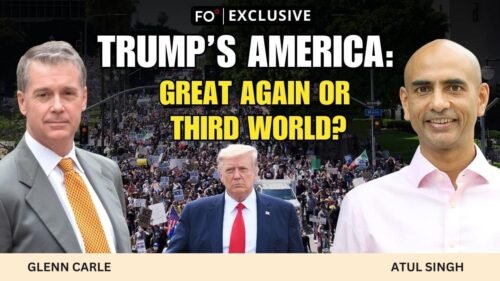
Fair Observer’s Video Producer Rohan Khattar Singh speaks with Alex Rosado, a Young Voices contributor, about US President Donald Trump’s decision to federalize and deploy the National Guard across multiple American cities. Their conversation weighs the legal, political and historical dimensions of Trump’s move and asks whether it’s a necessary security measure or a step toward authoritarian overreach.
Is Trump weaponizing the National Guard?
Khattar Singh begins by asking Rosado to explain what it means to federalize the National Guard. Rosado notes that the Guard usually operates under state authority but can be placed under federal command, shifting its chain of control to the president and the secretary of defense. This process, he says, invokes the tension at the heart of the Tenth Amendment between state autonomy and federal supremacy.
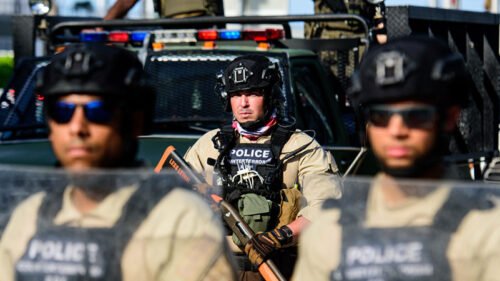
Federal troops are restricted by the Posse Comitatus Act, which limits their role in civilian law enforcement. Unless the president invokes the Insurrection Act, governors retain a say in their deployment. Rosado points out that Trump has not done so, making this federalization legally unusual. The Guard is now active in Washington, DC; Chicago, Illinois; Los Angeles, California; Portland, Oregon and Memphis, Tennessee. Advisors have floated the idea of sending troops to San Francisco, California, as well.
Trump’s justification, Rosado explains, rests on the argument that local governments have failed to keep their cities safe. He cites data showing alarming rises in crime, overdose deaths and homelessness, portraying the Guard’s presence as “restorative justice” for communities that local leaders have neglected. Chicago and Memphis, he says, have mayors with dismal approval ratings, while Washington, DC, faces one of the country’s highest homicide rates.
Critics see this as political opportunism aimed at Democratic strongholds. Rosado, however, does not believe that Trump is weaponizing the Guard to punish blue states. He insists that the deployment is not an act of vengeance but an attempt to impose order where municipal systems have broken down. The president, he argues, is responding to terrible stress in major urban centers rather than seeking political advantage.
Legal aspects
Khattar Singh presses Rosado on the legal foundation for the federalization. Rosado explains that Trump’s team leans on Article I, Section 8, Clause 15 of the US Constitution, which empowers the president to call up militias to “execute the Laws of the Union,” and on the Supremacy Clause, which affirms federal authority in protecting national interests. The administration’s lawyers have also tested what Rosado calls the protective power theory — the idea that executive mobilization of the Guard is constitutional if it stems from the president’s duty to enforce laws.
Several states have filed lawsuits claiming the move violates the Tenth Amendment and exceeds federal authority. Rosado notes that some deployments operate under Title 32, a hybrid framework allowing federal pay and benefits while maintaining nominal state control. Still, governors argue that the line between cooperation and coercion has been crossed.
A history of National Guard deployment
To contextualize the standoff, Khattar Singh asks how Trump’s action compares with past deployments. Rosado recalls that presidents have called out the Guard at least nine times in modern history. In 1957, Dwight Eisenhower used it to enforce desegregation in Little Rock, Arkansas. In 1992, George H. W. Bush invoked the Insurrection Act during the Los Angeles riots. After Hurricane Katrina, George W. Bush deployed troops to maintain order and assist relief efforts.
What makes Trump’s move different, Rosado argues, is its open-ended justification. Eisenhower and Bush acted either with court approval or gubernatorial consent; Trump’s rationale is more diffuse, based on a nebulous sense of crisis. A federal judge in Portland even issued a temporary restraining order against the Guard, deeming the protests, in Rosado’s words, “not significant enough to warrant federal invasion.”
Impact on midterm elections
The political fallout, Rosado says, is impossible to separate from the upcoming midterm elections. Democrats accuse Trump of militarizing domestic politics, while supporters of his Make America Great Again movement applaud him for “supporting and enforcing law and order.” Rosado sees this polarization as “more of an asset than a liability,” arguing that the public debate itself strengthens American democracy by forcing citizens to confront hard questions about power and safety.
Early data from Washington, DC, shows measurable declines in violent crime since the Guard’s arrival — a 27% drop in assaults, a 32% fall in robberies and an 82% reduction in carjackings compared with the same period last year. Rosado calls this evidence that tough-on-crime policies can work, though he concedes that enduring reform must come from the local level.
Rosado maintains that the Guard’s deployment, though controversial, has reopened a national discussion on the balance between liberty and security. “Our best days are still ahead,” he concludes.
[Lee Thompson-Kolar edited this piece.]
The views expressed in this article/video are the author’s own and do not necessarily reflect Fair Observer’s editorial policy.

































Comment