





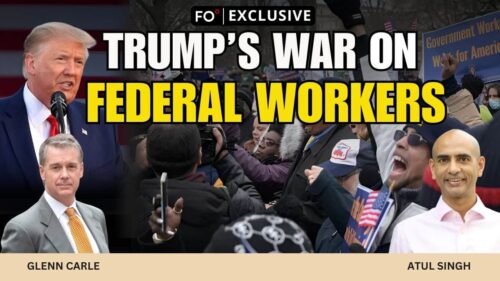
Fair Observer Founder, CEO & Editor-in-Chief Atul Singh and retired CIA Officer Glenn Carle emphasize that the United States is entering dangerous new territory under the administration of US President Donald Trump. They find the erosion of the independence and credibility of core institutions charged with safeguarding economic stability most alarming. In particular, the Treasury Department appears to be extending its influence into areas traditionally reserved for other agencies, attempting to control both fiscal and monetary policy.
That kind of concentration of power is usually found in developing nations that suffer from poor economic organization. These economies, whether their failures stemmed from oppression, exploitation or sheer mismanagement, often saw high inflation. One example Atul gives is Turkey; Turkish President Recep Tayyip Erdoğan “wanted lower interest rates and the central bank went along — and, of course, the end result was high inflation.”
Traditionally, Washington has drawn a firm line between fiscal policy — taxation, spending and debt, all managed by the government — and monetary policy, which is the preserve of the Federal Reserve, or the Fed. This separation ensures that politicians cannot tinker with interest rates to win short-term electoral advantages, avoiding the destabilizing stop-go economic cycles that plagued economies like Britain’s. Most functioning economies today separate fiscal and monetary policy. The current administration chipping away at that firewall in the US is, in Atul’s words, a “bloody bad idea.”
Assault on the BLS
The first and perhaps most visible breach comes with Trump’s firing of Bureau of Labor Statistics (BLS) Commissioner Erika McEntarfer after the release of what he called “phony” job numbers.
The move shocks markets, especially the $2.1 trillion Treasury Inflation-Protected Securities (TIPS) market. TIPS are designed to shield investors from inflation, but they rely on accurate data from the BLS. If those figures become politically manipulated, investors lose their hedge, and the entire instrument collapses in credibility. As Atul puts it, “this is bad for US bonds, this is bad for [the] US, period.”
McEntarfer had been appointed by the prior administration and was widely considered a respected economist rather than a partisan appointee. His removal signals, in the speaker’s words, that the US isn’t “any different than China” when it comes to official data credibility.
Trump’s replacement, EJ Antoni III, is the chief economist at the Heritage Foundation. This is the same think tank that authored Project 2025, the ideological blueprint behind Trump’s second term. The appointment raises fears inside the federal bureaucracy. Employees quietly admit to “panicking,” worried that their good-faith reporting of data could cost them their jobs if results are deemed politically inconvenient.
Trump justifies his move by branding the BLS’s July report, which showed only 73,000 new jobs and included downward revisions of 258,000 jobs for May and June combined, as rigged. Yet, as Atul and Glenn explain, revisions are normal: Job reports are built from survey samples, with initial numbers incomplete and later updated as more information comes in. This is standard practice, not bias.
The greater concern is what happens next. Statisticians may now feel pressure to massage data into headline figures acceptable to the Trump administration, even if underlying numbers tell another story. Already discrepancies have appeared: The BLS reported a 2.2% increase in food costs at home, while prices for staples like milk (+4.5%), eggs (+16.9%), chicken (+4.5%) and bananas (+7.2%) rose much higher. These numbers lead Gary Grappo, a Fair Observer board member and economist, to say, “Maybe there is something fishy going on.”
Upheaval at the IRS
The Internal Revenue Service (IRS) is another institution the Trump administration is throwing into turmoil. Trump removed Commissioner Billy Long, later dispatching him to Iceland as ambassador, and installed Treasury Secretary Scott Bessent in his place. This makes Bessent the seventh head of the IRS in 2025 and the sixth under Trump — an unprecedented rate of turnover that strongly suggests instability.
At the same time, the IRS faces sweeping budget cuts tied to former Special Government Employee Elon Musk’s Department of Government Efficiency. These cuts create “complete upheaval and pandemonium,” undermining the agency’s ability to collect taxes effectively.
Atul connects this dismantling to the broader Project 2025 agenda: shrinking government not just rhetorically but operationally. Republicans frequently argue that lower taxes mean smaller government and greater freedom, but critics note the blind spot — such cuts balloon deficits. Estimates suggest that slashing IRS staff and halting modernization will cost the government at least $80 billion annually in uncollected revenue. That, paradoxically, worsens the fiscal position the administration claims to be fixing.
Strike on the Fed
The most consequential front may be the Fed. This organization has long been considered the crown jewel of American economic governance, tasked with promoting maximum employment and stable prices. Its structure — with seven governors serving staggered 14-year terms — was designed to insulate it from political whims and guarantee both stability and renewal. Atul reminds viewers that vacancies occur every two years, a feature meant to keep the board refreshed while preserving continuity.
Since 1971, when the US dollar was severed from gold, Fed independence has been treated as an “article of faith” in US politics. Former Fed Chair Paul Volcker’s fight against runaway inflation in the 1980s cemented its credibility, underpinning the dollar’s role as the global reserve currency.
Trump, however, openly challenges this foundation. At a White House bill signing in June 2025, he announced plans to force the Fed to lower rates, insulting Chairman Jerome Powell — whom he appointed in 2018 — in the process. Trump said: “If we cut our interest by one point, for years we save $300 billion. If we cut it by two points, we save $600 billion a year … all because of one numbskull that sits here.” Bessent echoes the pressure, signaling the administration’s willingness to steamroll the Fed.
Fed Governor Lisa Cook became the first target, fired under a cloud of allegations about falsified loan documents. The Department of Justice even pressed Powell to dismiss her outright, escalating political pressure into a direct institutional challenge. Whether those charges justify her dismissal is legally murky; normally, presidents must show clear cause to remove a Fed governor.
Don Moynihan, a professor of public policy at the University of Michigan, describes the case as “lawfare,” noting that mortgage irregularities of this sort are common among lawmakers with multiple homes — but Trump is using them to purge opponents. Markets interpret Trump’s move as an alarming precedent, raising fears of further purges. Cook’s firing remains an ongoing case.
The motivations are transparent. With federal debt expected to top $37 trillion and the One Big Beautiful Bill Act alone projected to add $4.1 trillion by 2034, Trump and Bessent see rate cuts and dollar devaluation as ways to “inflate away” the burden. They also hope lower rates will boost lackluster job numbers. Bessent himself has claimed that “any model” supports rates 150–175 basis points lower, implying a fed funds rate of just 2.6% versus the current 4.33% — even though Producer Price Index inflation is running at 3.3%.
Economists across the spectrum reject his claim as absurd. Inside the Fed, officials warn that all central banks are “in the credibility business.” They see Bessent’s rhetoric as directly undermining that foundation.
Critics deride Trump and Bessent’s aim as reckless. Artificially cheap money, they argue, risks reigniting the stop-go economy of the 1970s, where bursts of growth gave way to painful recessions. Worse, meddling erodes the intangible but vital “animal spirits” that economist John Maynard Keynes described — business confidence, investor trust and the belief that rules matter.
Fed economists quietly fear a return to stagflation, the toxic mix of weak growth and high inflation that defined the 1970s. For them, the administration’s actions are not just policy shifts but existential threats to the credibility that makes the US financial system the backbone of the global economy.
The bigger picture
What unites the BLS firings, IRS chaos and Fed interventions is a single theme: the undermining of institutional independence. The US, once admired for its robust separation of powers and credible technocratic agencies, is being reshaped into something more personalized, less rule-bound and far riskier.
Atul and Glenn warn that this shift effectively replaces a “government of laws” with a “government of a man.” By stripping agencies of autonomy and credibility, Trump is concentrating authority in ways more typical of fragile or authoritarian systems.
This move brings stark potential consequences. Investors may lose faith in the accuracy of economic data. Markets may question whether the US will honor its debt commitments. Ordinary Americans may discover that statistics no longer reflect their lived reality, eroding trust in government altogether.
US economic governance is dramatically deteriorating. With every move Trump makes to politicize independent institutions, the risk of a full-blown crisis grows.
[Lee Thompson-Kolar edited this piece.]
The views expressed in this article/video are the author’s own and do not necessarily reflect Fair Observer’s editorial policy.








































Comment