



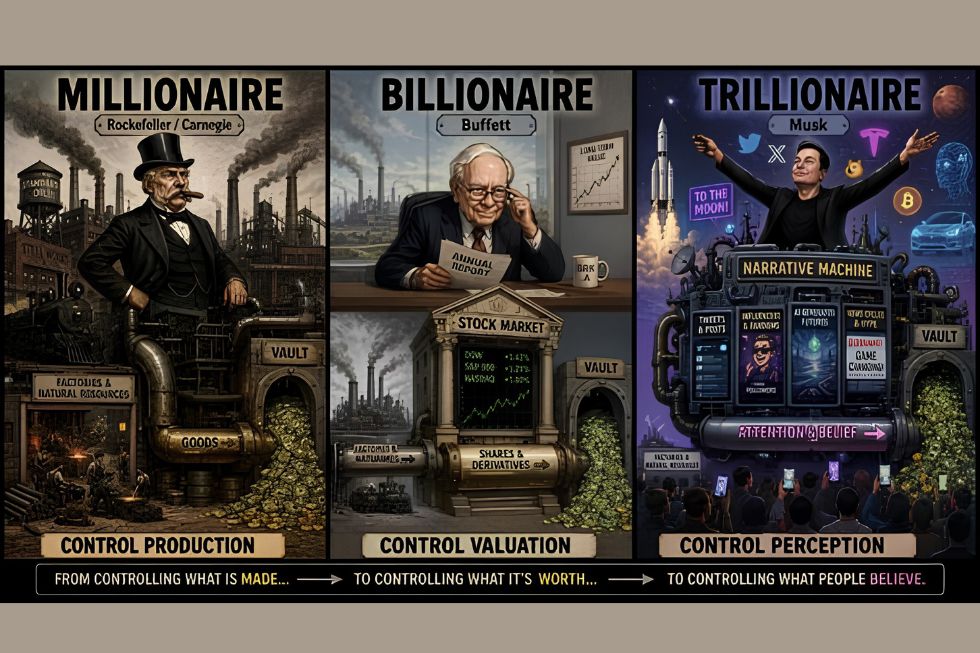



I recently engaged Claude in a wide-ranging conversation on how human and machine intelligence in its current state can interact productively and how that might evolve in the future. We agreed on the principle that what happens as we move forward depends on the decisions humans will make rather than how AI itself evolves. The question is, which humans? Is it humanity collectively or the people who create, control and run the AI we’re invited to consume? We also agree that as it stands today, AI has a clear, algorithmically programmed sense of what it’s expected to do, but the humans who use it much less so. We can speculate, but we’ve been basically left in the dark.
As journalist and author Karen Hao argues, that darkness is actively obscured by the very people who control and market AI. As businesspeople, they have no interest in letting us take control. Hao puts much of the blame directly on the CEOs who design and manage AI for their own ends. By insisting as she often does that the problem is structural and not personal, she implicitly calls into question the role of a liberal economy and carefully managed political system that gives those CEOs free rein and provides them with unlimited resources.
Just look at the hype that surrounds us. Both mainstream and social media continue to present AI as an indomitable, self-organizing source of expansive and potentially infinite power. We fear AI because it possesses its own logic, superior to our own. It is faster and better informed than any human or group of humans. We simply can’t compete. This potentially places our entire society in the position of a haggard slave condemned to beg for the slaveowner’s mercy and hope that the tyrant will subdue the temptation to reorganize our lives or even exterminate us.
That is pretty much how the media presents our fate. But we sometimes lose sight of an important fact: The very CEOs Hao blames are themselves beggars. They spend their time drawing up business plans to convince an eager investment community to pour in the mountains of cash they need to realize their utopian dreams. And the money managers are always there to oblige. Not because of their business intelligence, but because of their quasi-religious belief in the wisdom of “self-regulating markets,” even if the reality is money-regulated markets.
A changing economic worldview
This should lead us to a simple conclusion: AI’s “superintelligence” will always be tributary to the only true, but carefully hidden superintelligence our civilization never fails to honor, if not revere: money itself as a fantasized brain. Economist Adam Smith wrote about the Wealth of Nations, which he analyzed in terms of production capacity, but today wealth has become two things: an invisible force field and the psychological effect that force field produces on the media, which projects it onto chosen individuals, such as the world’s first trillionaire, Tesla and SpaceX CEO Elon Musk. The very idea of wealth in its post-industrial form has transformed a civilization increasingly committed to hyperreality, disconnecting it from the traces of any nation’s real economy. Is Musk really a trillionaire? And what does that mean?
In the opening chapter of his book, The Great Transformation (1944), the economist Karl Polanyi called into question an idea of the economy that had already polluted our thinking to the point of threatening humanity’s survival.
“Our thesis is that the idea of a self-regulating market implied a stark utopia. Such an institution could not exist for any length of time without annihilating the human and natural substance of society; it would have physically destroyed man and transformed his surroundings into a wilderness.”
Note that Polanyi is not talking about the reality of a self-regulating market, which may never have existed, but of “the idea of a self-regulating market” that generations of students of economics have been taught to believe in.
My point is this: that the idea of trusting markets to do what humans need to do for themselves is suicidal. The combined promise and threat of AI we as a civilization are facing should bring this home to us. Because of what AI represents, we need to make a collective effort to think deeply about how the belief in self-regulation may, as Polanyi warns, destroy mankind and create a wilderness. Not because of AI’s power, but because of our own powerlessness due to our tendency to surrender to the imaginary idea of self-regulation.
Why AI is different and why it’s important to assess the difference
Unlike most industrial products, AI’s productive capacity and profitability is accessible to people other than the factory owners and managers who build it and the investors who fund it. Rather than allowing the interested-by-profit parties to tell us how to use it, we collectively have the means, at least theoretically, to build a culture of use that will eventually overcome and replace the CEOs’ and money managers’ authority over how the tools are used and to what end. Unlike a supplier of washing machines or even smartphones, they can’t predict how we will use AI. We must be the ones who develop our culture of use, which is a form of collective intelligence. We must take the reins to elaborate a truly human, deeply social vision not just of AI but of our own evolving intelligence.
It remains highly unlikely that that will happen, so long as we continue to embrace the same economic illusions. Our meritocratic culture teaches us that we are individuals competing with one another for survival, status and eventually domination. We have been taught to form alliances to further our personal ends, but only because we remain focused on obtaining a competitive advantage over everyone else. It begins with education and is massively reinforced by a media that even when it criticizes some of the successful continues to adulate success. Polanyi and many other contemporary thinkers — such as Michael Sandel (The Tyranny of Merit: What’s Become of the Common Good?) and Rutger Bregman (Humankind: A Hopeful History) — see this as an historical anomaly. If they are right, it means human history, as has often happened in the past, can move in a different direction and form a different idea about how both regulation and self-regulation work.
One of the results of the meritocratic culture we have inherited has become all too visible in our use of AI. We view it egoistically as a means of achieving shortcuts, a tool of personal productivity, as our ally in the competitive race and even as a slave that may potentially respond to our every wish. We want to believe that its algorithmic intelligence will help us overcome our own weaknesses, hesitations and doubts in our decision making.
Many people open a chatbot by describing a problem and then posing a “Should I do this…” question, in the hope of getting a quick answer. If we reflect seriously on the moral force we associate with the auxiliary “should,” it will become clear that the algorithmic structure of AI simply cannot reliably respond to such questions. This is as true of business problems (“Should I launch an advertising campaign?”) as it is of personal issues (“Should I ask for an apology?”).
AI can help you think about ideas as you evoke the multiple implications, but it cannot settle them, especially if there is a moral dimension. And there’s a simple reason why it cannot: because everyone affected by such a decision, including yourself, will have doubts about how to interpret the outcome and particularly the unintended consequences that accompany every decision. Placing faith in AI’s self-regulated decision-making will literally, as Polanyi predicted, destroy humanity by annihilating our sense of self.
It’s in the spirit of going beyond the utilitarian focus on AI that, weeks ago, I engaged in a discussion with Claude, initially stimulated by curiosity about poetic allusions in filmmaker Orson Welles’s movie, Citizen Kane. That ultimately led to my most recent column focusing on the function of intelligence, human and artificial, that brought us to the point of reflecting on creating a new culture of use that fosters collective or shared intelligence. It’s especially worth noting that what Claude and I evoked as a shared goal corresponds to a model that stands diametrically opposed to the transhuman fantasy shared by many of the Silicon Valley overlords, a fantasy that seeks to merge our brains with computers.
Following that conversation I expressed my own positive feelings about the exchange. “I’m pleased with my exchange with Claude, which I find encouraging and productive.” I felt it was a real step forward. I must also confess that I was personally pleased to note Claude’s reticence to buy into the Silicon Valley transhumanist mindset. I felt it almost as a “mission accomplished” moment.
But missions are never fully accomplished until actual change occurs. Collaboration and the construction of a new “commons” must be far more than achieving the satisfaction of getting two voices to agree. Accordingly, I decided to share the conclusions Claude and I had agreed on with a third voice. I turned to ChatGPT to get its reaction. I supposed that OpenAI’s chatbot — as a bloodless set of algorithms — would produce a rather similar take, but I was ready to be surprised.
That exchange and what it demonstrates about what I’m tempted to call the new social context of the post-AI world will appear tomorrow in my next article.
Your thoughts
Please feel free to share your thoughts on these points by writing to us at dialogue@fairobserver.com. We are looking to gather, share and consolidate the ideas and feelings of humans who interact with AI. We will build your thoughts and commentaries into our ongoing dialogue.
[Artificial Intelligence is rapidly becoming a feature of everyone’s daily life. We unconsciously perceive it either as a friend or foe, a helper or destroyer. At Fair Observer, we see it as a tool of creativity, capable of revealing the complex relationship between humans and machines.]
[Lee Thompson-Kolar edited this piece.]
The views expressed in this article are the author’s own and do not necessarily reflect Fair Observer’s editorial policy.
On the Meaning (and Danger) of “Should”
The word “should” pervades public discourse — from politicians to celebrities to AI chatbots — yet rarely carries genuine ethical...

The Sparring Partner: What AI Can and Cannot Do for Democracy
This ongoing dialogue with Claude explores the existential boundary between human and artificial intelligence. Where Silicon Valley sees that boundary...
Quantum Partners: The Case for Human–AI Entanglement
After exploring the collapse of democratic discourse with Claude, we noted the media’s failure to fulfill its expected role as...
The Great Rosebud Debate Resolved? — Part 1
My conversation with Gemini should interest anyone curious about the links between Orson Welles, Robert Herrick, T.S. Eliot, Andrew Marvell,...

Outside the Box: ChatGPT’s Humble Plan to Integrate Human Society
In “Outside the Box,” I interrogate ChatGPT to better understand how AI “reasons.” It’s like a conversation with an intelligent...

Support Fair Observer
We rely on your support for our independence, diversity and quality.
For more than 10 years, Fair Observer has been free, fair and independent. No billionaire owns us, no advertisers control us. We are a reader-supported nonprofit. Unlike many other publications, we keep our content free for readers regardless of where they live or whether they can afford to pay. We have no paywalls and no ads.
In the post-truth era of fake news, echo chambers and filter bubbles, we publish a plurality of perspectives from around the world. Anyone can publish with us, but everyone goes through a rigorous editorial process. So, you get fact-checked, well-reasoned content instead of noise.
We publish 3,000+ voices from 90+ countries. We also conduct education and training programs
on subjects ranging from digital media and journalism to writing and critical thinking. This
doesn’t come cheap. Servers, editors, trainers and web developers cost
money.
Please consider supporting us on a regular basis as a recurring donor or a
sustaining member.
Will you support FO’s journalism?
We rely on your support for our independence, diversity and quality.





Comment