


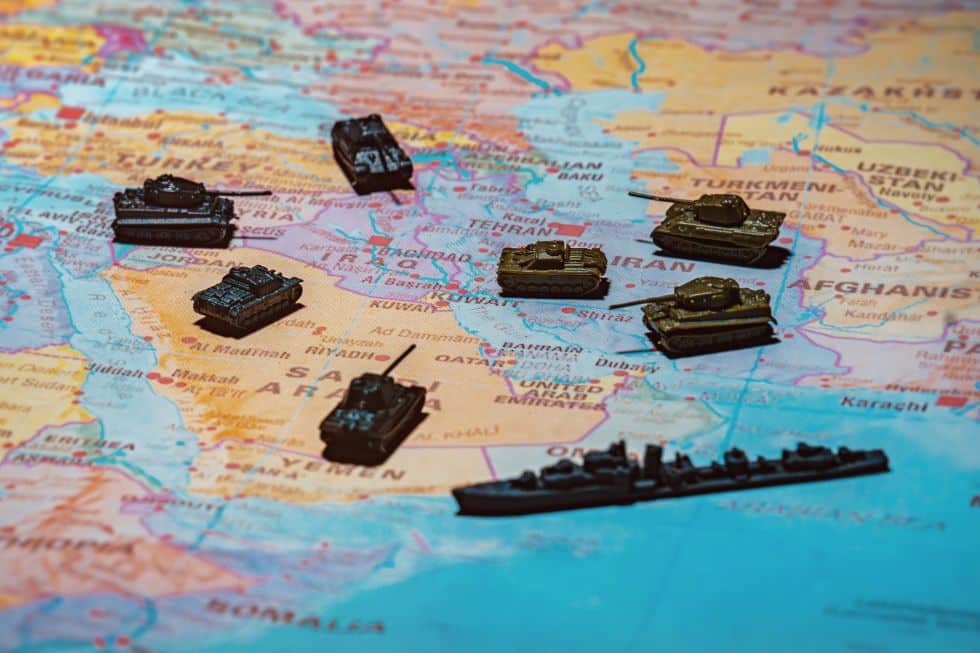



The dominance of Western imperialist powers over the world is an old story. While the locus of global imperial power shifted across the Atlantic from Europe in the 1940s, Western influence has persisted under the US-led hegemonic global order. We have just seen, yet again, in Venezuela, how this imperialist will asserts itself on the rest of the world.
Under the shadow of economic sanctions imposed by the US and its Western brethren, Venezuela’s oil remained largely buried after nationalization. The country’s oil fields couldn’t be upgraded or developed due to a lack of investment, and whatever could be exploited still couldn’t be sold freely at the best price. The US thus successfully contained Venezuela’s strategic oil wealth, ensuring that no other country could challenge or alter the US’s will.
As if all this were not enough, the US has militarily seized control of Venezuela’s oil, effectively turning the country into an oil colony after abducting the intransigent “narcoterrorist” President Nicolás Maduro and either coercing or bribing its remaining ruling leadership into absolute submission. This is how an empire works.
Asymmetric Western wars
Western wars are always asymmetric in many ways. The unmatched military power and immense resources available to these predominantly Caucasian nations give them a tremendous operational advantage in warfare. Their enormously destructive military technology and ability to strike from a remote safe distance limit their own casualties and material losses to just a fraction of what they inflict on their enemies. Their lineal brotherhood and strategic alliances — which provide a vast pool of military, financial and industrial resources — serve as a powerful force multiplier. Moreover, their tight control over the global economy and financial institutions allows them to influence the official reactions and actions of almost all other countries to their liking. Their highly dominant and sophisticated propaganda machinery shapes the international public opinion in their favor.
This comprehensive domination enables them to bring war to other people’s homes while their victims cannot retaliate in kind. The best these victimized nations can do out of vengeance and frustration is to carry out occasional bombings and shootings in the homelands of the Western powers. These occasional incidents are dubbed as the most heinous crimes of cowardly terrorism, while the hundreds of thousands of defenseless people killed in other countries by the relentless aerial bombings and missile strikes of Western nations are glorified as acts of valor and heroism.
Western powers wage such imperialist wars repeatedly under various pretexts, many of which are manufactured, full of lies, and marked by brazen dishonesty and double standards. They remain unaffected due to their domination over the international order. In the end, they always get away with their illegal and immoral deception and destruction. Their hegemonic wars are deemed just, while any resistance from others is labeled entirely unworthy and immoral. Others are only expected to surrender and accept the will of Western aggressors.
That is how things have largely been for a long time.
In a matter of a mere month
After the implementation of US President Donald Trump’s tariffs, which caused almost every country except China to fall in line, and the swift and impressive US military operation in Venezuela on January 3 — which even made the Chinese admit that their People’s Liberation Army (PLA) was lagging far behind — Iran has managed to greatly diminish the US’s larger-than-life image in just one month.
In the eyes of the world, this marks a sudden decline of the US from the zenith of glory achieved in Venezuela. The mythical and mighty B2 bombers, F35 stealth fighters, Tomahawk missiles, Massive Ordnance Penetrators (MOPs), Patriots, THAAD systems and the Gerald Ford aircraft carrier were all proven ineffective. Trump’s much-trumpeted secret weapon, the “discombobulator,” which he said was used in Venezuela, was nowhere to be seen. And the mockery of the Iranian, Russian and Chinese systems couldn’t be made.
The US’s acclaimed air superiority, along with its constant bombing and assassinations, couldn’t break the will of the Iranians. Nor could Western propaganda make pro-US Iranians march on the streets of Tehran. US Secretary of War Pete Hegseth’s animated bullying and Trump’s cold threats on camera and faceless warnings on Truth Social didn’t work either. Iran has stayed firm and held on to its tit-for-tat military strategy unwaveringly from day one.
The US arms lobby also found little to celebrate beyond supply orders, as there was nothing mind-boggling about its technological advancements to attract global interest. In contrast, Iran’s unparalleled sacrificial courage and fearless conduct have captured the public imagination. Its sustained and effective military retaliation has taken the spotlight, sidelining storied Western military technology for the first time in memory.
Despite tall claims that the US has decimated Iranian missile capability and decapitated its political and military leadership, there is no let-up in Iran’s retaliatory strikes. There are no signs of the nation weakening, much less surrendering and capitulating.
War of attrition and will to endure
The myth surrounding technology and generalship often falls apart during a war of attrition. Scholarly inquiries such as Canadian historian Cathal Nolan’s The Allure of Battle dispel the powerful myths of “military genius” and “decisive battles” and rouse us to see that victory is achieved “by grinding rather than genius.” However, the heroic tales of Carthaginian General Hannibal, King of Sweden Gustavus Adolphus, John Churchill, 1st duke of Marlborough, Holy Roman Emperor Frederick II, French Emperor Napoleon I, German military commander Helmuth von Moltke and even German Dictator Adolf Hitler are still widely told and believed, especially in military circles. Nolan explains this phenomenon:
Modern wars are won by grinding, not by genius. Strategic depth and resolve is always more important than any commander … Losers of most major wars in modern history lost because they overestimated operational dexterity and failed to overcome the enemy’s strategic depth and capacity for endurance. Winners absorbed defeat after defeat yet kept fighting, overcoming initial surprise, terrible setbacks and the dash and daring of command “genius.” Celebration of genius generals encourages the delusion that modern wars will be short and won quickly, when they are most often long wars of attrition … We might better accept attrition at the start, explain that to those we send to fight, and only choose to fight the wars worth that awful price … With humility and full moral awareness of its terrible costs, if we decide that a war is worth fighting, we should praise attrition more and battle less.
History tells us that there is no quick victory in wars that are fought against ideologically committed and determined nations. We have seen it in our own lifetime in Vietnam, Somalia, Afghanistan and Yemen. Iran, I believe, will be no different, given its conduct of warfare to date. And, it is not difficult to understand why.
Iran is neither Iraq nor Venezuela; it is neither Libya nor Syria. Iran is Iran, and its national honor and pride came out in its refusal to submit to Western money and military might. Today, it is evident to the whole world that the Iranian leadership, military and society are not corrupt like the Venezuelan government — they cannot be bribed — nor are they cowardly.
One cannot fight for long without absolute clarity and total commitment to one’s beliefs. Against sacrificial courage and an iron will to endure, bombs, missiles, death, destruction, duration, along with petty tariffs, are ultimately insignificant. The Iranian people have demonstrated their ability to withstand the world’s greatest military power. No empire can defeat this spirit. No technological superiority can subdue such people. Resistance is never a rational choice; it is always a moral imperative. Those who lead life pragmatically by calculating the costs and benefits of their decisions and actions can never understand why some people(s) resist against all odds.
Illusion of democracy and distortion of legitimacy
The conceit of politicians and intellectuals in democracies is well known. They strongly believe that only a democratically elected government is legitimate, even if the majority (opposition and abstentions) disapproves of their rulers. They are incapable of understanding that there could be other forms of government, backed by much greater majorities than Western-style democracies, due to the spontaneous convergence of minds shaped by shared ideologies and worldviews.
This Western prejudice against Iran and its political system might have led Trump, Israeli Prime Minister Benjamin Netanyahu and their advisers to believe that after decapitation strikes, the Iranian people would overthrow the Islamic Revolutionary regime themselves. Instead, powerful religious and nationalist feelings have rallied them all against the aggressors, making the regime more resolute than ever to take on the US, Israel and their hesitant nonwarring enablers in the Gulf and Europe.
Emergence of doubt and erosion of morale
Whose wars are the imperialist wars? What if we were to arm all supporters of war — including politicians, generals, industrialists, scientists, intellectuals, journalists and their young sons — and send them to the front lines first, with professional soldiers only taking over afterward? In all likelihood, there probably won’t be any wars because most imperialist wars are their wars. Despite the rich and powerful being the main beneficiaries of national projects, they don’t fight wars. Instead, wars are fought by the young sons of ordinary people, who stand at the broad base of the national pyramid. In the name of the nation, these countless faceless commoners make all the sacrifices in wars they have no control over starting or ending.
In normal times, when life is comfortable and manageable, soldiers, along with their families and friends, have no doubts. They are co-opted completely by the overwhelming nationalist propaganda and brainwashed thoroughly by the hegemonic nationalist ideology. At the beginning of a war, people rally enthusiastically behind the nation and credulously believe in the judgment of their political masters.
However, the seemingly solid national consensus begins to fracture when the death toll continues to mount in a war of attrition with no end in sight. Everyone knows that inside the endless truckloads of coffins that arrive neatly wrapped in the national flags lie the mutilated dead bodies of healthy and handsome young men and women whose lives have been cut short, along with their dreams. Against this dreadful and sorrowful reality, no amount of loud and skillful boasting, bravado, slogans and propaganda makes much difference.
Past that point, the same people — civilians and soldiers — now begin to question, doubt, and recognize the unfairness of the world and the unnecessary nature of the wars. Their common sense reveals truths that scholars discern after years of research.
Scholarly critique of nationalist ideology and wars of choice
Historically speaking, nations as communities did not naturally exist; they were invented. They are the product of mass politics and its accompanying mythology. Irish political scientist and historian Benedict Anderson, therefore, calls them “imagined communities” in his famous book of the same name. Similarly, US historian Howard Zinn argues:
Nations are not communities and never have been. The history of any country, presented as the history of a family, conceals fierce conflicts of interest (sometimes exploding, most often repressed) between conquerors and conquered, masters and slaves, capitalists and workers, dominators and dominated in race and sex.
British-Czech philosopher and social anthropologist Ernest Gellner also contends that “nations as a natural, God-given way of classifying men, as an inherent though long-delayed political destiny, are a myth” invented by nationalism. British historian Eric Hobsbawm agrees that “nations do not make states and nationalisms but the other way round.” Then, he remarkably sums up the reality of this ideology in just one sentence: “Nationalism requires too much belief in what is patently not so.”
The problem with nationalism is that it not only seeks to make us believe in falsehoods, but it is an extremely hegemonic and intolerant political ideology. It claims absolute legitimacy and demands total loyalty from individuals it identifies as belonging to a nation. According to Hobsbawm, nationalism “overrides all other public obligations, and in extreme cases (such as wars) all other obligations of whatever kind.”
On the topic of war, US psychologist Philip Zimbardo offers an interesting, yet often-overlooked, perspective when he writes, “Most wars are about old men persuading young men to harm and kill other young men like themselves.” In contrast, Nolan’s perspective is more inclusive and collective. He writes:
War remains the most expensive, complex, physically, emotionally and morally demanding enterprise that humans collectively undertake. No great art or music, no cathedral or temple or mosque, no intercontinental transport net or particle collider or space program, no research for a cure for a mass killing disease receives even a fraction of the resources and effort humanity devotes to making war. Or to recovery from war, and to preparations for future wars that are invested over years and even decades of always tentative peace.
And, we never seem to learn:
After every war we also write more heroic poetry and books preaching “the old lie.” We bury the dead while neglecting survivors. We mourn awhile … then write more war songs and speak of “pouring out the sweet red wine of youth” to another generation of boys breathlessly eager for war. We bury more dead, erect more granite statues, and write lists of soon-forgotten foreign place-names scored with acid in brass on stone. We admire oiled images of oafish, mounted generals in silk and lace who led armies to slaughter in endless wars over where to mark off a king’s stone borders. Perhaps most of all, we watch films with reassuring characters and outcomes which glorify war even while supposedly denouncing it.
We do all this without “a critical look at the societies and cultures that produced mass armies and sent them off to fight in faraway fields for causes about which the average soldier knew nothing.”
Humanity’s moral disengagement and characteristic human hypocrisy
Perhaps, the simplest and the best description of the grotesqueness of the Iran war and dispositional “Western hypocrisy,” or rather human hypocrisy, comes from the defense minister of Pakistan, Khawaja Asif, who wrote on X, “The goal of the war seems to have shifted to opening the Strait of Hormuz, which was open before the war.”
Clearly, what is most important is the flow of oil and gas through the Strait of Hormuz. Most deplorably, what is totally unimportant is the loss of countless human lives — least of all animals and plants — and the immeasurable pain and suffering of all. We have just seen it in Gaza and are now seeing it in Lebanon and Iran, too. Greed and power have made us all so dastardly pathetic and morally degenerate that we have lost the precious voice of human conscience completely.
The disruptive Iran war and its geopolitical repercussions
Among the three geopolitical theaters where the US has established military bases — Europe, the Middle East and the Far East — the Middle East offers the least serious military challenge to the US. This is due to the absence of any great military power, such as Russia or China, there. Nonetheless, Iran has delivered a serious strategic blow to the US’s reputation as the greatest military and economic power in the world when it initiated an unprovoked imperialist war against Iran.
The war in Iran has disrupted the long-held awe associated with US military might, forcing a reconsideration of its ability to impose its will on others. While the US remains the largest economic and military power, retaining its global network of military bases and alliances, the real impact of the Iran War extends beyond material changes. The war has fundamentally altered global perceptions of the US, especially among nations dependent on US support.
In light of Iran’s resolute resistance, no reasonable person can have total trust in the so-called invincible and fabled military might of the US and its ability to protect anyone. Genuine skepticism has replaced the blind faith in the US’s ability to prevail over its enemy, which is militarily capable and determined to fight back. Above all, Iran has shaken the confidence of the US’s allies regarding the security offered by the US. And, in that sense, the global domination of the US is no longer the same as it was before February 28, 2026.
Although the final word on the Iran war is yet to be written, I must say, it is impossible to believe that there has been no erosion of confidence of its dependent allies in the US, and that there will be no perceptible strategic repercussions. My theoretical understanding and limited foresight point to the following direction the world may take.
In a rapidly changing world, the US may not have the luxury of time to restore the perception of its military superiority and magical invincibility, even if public memory shortens. Before China could do it, Iran has fundamentally changed the world forever.
The Greenland incident has also changed many things. After the US laid claim to Greenland, many in Europe and elsewhere, who had previously been vocal about wanting war without the means to fight it, fell silent, believing in the unwavering and formidable support of the US in their wars. European liberals, once too aggressive in their nationalist rhetoric, are more cautious and measured now; they have stopped roaring and begun to meow. And, the Nordic and Baltic nations are now thinking twice before flexing their infantile muscles to fight a great war.
If Greenland had called into question Washington’s reliability, Iran has cast a shadow on its capability. So, what now? Maybe, most US vassals in Europe, the Middle East, the Far East and Oceania will come to their senses. Perhaps, they won’t talk about war. Hopefully, many won’t follow in the footsteps of their domestic fascist competitors. Probably, those in South Asia, Africa and South America who are scrambling and groveling to get some shade under the crowded canopy of the US security umbrella will reconsider and go back to their sensible nonalignment. Possibly, nations will rely on good old diplomacy again, choosing sanity over madness; they will sit around and talk, give and take to resolve contentious issues, and make concessions to buy peace.
It’s easy to talk about war. It’s extremely difficult to fight one, especially a protracted war of attrition.
Lessons of history and the magical powers of propaganda
I will be pleasantly surprised if the world becomes saner as projected above, perhaps wishfully, after learning lessons from the Iran war. But, I will not be surprised at all if Italian Marxist philosopher Antonio Gramsci is proven right again, when he perceptively said, “History teaches, but has no pupils.”
Throughout history, we have seen that while things may change, nothing actually does. The more things change, the more they stay the same. We know well that the two-and-a-half millennia-old Thucydides’ dictum — propounded in his work History of the Peloponnesian War — which states that “the strong do what they can; the weak endure what they must,” continues to hold its ground, defying countless resistance struggles waged by the exploited and oppressed people throughout human history.
It is easy to believe that “I am okay, you are not.” It is easy to invent an enemy and sell its imaginary threat as real and imminent to the public. Dangerous enemies have always been there in the world — the Soviet Union, Vietnam, Iraq, Libya, Syria and so on. There are still plenty in our world — communist China, rabid Russia, nihilist North Korea, fundamentalist Iran, racist South Africa, terrorist Afghanistan, Yemen, Cuba, Colombia and more besides. Manufacturing a narrative around these invented enemies is not very difficult.
Propaganda is an organized and sustained misinformation campaign based on certain ideas, beliefs and, above all, lies, carried out for the purposes of capturing, securing or sustaining power. It is a political tool for manufacturing public opinion and rallying people behind a certain idea, ideology or individual. Propaganda tends to monopolize public discourse by discrediting competing narratives, punishing polemics and smothering dissent.
Propaganda has magical powers, and it is a great winner. It is said that a lie can travel halfway around the world before the truth can get its boots on. Imagine the fate of credulous and prejudiced masses with short memories when a million lies are bombarded from all directions and repeated endlessly. It can make them believe in anything. And, our beliefs and imagined realities can make us do and create anything. This fact is encapsulated in what is called Thomas theorem. Propounded by US sociologists William and Dorothy Thomas, this theorem states, “If men define situations as real, they are real in their consequences.”
[Kaitlyn Diana edited this piece.]
The views expressed in this article are the author’s own and do not necessarily reflect Fair Observer’s editorial policy.
Beware Hubris: Trump’s Iran War Has an Ozymandias Flavor
Never short of hyperinflated self-praise and self-adulation, US President Donald Trump has been true to form regarding his blitzkrieg joint...
US Strike on Venezuela: A Violation of the Sovereign Equality of Nation-State Principle
The US strike on Venezuela violates the long-standing principle of sovereign equality, undermining international law and global stability. Driven by...

The Trump Corollary: US Imperialism in Latin America From the Monroe Doctrine to Maduro
Washington is reviving its long-standing history of control in the Western Hemisphere by citing threats from Venezuela to justify military...

Support Fair Observer
We rely on your support for our independence, diversity and quality.
For more than 10 years, Fair Observer has been free, fair and independent. No billionaire owns us, no advertisers control us. We are a reader-supported nonprofit. Unlike many other publications, we keep our content free for readers regardless of where they live or whether they can afford to pay. We have no paywalls and no ads.
In the post-truth era of fake news, echo chambers and filter bubbles, we publish a plurality of perspectives from around the world. Anyone can publish with us, but everyone goes through a rigorous editorial process. So, you get fact-checked, well-reasoned content instead of noise.
We publish 3,000+ voices from 90+ countries. We also conduct education and training programs
on subjects ranging from digital media and journalism to writing and critical thinking. This
doesn’t come cheap. Servers, editors, trainers and web developers cost
money.
Please consider supporting us on a regular basis as a recurring donor or a
sustaining member.
Will you support FO’s journalism?
We rely on your support for our independence, diversity and quality.
The US and Its Incoming War With China
US defense spending favors aircraft carriers, tanks and fighter jets that China seeks to counter with cheaper missiles, drones and...
FO° Exclusive: Pakistan’s Deadly Islamist Terror Attack, India’s New Water War
The latest Islamist terrorist attack in Kashmir killed 26 people, including Indian security personnel and tourists. This conversation explores Pakistan’s...

US Can Repel China With Taiwan’s Porcupine Defense Strategy
China is stepping up pressure on Taiwan and showing plans for a possible invasion. In response, the US is drawing...






Comment