





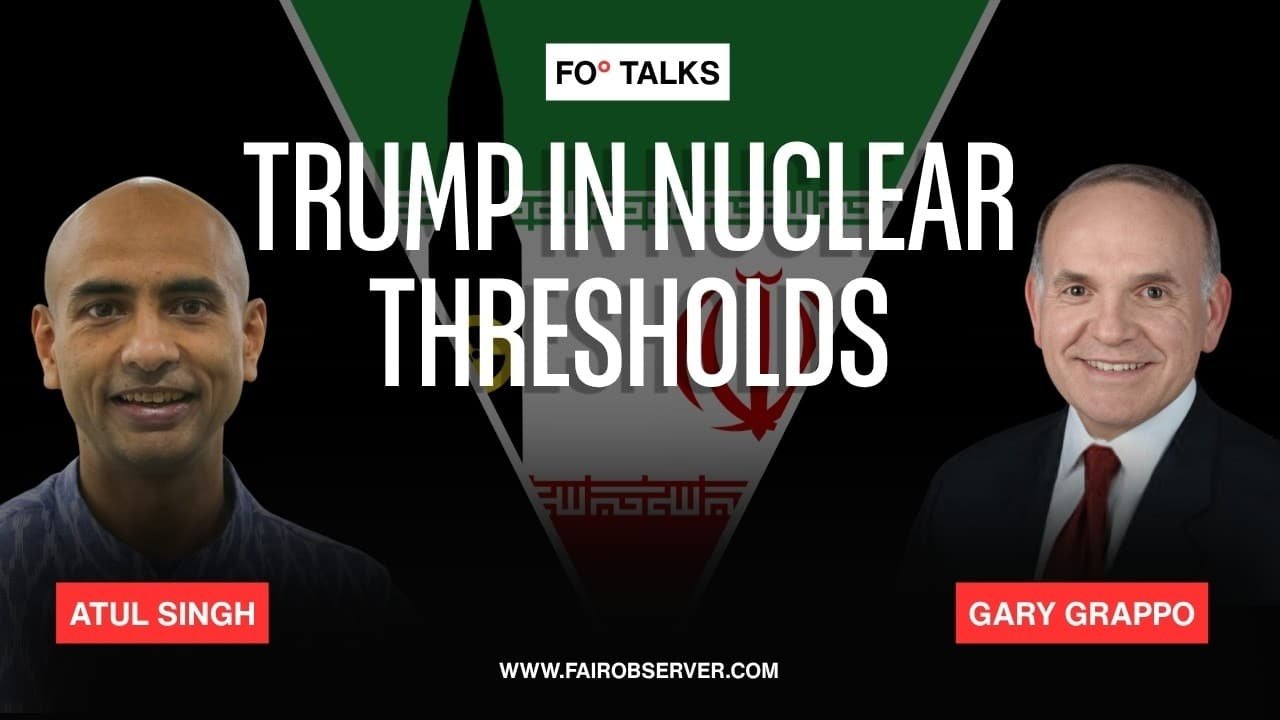
Editor-in-Chief Atul Singh and former US Ambassador Gary Grappo, who served as Envoy and Head of Mission of the Office of the Quartet Representative Tony Blair in Jerusalem, examine the Trump administration’s approach to allies, adversaries and nuclear weapons. They examine threats against Oman, doubts about American security commitments in East Asia and the risks of expanding nuclear options. As they express, unpredictable leadership weakens alliances and encourages countries to seek security through their own nuclear arsenals.
Threatening Oman undermines a longstanding alliance
Gary describes the Iran conflict as an “unnecessary war from the very beginning.” He argues that Washington entered the campaign without a coherent strategy and is turning toward economic pressure because military action has failed to produce its expected victory. Iran’s leadership has demonstrated resilience and remains committed to preserving the Islamic Republic.
Oman’s position in the Strait of Hormuz makes diplomacy especially important. Gary explains that its territorial waters contain the deep channels used by large vessels entering and leaving the Gulf. Oman’s negotiations with Iran therefore concern its sovereignty, maritime access and national interests.
The distinction between transit tolls and service fees matters. Gary distinguishes charging vessels simply to pass through the strait from charging for services such as emergency assistance or environmental cleanup. He notes that the negotiations remain opaque, while Oman has publicly affirmed its international obligations.
Washington should clarify these issues through conversations with a reliable partner. Threatening to bomb Oman instead turns a diplomatic disagreement into an assault on allied confidence. Gary calls such threats “unconscionable.”
The problem extends beyond presidential rhetoric. Atul and Gary criticize reliance on Jared Kushner and Steve Witkoff across major diplomatic portfolios. Concentrating negotiations among presidential confidants, while leaving diplomatic posts unfilled, deprives other governments of dependable channels for resolving disputes.
South Korea questions the American guarantee
Atul shifts the discussion to East Asia, where he describes growing anxiety about resources diverted toward Iran and American pressure on partners to support the war. Allies that were never consulted have little incentive to commit personnel or equipment to a campaign whose objectives remain unclear.
Gary regards South Korean skepticism as justified. Its security relationship with Washington involves shared planning, joint training, compatible weapons and closely aligned military doctrine. Suspending exercises therefore affects an integrated defense system and raises questions about the durability of American commitments.
He suspects the decision occurred without adequate analysis or consultation, while acknowledging that private communications may exist beyond public view. For South Korea, uncertainty is particularly dangerous because North Korea retains its nuclear arsenal and has abandoned reunification as a goal.
Gary dismisses the prospect of North Korean disarmament. A negotiated freeze might be possible, depending on what Washington offers, but eliminating the arsenal is another matter. Any engagement with Pyongyang must account for the security of American allies.
Atul argues that an unreliable guarantee strengthens South Korea’s incentive to acquire nuclear weapons. Gary shares that concern and extends it beyond East Asia. Countries exposed to Russian threats, particularly Poland, could also reconsider dependence on external protection.
Modernization raises questions about nuclear restraint
Atul introduces Pentagon discussions about expanding nuclear options associated with Elbridge Colby. Gary distinguishes these debates from the longstanding existence of American tactical nuclear weapons and the modernization of the arsenal.
Lower yields and improved precision do not make nuclear use predictable. Gary explains that tactical weapons originally addressed fears of overwhelming conventional attacks during the Cold War. Renewed Russian aggression has revived questions about their potential military role.
Nevertheless, possessing options does not resolve the uncertainties surrounding their use. Other governments’ responses could defy military planning, and escalation could become impossible to control.
For Gary, the source of alarm is presidential judgment. Allies and Americans worry about how Trump might employ capabilities that previous presidents approached with caution. Modernization becomes more unsettling when policy appears to change with successive social media posts.
Economic pressure offers an alternative to escalation
Atul reports arguments from young Republicans who favor tactical nuclear strikes against Iran to force surrender. Gary rejects their reasoning: “I don’t think it would be effective.” Such an attack could kill many people while hardening the leadership’s determination.
He also challenges the assumption that disruption in Hormuz leaves no alternative. Economies can adjust through different supply routes, production changes, reduced consumption and infrastructure investment. These adaptations take time but offer a preferable response to nuclear escalation.
Gary advocates stronger sanctions, continued maritime pressure and coordination with allies. He acknowledges the severe hardship facing ordinary Iranians, while arguing that economic pressure could bring their leaders into negotiations.
The discussion ends with a warning. American power depends on credible commitments and sustained diplomacy. Threatening partners while loosening nuclear restraint risks weakening both, leaving allies less secure and proliferation more attractive.
[Lee Thompson-Kolar edited this piece.]
The views expressed in this article/video are the author’s own and do not necessarily reflect Fair Observer’s editorial policy.


































Comment