





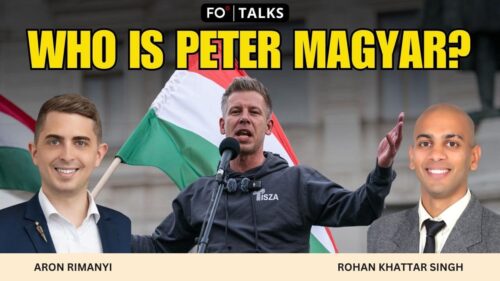
Editor-at-Large Kent Jenkins Jr. speaks with Aron Rimanyi, an associate at Training The Street, about former Hungarian Prime Minister Viktor Orbán’s defeat following 16 consecutive years in power. Hungarian Prime Minister Péter Magyar’s Respect and Freedom Party (or TISZA) party has secured the parliamentary supermajority once enjoyed by Orbán’s Fidesz party. Jenkins and Rimanyi examine the economic discontent and grassroots mobilization behind this political reversal, as well as the new government’s efforts to reform Hungary’s institutions, finances and foreign policy.
An illiberal system built around centralized power
Orbán entered office in 2010 with a two-thirds parliamentary majority. His government concentrated authority around the prime minister, reshaped institutions and renamed the Supreme Court the Curia. It also cultivated what Orbán called a national capitalist class by transferring assets and opportunities to Hungarian business owners.
Rimanyi argues that this economic project became associated with corruption because many beneficiaries had personal or family connections to Orbán. Government allies also acquired influence over much of Hungary’s media. For younger Hungarians, the resulting assumption that influence required government connections may have done even more damage than the immediate economic consequences.
This concentration of political, economic and media power led scholars to describe Hungary as an example of an authoritarian breakthrough: Elections continued, but removing the governing party appeared nearly impossible.
Economic weakness undermined Fidesz
Orbán’s system remained stable while living standards improved. His government used subsidies, tax rebates and other benefits to maintain support, but Hungary eventually fell into a middle-income trap marked by weak productivity and insufficient investment in higher-value industries. In 2022–2023, Hungary recorded the European Union’s highest inflation rate.
As wages failed to keep pace with prices, perceptions of corruption grew harder to overlook. Rimanyi summarizes the delayed consequences of Orbán’s economic model simply: “The bill ultimately comes due.”
Magyar translated these structural problems into everyday language about food prices, wages and Hungary’s declining position relative to neighboring countries. Meanwhile, Fidesz concentrated its campaign on warnings about Ukraine, an issue Rimanyi says did not reflect voters’ principal concerns.
Magyar remobilized Hungarian voters
Before establishing a developed party organization, Magyar traveled throughout Hungary and held as many as five rallies a day. He visited small villages that national politicians had rarely reached, addressed local concerns and assembled a grassroots volunteer network.
This campaign helped TISZA win 55% of the popular vote. Under electoral rules created by Fidesz, that result produced a two-thirds parliamentary majority. The outcome demonstrated that even a population regarded as politically disengaged could mobilize rapidly around new leadership.
Magyar has continued using social media and direct public engagement to sustain that participation. His combative communication style can deepen divisions, but his emphasis on practical matters such as living costs, energy use and water shortages has also appealed beyond TISZA’s electoral base.
TISZA begins rebuilding the state
The new government has appointed ministers with international corporate experience and begun tightening public finances. Hungary recently reported monthly fiscal surpluses, although Rimanyi notes that the figures require further examination. The government has also secured the release of much of the €17 billion in EU funding frozen over rule-of-law concerns and inadequate spending plans.
A new Bureau for Reclaiming Public Money will investigate assets privatized under Orbán. Fidesz describes the effort as a politically motivated witch hunt, while TISZA presents it as a lawful recovery process. Rimanyi expects political motivations and legitimate judicial review to coexist.
Parliament has also removed Orbán-appointed President Tamás Sulyok through a constitutional amendment and elected retired judge András Baka as a transitional president. Orbán’s government had pushed Baka out as Supreme Court president in 2011. His return carries symbolic weight as TISZA prepares a new constitution, although the government faces the difficult task of building consensus without marginalizing Fidesz voters.
Hungary changes course
Magyar has moved Hungary closer to the EU consensus on Ukraine while stopping short of a complete foreign policy reversal. Hungary will still not send weapons to Ukraine, but it has stopped blocking a €90 billion loan package, supported the opening of EU accession negotiations and identified Russia as the aggressor.
Hungary nevertheless remains dependent on Russian hydrocarbons and Russian-supported nuclear infrastructure. Rimanyi therefore expects continued practical cooperation alongside gradual energy diversification.
For other countries, Hungary demonstrates both the limits of patronage-based government and the instability of apparently entrenched political cultures. As Rimanyi concludes, “Political culture is easier to change than a lot of people think.” Economic deterioration can weaken ideological loyalty, while credible leadership and sustained local engagement can rapidly return disengaged citizens to political life.
[Lee Thompson-Kolar edited this piece.]
The views expressed in this article/video are the author’s own and do not necessarily reflect Fair Observer’s editorial policy.








































Comment