





Temper your sharpness, disentangle your ideas, moderate your brilliancy, live in harmony with your age. This is being in conformity with the Tao. Such a man is impervious alike to favour and disgrace, to benefits and injuries, to honour and contempt.
— Lao Zi, fifth century BCE.
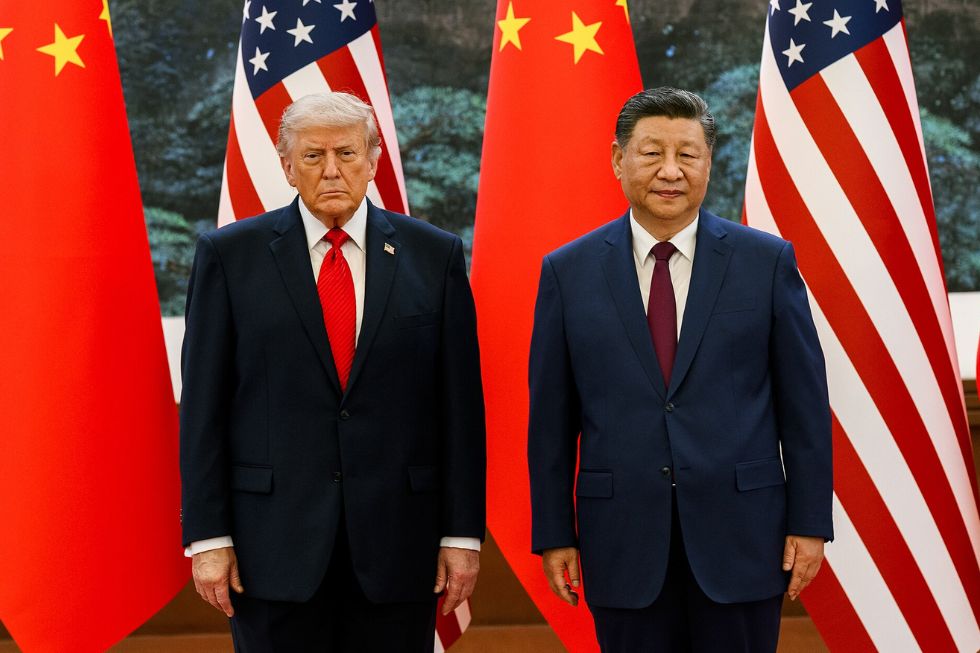
China received US President Donald Trump and his entourage in Beijing last week under intense global scrutiny. The détente benefited both sides, and the watching world took some solace that, in volatile times, these two presidents met in person. Expecting little, few were disappointed at the outcome of Trump’s three days in China. The fact that they passed without major mishap — and that it was the first US-China engagement at which they met as great-power equals — was significant.
Symbolism and stagecraft in Beijing
Chinese President Xi Jinping was a gracious host, showing moments of uncommon spontaneity in a political culture where, while Chinese leaders are usually hospitable — even towards adversaries — they usually work within tight, well-prepared formulas. Meanwhile, Trump was unusually contained behind his characteristic grin.
It is important that an American president met his counterpart on Chinese soil for the first time in nine years. Any time great powers meet, there is potential for deeper understanding and a chance that each may temper the other’s actions in projecting its power, at least at the margins. Yet beneath the carefully choreographed symbolism, the visit also exposed the extent to which Washington arrived unprepared for a genuinely strategic engagement with Beijing.
Washington’s poor preparation for the détente was emphasized by what appeared to be a hurried meeting between Chinese Vice Premier He Lifeng and US Secretary of the Treasury Scott Bessent in Seoul on the eve of Trump’s arrival. No China specialists or even experienced diplomats accompanied Trump. His entourage was comprised of the usual former conservative TV anchors and real estate magnates. Trump is dismissive of the US foreign service to the extent that 115 of Washington’s 182 embassies still lack ambassadors, and he has removed many of Washington’s experienced sinologists.
Businessman Elon Musk, Apple’s Tim Cook, and NVIDIA founder and CEO Jensen Huang accompanied Trump and may have shared their experiences and insights on China, but that was not evident. Trump was characteristically crass. For example, he made no attempt to recall, if he ever knew it, the name of Taiwanese president Lai Ching-te, the political ghost at the Beijing banquet.
Trade promises and strategic distrust
If the political atmospherics appeared cordial, the substance of the discussions revealed a far narrower and more transactional agenda. Trump said China agreed to purchase 200 Boeing jets — a claim recently confirmed by China. His delegation mentioned a breakthrough in China’s commitment to buy more US farm products, although no agreements were signed, nor were there any memoranda to support a Chinese commitment to buy more US oil or for the US to lift sanctions on Chinese companies buying Iranian oil.
Trump’s team indicated that they had extended the trade truce, and both sides announced that Washington would establish jointly staffed boards of trade and investment to manage the US–China economic relationship and avoid conflict. But the absence of formal agreements underscored the deeper reality that neither side fundamentally trusts the other’s long-term intentions.
As Iran has learned, a US truce is one in which the US continues to wage war through blockade. Washington’s determination to block China’s rise, supported by both Republicans and Democrats, has been a fulcrum of US foreign policy since President George W. Bush, making meaningful collaboration on future boards of trade and investment highly unlikely. More tariffs will be applied and embargoes mandated.
Trump referred to exchanges in which China agreed to restrict help for Iran’s nuclear development, but these were missing from Chinese summaries of the discussions. However, China does not want Iran to develop a nuclear weapon.
Diplomacy, face and mutual illusions
That lack of trust, however, did not prevent both sides from performing the rituals of diplomatic warmth with considerable skill. In a strange alchemy of toxicity and attraction, the US–China détente worked superficially. Trump craves the center of the stage and constant flattery. In Chinese traditions of hospitality, the guest is flattered and contention avoided, for at all times, Chinese hosts confer face on their guests as they would expect face to be conferred on them. In a Chinese diplomatic context, face is a governing principle in relationships between states, in which each recognizes the other’s status and dignity.
Trump soaked up the flattery and apparent deference, seemingly oblivious to the fact that it was neither acquiescence nor heartfelt respect, and that the trust and empathy he shares with Xi exist only in his imagination. Xi does not trust the man who has waged a trade war against his country for a year, fronting an administration which has fought to contain China for 33 years.
Taiwan and the Thucydides Trap
Beneath the ceremonial politeness and carefully managed displays of respect, the central geopolitical disputes between the two powers remained firmly unresolved. Xi warned the US against supporting Taiwan with a directness uncharacteristic of a state banquet speech. He veiled it thinly behind an allusion to the Thucydides Trap — which assumes that, in China’s case, the rising power is not so much supplanting as it is diminishing the primacy of the incumbent hegemon. Xi has previously rejected the inevitability of the US and China falling into the trap Thucydides described, but was subtly suggesting in his speech that the US was the declining power in the relationship.
The ambiguities and mixed signals that characterized the broader visit were equally evident regarding Taiwan and other strategic questions. Neither Trump nor Xi may follow through on commitments made by their teams. Whatever was agreed on soybeans, aircraft purchases or rare earths may be bedeviled in the detailed execution and prove largely performative. With some directness, but mostly innuendo, both sides signalled their geopolitical concerns. Trump’s discouragement of Taiwan’s declaring independence was a concession to his hosts, although he equivocated on the pending $14 billion arms sale to the island.
Iran, maritime chokepoints and China’s long game
The same uncertainty extended beyond East Asia, particularly regarding the Middle East and the future of American power in the region. Trump probably came hoping for practical help with his war with Iran, but appeared to get little. He is likely to try to exit the Iranian entanglement with a spasm of missile strikes, leaving Iran with significantly degraded military and civilian infrastructure, but greater political and economic agency in the region than before the war. The trip to China may have reinforced his intention to quit.
As America departs from the Persian Gulf, China will not fill the political space it leaves. It will benefit from reconstruction projects and resources priced preferentially in the future, but Beijing is likely to let the region find its own power equilibrium.
That approach reflects China’s broader preference for strategic influence without assuming the burdens of direct regional dominance. Xi will continue to work to encourage Iran to avoid escalating regional tensions and to help broker peace and economic stability. China rues that Iran will likely continue to levy tolls for passage through the Strait of Hormuz, resenting the US for having created the conditions for this and, even more so, for the precedent it has set, with other nations now considering similar measures.
Jakarta has indicated it may charge ships for the right of passage through the Straits of Malacca. While not as directly affected by the partial closure of the Strait of Hormuz as most nations — 30 Chinese tankers passed through while Trump was in Beijing — China dislikes the fact that its trading partners will face greater economic costs and deplores the US’s dismantling of the over 200-year-old principle of freedom of navigation. You may ask tolls for the use of the canals you build, but not for passages forged by geography.
Ultimately, the visit highlighted not a resolution of tensions between Washington and Beijing, but the emergence of a more cautious and transactional coexistence between rival powers. Xi will probably travel to New York to address the UN General Assembly in September. If so, he may add a state visit to Washington, signalling the US had slipped in geopolitical importance. He may also announce a state visit to Washington, to which he would add an address to the UN General Assembly, conferring face on Trump. Despite the economic tariffs and embargoes, Trump has been circumspect toward China, militarily and geopolitically. It would be in China’s interest to nurture this stance while Trump is in the White House.
[Mahon China first published this piece as a memorandum]
[Kaitlyn Diana edited this piece.]
The views expressed in this article are the author’s own and do not necessarily reflect Fair Observer’s editorial policy.
FO° Live: A New Look at Post Asia Pivot US Foreign Policy
In this episode of FO° Live, Singh, Fontaine and Blackwill discuss how US policy squandered the 2010s. The guests say...
FO° Exclusive: US Budget and US–China Tariff Deal Unleash New Economic Uncertainty
The US House of Representatives has passed a divisive budget that increases spending, deepens deficits and provokes market anxiety. Simultaneously,...
The View From China on Trump 2.0
A second Donald Trump presidency will escalate US–China tensions, replacing Joe Biden's steady diplomacy with an aggressive, zero-sum approach. Trump’s...
Support Fair Observer
We rely on your support for our independence, diversity and quality.
For more than 10 years, Fair Observer has been free, fair and independent. No billionaire owns us, no advertisers control us. We are a reader-supported nonprofit. Unlike many other publications, we keep our content free for readers regardless of where they live or whether they can afford to pay. We have no paywalls and no ads.
In the post-truth era of fake news, echo chambers and filter bubbles, we publish a plurality of perspectives from around the world. Anyone can publish with us, but everyone goes through a rigorous editorial process. So, you get fact-checked, well-reasoned content instead of noise.
We publish 3,000+ voices from 90+ countries. We also conduct education and training programs
on subjects ranging from digital media and journalism to writing and critical thinking. This
doesn’t come cheap. Servers, editors, trainers and web developers cost
money.
Please consider supporting us on a regular basis as a recurring donor or a
sustaining member.
Will you support FO’s journalism?
We rely on your support for our independence, diversity and quality.





Comment