


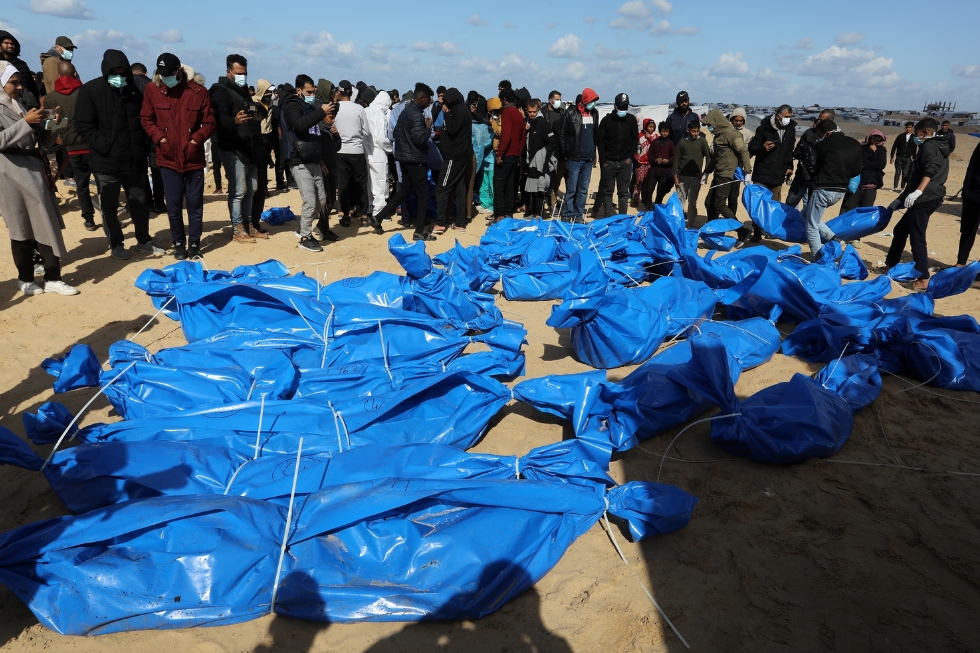



Western media is engaging in a subtle syntactical trick to discredit Palestinian loss of life in Gaza. This trick came into effect from the beginning of the Israeli invasion of Gaza after the Hamas-led attacks on October 7, 2023. Western media uses certain phrases repeatedly to shape the narrative, which mitigates the genocidal military and policy actions of the Israeli state. In a nutshell, Western media discredits the loss of life of innocent Palestinians and insidiously produces an element of doubt on the veracity of death figures in Gaza.
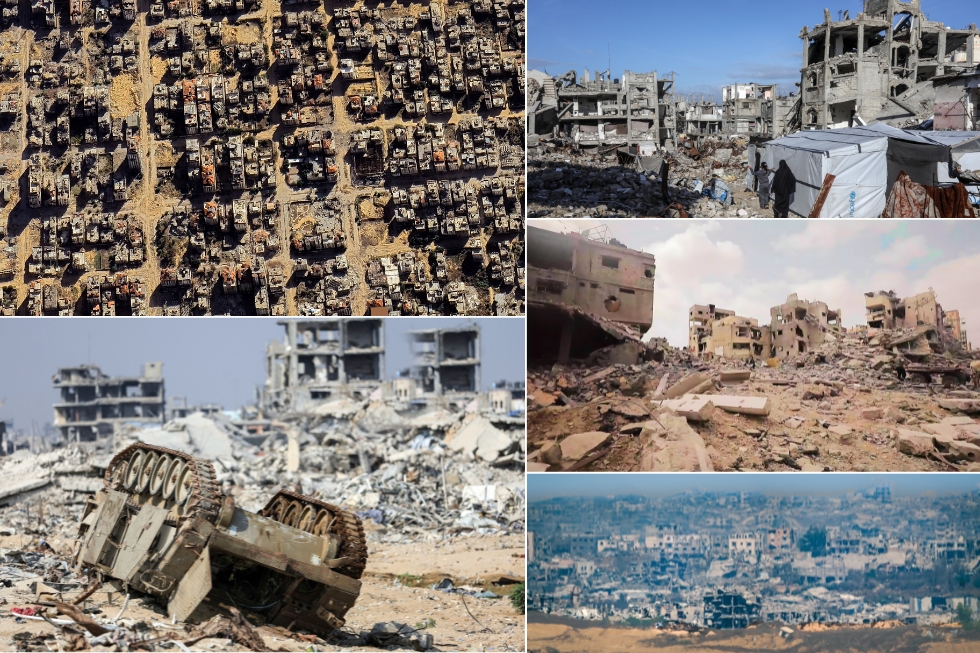
Note that Israeli crimes in Gaza have a fanatical and rapturous approval of a vast majority of its citizens. After the attacks in 2023, Israel has acted with disproportionate violence. According to the UN, “as of October 11, 2025, approximately 81% of all structures in the Gaza Strip are damaged.” Note that the figure for Leipzig, the scene of some of the worst bombing in World War II, was 40–60%. Gaza compares unfavorably even to Dresden. The Allies bombed the city four times between February 13 and 15, 1945. Relentless firebombing killed over 20,000 people and destroyed Dresden’s historic city center.
Sir Arthur Travers Harris was the commander-in-chief of RAF Bomber Command who developed the saturation technique of mass bombing that destroyed German cities like Dresden and Leipzig. This meant sending lots of bombers on “a giant raid on a single city, with the object of completely demolishing its civilian quarters.” To this day, this British-Rhodesian is referred to as “Butcher” or “Butch” Harris. Note that the Israelis have proved more butcherous than Harris and, in the Western media, have gotten away with mass murder.
The tools of imperial misinformation
So, how do the purveyors of liberty, equality and human rights wash away the sins of Israel in Gaza? They present Israeli numbers as fact while casting doubt on numbers of dead or injured people in Gaza. Invariably, Western media says that these numbers are “according to the Gaza Health Ministry” and some add that this is “a Hamas-run body.” By citing the source of these figures, which Western media hypocritically does not do in the case of Israel, reporters, commentators and analysts create underlying doubt about deaths and injuries. Implicit is the allusion that a Hamas-controlled body might be lying. Of course, this might be a subconscious practice but has the same effect as a concerted conscious strategy of mitigating Israeli war crimes and downplaying Palestinian suffering.
Even when the Gaza Health Ministry gives personal information of victims, sentence construction in Western media indirectly disowns the figures, subtly discrediting figures of deaths and injuries. Here are a few examples of articles in top Western publications to prove the point:
Gazans Release Names of 6,747 People They Say Were Killed in Israeli Strikes (The New York Times, October 26, 2023)
The detailed list from the Hamas-controlled health ministry — including ages, genders and ID numbers — followed President Biden’s comment that he had “no confidence” in its figures.
More than 10,000 killed in Gaza, Hamas-controlled health ministry says, as condemnation of Israel’s campaign grows (CNN, November 6, 2023)
More than 10,000 people have been killed in Gaza since Israel launched its military offensive nearly a month ago, the Hamas-controlled health ministry in the Palestinian enclave said Monday.
Israel declared war on Hamas after the Islamist militant group launched a brutal attack on October 7, killing 1,400 in Israel and kidnapping more than 240. Israel retaliated by launching an air and ground offensive on Gaza, vowing to eliminate the militant group.
Palestinians in Gaza search for missing family members (Deutsche Welle (DW), June 17, 2024)
Even the bodies that are retrieved and brought to Gaza’s morgues are not always easily identified. As of June 10, 9,839 bodies are lying in morgues unidentified, according to Gaza’s Health Ministry, while 27,325 others have been identified.
More than 60,000 killed in Gaza war, local health officials say (The Washington Post, July 29, 2025)
The toll reported by the Gaza Health Ministry, which is run by Hamas and whose numbers are widely accepted by the United Nations and other international institutions, includes combatants as well as civilians.
In Gaza war, tens of thousands killed and widespread destruction (Reuters, October 7 2025)
Since October 7, 2023, more than 67,000 Palestinians have been killed in Gaza, with nearly a third of the dead under the age of 18, according to Gaza health authorities.
The Health Ministry in Gaza does not distinguish between civilians and fighters in its tally. Israel has previously said at least 20,000 of the dead were fighters.
Gaza death toll tops 69,000 as Israel and militants again exchange remains (AP News, November 9, 2025
More than 69,000 Palestinians have been killed in the Israel-Hamas war so far, Gaza health officials said Saturday.
It began with the Oct. 7, 2023, Hamas-led attack on southern Israel that killed about 1,200 people and saw 251 taken hostage.
Gaza death toll 40 percent higher than recorded, Lancet study estimates (France 24, November 29, 2025)
The health ministry in Hamas-run Gaza on Saturday said more than 70,000 people have been killed since the war between Israel and Hamas erupted more than two years ago.
“There’s no ceasefire”: Gaza paramedic and father of two killed as civilian death toll since October passes 650 (The Guardian, March 23, 2026)
Since the ceasefire was announced on 10 October last year, Israel has killed 677 and injured a further 1,800 Palestinians, according to Gaza’s health ministry.
Over 38,000 women and girls killed in Gaza war, UN Women report estimates (Euronews, April 24, 2026)
More than 38,000 women and girls were killed in Gaza between October 2023 and December 2025, UN Women estimated in its latest report.
The figure is based on data reported during this period by the Gaza Health Ministry, which stated 71,200 people were killed since the start of Israel’s military offensive in Gaza, launched in response to the Hamas-led attack on southern Israel on 7 October 2023.
Fears of renewed Gaza war as Hamas disarmament talks stall (BBC, May 7, 2026)
At least 846 people – including many women and children – have been killed in Gaza since the ceasefire began, according to the Hamas-run health ministry.
The examples above reveal Western bias clearly. Israeli figures are presented as fact. Palestinian figures come from a Hamas-run entity. Readers are well aware that Hamas is a terrorist organization responsible for the horrific attacks of October 7, 2023, and, therefore, cannot be trusted. This is not to say that the Gaza Health Ministry does not engage in fudging and finagling. The key point here is that so does Israel, but this Western power in the Middle East gets a pass. There are no saints in this conflict, and remember even saints lie.
So, what are the real numbers?
Given the utterly broken and rudimentary structure of governance in Gaza and constant strikes by the Israeli Defense Forces (IDF), the figures of the Gaza Health Ministry might be understated. Researchers with great expertise who have studied the conflict are a much better guide to estimate the numbers.
“Accounting for uncertainty in conflict mortality estimation: an application to the Gaza War in 2023-2024” is an important paper. Published in Population Health Metrics, the paper was a result of a study carried out with Open Access funding enabled and organized by Projekt DEAL. Ana C. Gómez-Ugarte, Irena Chen, Enrique Acosta, Ugofilippo Basellini and Diego Alburez-Gutierrez are the authors. This team of researchers from the Max Planck Institute for Demographic Research, Germany and the Centre for Demographic Studies, Spain, has used an innovative statistical model that accounts for the large uncertainties caused by limited data availability. This is what the paper says:
Official death tolls have been contested due to damage to infrastructure and hospital buildings, limited resources, and challenges in verifying the true scale of fatalities. This has hindered both the accurate reporting of death counts and the identification of the deceased. Some argue that official figures are underreported, as they do not account for indirect deaths or people reported missing under the rubble. Others have suggested that data from the Gaza Ministry of Health may be inflated for political reasons. However, recent studies have found no evidence of systematic over-reporting in GMoH data.
Our conflict-related death toll estimate of 78,318 (70,614-87,504) by the end of 2024 closely aligns with the independently conducted Gaza Mortality Survey’s estimate of 75,200 (63,600-86,800) violent deaths between October 7, 2023, and January 5, 2025, providing robust mutual validation.
The paper also reveals that life expectancy in 2024 sharply decreased to less than half of the level that would be expected without the war. Furthermore, “Gaza’s estimated age–sex pattern of conflict deaths since October 7, 2023 mirrors UN-IGME profiles from prior genocides.”
Another paper in The Lancet Global Health is well worth a read. “Violent and non-violent death tolls for the Gaza conflict: new primary evidence from a population-representative field survey” was funded by the European Research Council, ANTICIPATE program under Horizon Europe, and the Center for Research on the Epidemiology of Disaster at Université Catholique de Louvain. Michael Spagat, Jon Pedersen, Khalil Shikaki, Michael Robbins, Eran Bendavid, Håvard Hegre and Debarati Guha-Sapir, an international team of researchers, were the authors, and this is what they had to say:
We estimated 75 200 violent deaths (95% CI 63 600–86 800) between Oct 7, 2023, and Jan 5, 2025, representing approximately 3·4% of the Gaza Strip’s pre-conflict population. Women, children (ie, younger than 18 years), and older people (ie, older than 64 years) comprised 56·2% (95% CI 50·4–61·9) of violent deaths, totalling 42 200 deaths (95% CI 33 100–51 300). We also estimated 16,300 non-violent deaths (12 300–20 200), of which 8,540 (4,540–12,500) represent excess deaths above pre-conflict projections. The MoH figure for this period (49,090 violent deaths) was 34·7% below our central estimate.
“Counting the dead in Gaza: difficult but essential” is a paper published in The Lancet that comes to a similar conclusion. Authors Rasha Khatib, Martin McKee and Salim Yusuf say:
Armed conflicts have indirect health implications beyond the direct harm from violence. Even if the conflict ends immediately, there will continue to be many indirect deaths in the coming months and years from causes such as reproductive, communicable, and non-communicable diseases. The total death toll is expected to be large given the intensity of this conflict; destroyed health-care infrastructure; severe shortages of food, water, and shelter; the population’s inability to flee to safe places; and the loss of funding to UNRWA, one of the very few humanitarian organisations still active in the Gaza Strip.
In recent conflicts, such indirect deaths range from three to 15 times the number of direct deaths. Applying a conservative estimate of four indirect deaths per one direct death to the 37 396 deaths reported, it is not implausible to estimate that up to 186 000 or even more deaths could be attributable to the current conflict in Gaza. Using the 2022 Gaza Strip population estimate of 2 375 259, this would translate to 7·9% of the total population in the Gaza Strip.
Despite such studies by accomplished researchers, the true extent of loss of life cannot be known in the midst of military aggression anyway and may never be known, even after peace returns.
The seductiveness of the Western narrative
As is clear above, the figures of the dead and injured in Gaza are credible. International researchers have published in peer-reviewed journals and corroborated these figures. Yet even respectable scholars in the West are trapped by the dominant media narrative. Israeli-American historian Omer Bartov is honest and courageous. Yet Bartov falls prey to the same bias as Western media. Note what he writes in his 2026 book, Israel: What Went Wrong?
Within four weeks, responding to the October 7, 2023, massacre by Hamas—itself a war crime and crime against humanity—Israel’s air and ground assault on Gaza had killed more than 10,500 Palestinians, according to the Gaza Health Ministry, a number that included thousands of children. That was nine times as many people as the 1,164 victims of Hamas (as we now know, rather than the 1,400 originally claimed)—a death toll that included 362 members of the security forces, police, and first responders as well as 91 foreign nationals and local Bedouin.
Not many have deconstructed Western media’s smart linguistic manipulation, which often infects even those sympathetic to Palestinians and hostile to Israel. Many are aware of this bias, though. Fair Observer’s Chief Strategy Officer Peter Isackson has pointed out the hypocrisy of Western media for over a decade. So has Didier Fassin, a French anthropologist and sociologist. In his hard-hitting and daring 2024 book-length essay, Moral Abdication: How the World Failed to Stop the Destruction of Gaza, Fassin flags this double standard in passing, with focus on the victims, not readership:
Every time statistics for Palestinian deaths are given by journalists, they are accompanied by the formula “according to the Gaza Health Ministry” or even “according to the Hamas-run Health Ministry,” whereas no equivalent phrase qualifies the data presented by the Israeli authorities . . . This querying of the number of dead is a double punishment for the victims of war. Their life has been taken; their death is denied.
Fassin is not free from prejudice. In Chapter 7, he labels the Iranian regime as one of mullahs. There is an argument to be made that in a region dominated by monarchies and dictatorships, Iran is far more democratic than others. Mehdi Alavi has highlighted the lies the US and the media have told about Iran, which hold wide sway.
Passing propaganda as news has long been the way of the West. Three books examine this phenomenon in great detail. In 1986, Deborah Lipstadt published Beyond Belief, which was followed by Edward Herman and Noam Chomsky publishing Manufacturing Consent in 1988 and Michael Parenti’s Dirty Truths in 1996.
To revert to Fassin, he shines the light on persistent Western political, diplomatic, and journalistic justifications of vastly disproportionate, mindlessly indiscriminate and ruthlessly relentless Israeli violence to obliterate and depopulate Gaza.
An examination . . . of what led to a situation where, for political leaders and intellectual personalities in the principal Western countries – with rare exceptions such as Spain – the statistical reality that the lives of Palestinian civilians are worth several hundred times less than the lives of Israeli civilians, and the claim that the death of the former is less worthy of being honoured than that of the latter, have become acceptable; . . . where, without independent confirmation, most of the mainstream Western media quasi-automatically reproduce the version of events relayed by the camp of the occupiers, while incessantly casting doubt on that recounted by the occupied.
We were witnessing a major event in contemporary history whose moral consequences, political fallout and intellectual implications would be considerable. But the language to describe it seemed somehow dead. Or, rather, an attempt was underway to induce its death by imposing a vocabulary and grammar of the facts, by prescribing what must be said and condemning what must not be said
Such an inversion of the values proclaimed by Western societies, such a political dereliction, such an intellectual collapse demand examination.
Moral degeneration and self-deception
A question many ask is how the Jewish people, whose history and memory are deeply rooted in the Holocaust, proudly, passionately and self-righteously support genocide. Albert Bandura, a Canadian-American psychologist, posits an interesting theory. He highlights “the paradox of violating one’s moral principles without loss of self-respect while doing so” by “selective disengagement of moral self-sanctions from harmful conduct.” He notes:
This selectivity of moral engagement was strikingly illustrated by Amon Goeth, the notorious Nazi commandant of a concentration camp. While dictating a letter replete with empathy and compassion for his ailing father, he saw a prisoner on the grounds who he thought was not working hard enough. He whipped out his revolver and callously shot the prisoner. The commandant was both overcome with compassion and savagely cruel at the same time.
Bandura also notes the several processes through which people avoid self-sanctions. In his words:
Self-sanctions can be disengaged by reconstruing detrimental conduct through moral justification, euphemistic labeling, and advantageous contrast with other inhumanities; by obscuring personal agency in detrimental activities through diffusion and displacement of responsibility; by disregarding or misrepresenting the harmful consequences of inhumane conduct; and by blaming and dehumanizing the victims. These mechanisms of moral disengagement operate not only in the preparation of inhumanities under extraordinary circumstances, but in everyday situations where people routinely perform activities that bring personal benefits at injurious costs to others.
Besides euphemistic or derogatory labels, the unfeeling acronyms in military argot also dehumanize the victims. Both dehumanizing and selectively evoking, suppressing, or silencing personal morality help many Jews today to support what Israel is doing to Palestinians.
Hannah Arendt’s theory about social forces shaping individuals is also instructive today. In 1961, this US philosopher and political theorist attended Adolf Eichmann’s trial in Jerusalem. Two years later, she published Eichmann in Jerusalem: A Report on the Banality of Evil. This was a highly provocative book at the time. Vehemently denounced by Jewish organizations, scholars and sympathizers, this classic explained how the unfeeling actions and moral numbness of many Nazi officials like Eichmann were not primarily driven by hatred for Jews but were a result of bureaucratization and routinization of individual actions. This caused a diffusion of individual responsibility in a hierarchical command structure of impersonal modern organizations.
In Arendt’s words, “The trouble with Eichmann was precisely that so many were like him, and that the many were neither perverted nor sadistic, that they were, and still are, terribly and terrifyingly normal.” She suggested that it is the system and situation that make “this new type of criminal, who . . . commits his crimes under circumstances that make it well-nigh impossible for him to know or to feel that he is doing wrong.”
Stanley Milgram, then a young US psychologist, agreed with Arendt. He published Obedience to Authority: An Experimental View in 1974, which highlighted the pathological role of authority in making ordinary persons inflict unspeakable cruelties upon innocent strangers. As members of an organization, individuals are socialized and trained to obediently follow orders given by superiors with authority to command them and their actions. Milgram’s conclusions were drawn from experimental studies, designed and conducted by him around the time when Arendt was reporting from Jerusalem. These have since been reproduced many times over in cross-cultural settings, validating and firmly establishing Milgram’s theory.
Milgram set out to examine why ordinary people turn cruel. In his words, “Of all moral principles, the one that comes closest to being universally accepted is this: one should not inflict suffering on a helpless person who is neither harmful nor threatening to oneself. This principle is the counterforce we shall set in opposition to obedience.” The aim of Milgram’s “investigation was to find when and how people would defy authority in the face of a clear moral imperative.” In a nutshell, Milgram presented his findings as below.
We have now seen several hundred participants in the obedience experiment, and we have witnessed a level of obedience to orders that is disturbing. With numbing regularity good people were seen to knuckle under to the demands of authority and perform actions that were callous and severe. Men who are in everyday life responsible and decent were seduced by the trappings of authority, by the control of their perceptions, and by the uncritical acceptance of the experimenter’s definition of the situation into performing harsh acts.
US historian Christopher Browning’s 1992 classic, Ordinary Men: Reserve Police Battalion 101 and the Final Solution in Poland, proves Milgram’s point. Ordinary middle-aged men from Hamburg formed this battalion. They went on to shoot a minimum of 38,000 Jewish men, women, and children and deported a minimum of 45,000 of them to Treblinka extermination camp from July 1942 to November 1943. In his chilling conclusion, Browning summarises the insurmountable power of social forces over individuals.
The collective behavior of Reserve Police Battalion 101 has deeply disturbing implications. There are many societies afflicted by traditions of racism and caught in the siege mentality of war or threat of war. Everywhere society conditions people to respect and defer to authority… Everywhere people seek career advancement. In every modern society, the complexity of life and the resulting bureaucratization and specialization attenuate the sense of personal responsibility of those implementing official policy. Within virtually every social collective, the peer group exerts tremendous pressures on behavior and sets moral norms. If the men of Reserve Police Battalion 101 could become killers under such circumstances, what group of men cannot?
The hypocrisy and double standards of Western journalists can also be explained by the economic pressures they face to pander to their owners and readers. In the age of the internet, the media needs eyeballs to sell advertisements or subscribers willing to pay. Pandering to prejudice becomes essential in such a situation. This is an old story in a capitalist-controlled media. John Swinton’s 1880 speech in New York still rings true:
There is no such a thing in America as an independent press, unless it is out in country towns. You are all slaves. You know it, and I know it. There is not one of you who dares to express an honest opinion. If you expressed it, you would know beforehand that it would never appear in print. I am paid $150 for keeping honest opinions out of the paper I am connected with. Others of you are paid similar salaries for doing similar things. If I should allow honest opinions to be printed in one issue of my paper, I would be like Othello before twenty-four hours: my occupation would be gone.
The man who would be so foolish as to write honest opinions would be out on the street hunting for another job. The business of a New York journalist is to distort the truth, to lie outright, to pervert, to vilify, to fawn at the feet of Mammon, and to sell his country and his race for his daily bread, or for what is about the same—his salary. You know this, and I know it; and what foolery to be toasting an “Independent Press”! We are the tools and vassals of rich men behind the scenes. We are jumping-jacks. They pull the string and we dance. Our time, our talents, our lives, our possibilities, are all the property of other men. We are intellectual prostitutes.
Why the West dehumanizes Palestinians
To understand why the West dehumanizes Palestinians, it is important to go back to Fassin. He points out that the West deliberately adopted a myopic, ahistorical view of the Hamas-led attack on October 7, 2023. Western leaders and thought leaders viewed this attack as a casus belli that set off righteous Israeli violence as an act of defense.
This ignores Israel’s long history of oppression and uprooting of Palestinians from their own land. Many intellectuals argue that the Hamas attack itself was a reaction to sustained Israeli oppression. It was an act of resistance and reassertion by a dispossessed, subjugated, and incarcerated mass of people. Fassin suggests multiple reasons: historical (Holocaust guilt), geopolitical (oil security and Iran’s containment), economic (investments and markets), military (war economy, arms industry and military aid) and electoral (Jewish lobby with deep pockets) that influenced the West. Western leaders, intellectuals and journalists proffered unconditional and uncritical justifications for Israel’s actions. They also offered total support for Israel’s total obliteration of Gaza, at the expense of losing their own credibility in the world and democratic values at home. He adds:
Alongside these various logics – historical, geopolitical, economic, military and electoral – whose configurations vary with national contexts, one element is common to Western countries. It is ideological. It manifests itself in hostility towards Muslims and racism against Arab populations. Both form part of a colonial heritage, especially for the French and British empires, and even of a pre-colonial heritage, for what Maxime Rodinson dubbed the ‘Christian West’. But this rejection assumed a different meaning after 11 September 2001. Islam became associated with terrorism, Muslims with a danger to the security of Western countries, and Arab populations with a threat to European identity.
Hamid Dabashi of Columbia University offers another context-specific iconoclastic theory of dehumanization, taking a long view of history. He is an Iranian-American philosopher who published After Savagery: Gaza, Genocide, and the Illusion of Western Civilization in 2025. Dabashi contends that the European colonial history of violently conquering, crushing, eradicating, exterminating, dispossessing, displacing, subjugating, dominating, degrading and humiliating the people of color the world over resulted largely from their belief in Caucasian cultural, religious and racial superiority. However, their psyche of racial superiority has deeper roots in the underlying intellectual traditions of Europe, which undergird the European conception of the world and provide Caucasians the lens through which they view the world even today. Dabashi writes:
Since its very inception, Israel is the summation of the West. . . . It is not just a settler colony that the West supports, but it is “the West” in its very quintessence. It is the highest manifestation of the calamitous ideology of conquest that calls itself “the West,” exposing its murderous roots and occasioning the groundwork for the very metaphysics of barbarism that has sold itself to the world as “Western civilization.” Today, Gaza and the rest of Palestine is where the false premise of Western moral authority is buried.
The political and military might of the entire “Western” world that thought and sold itself as the crowning achievement of our humanity did nothing and, in fact, aided and abetted the mass murder of tens of thousands of innocent Palestinians. The proudest achievement of “Western civilization,” which is “Western philosophy,” as it calls itself, the history it has colonized for itself, from Plato and Aristotle to Hegel and Heidegger, were all summed up in the miserable statement by the senior-most European philosopher Jürgen Habermas.
Palestine is neither the first nor the last homeland that the West has conquered and abused, but the history of the world has been summarized in Palestine. What Israel is doing in Palestine today is what the world has endured from Western colonialism and imperialism for centuries.
And, in this sense, Dabashi claims that Palestine is the world and the world is Palestine.
The views expressed in this article are the author’s own and do not necessarily reflect Fair Observer’s editorial policy.
FO Talks: Making Sense of What Life Is Like in Palestine Today
In this episode of FO Talks, Lucy Golish and Ahmed Ihab Abuward discuss Gaza’s humanitarian conditions. Abuward describes severe essential...
The Executioner’s Noose, Not the Scales of Justice: Crime and Punishment in Israel and Palestine
Israeli soldiers and settlers commit daily acts of violence in the occupied Palestinian territory with near-total impunity. By contrast, Palestinians...

The World’s Silent Complicity in Israel’s War on Gaza
Israel has carried out a relentless and zealous military onslaught in Gaza that shows orchestrated mass inhumanity on a gargantuan...

Support Fair Observer
We rely on your support for our independence, diversity and quality.
For more than 10 years, Fair Observer has been free, fair and independent. No billionaire owns us, no advertisers control us. We are a reader-supported nonprofit. Unlike many other publications, we keep our content free for readers regardless of where they live or whether they can afford to pay. We have no paywalls and no ads.
In the post-truth era of fake news, echo chambers and filter bubbles, we publish a plurality of perspectives from around the world. Anyone can publish with us, but everyone goes through a rigorous editorial process. So, you get fact-checked, well-reasoned content instead of noise.
We publish 3,000+ voices from 90+ countries. We also conduct education and training programs
on subjects ranging from digital media and journalism to writing and critical thinking. This
doesn’t come cheap. Servers, editors, trainers and web developers cost
money.
Please consider supporting us on a regular basis as a recurring donor or a
sustaining member.
Will you support FO’s journalism?
We rely on your support for our independence, diversity and quality.





Comment