




When someone thinks their own life got worse because someone else’s got better, the ballot box stops choosing governments and starts handing out punishment. The best diagnosis of the average Brazilian came in a one-minute statement by Felipe Nunes, the founding partner of Quest, a Brazilian polling and research institute. He said that the country’s representative citizen is someone who believes his own life has not improved enough over the past 20 years and who sees Brazil as having improved mainly for the most disadvantaged. Then came the essential cherry on top: He believes those people did not deserve to improve their lives.
That perception — that someone else has improved without deserving to — is what gets me. Because it turns inequality into resentment and resentment into moral judgment.
Let me translate that into non-academic English: The average Brazilian is frustrated, resentful, selfish, insensitive and largely indifferent to other people. Did you notice that Sunday’s election was not really about politics at all, but about morality? When political decisions are no longer about how we live together but about breaking the basic civic pact, is dialogue still worth trying?
That last question is not rhetorical. I mean it. I am tired of banging my head against a brick wall.
Left or right? No, just spite
There is a civilizational difference between voting for someone because you believe that person will manage the state better and voting for someone because you believe certain people should never have reached their current position. In the second case, politics arrives already rotten, carrying an earlier idea of who deserves what, as though the world were unjust strictly in the immediate vicinity of one’s own navel.
From day zero of the Bolsonaro family’s political abomination, it was obvious that this was not simply a matter of left versus right. Or do you really think the great villains of history can be measured on that ideological ruler? Pol Pot, Joseph Stalin, Saddam Hussein — even Benito Mussolini and Adolf Hitler. Would you really take their judgment to the liberal and progressive columns?
Right and left remain useful categories for understanding economic, social and institutional positions. The problem begins when those categories become an alibi for any behavior committed in their name. Defending a smaller state, more market freedom, social conservatism or tougher criminal policies is one thing. Believing that democracy itself can be discarded whenever an election produces an inconvenient result is another.
Politics does not create the grotesque Brazilian contradictions we know so well: “the right-wing poor person”; the “Christian” who screams to Pontius Pilate that he prefers Barabbas; the criminal who has been politically sanctified; the female leader who opposes women’s rights. I could go on, but you get the point.
Curiously, these stop looking like contradictions once politics is organized around belonging. A person can lose money, rights and access to public services and still vote for someone who offers an identity he considers superior to his own material condition. Politics stops answering the question, “What will improve my life?” and starts answering, “Who are we?”
Returning to the argument: Politics do not create these aberrations. Corrupted morality and character do. And when I say morality, I am not talking about good manners, going to church or behaving politely in the supermarket line. I am talking about the set of values that determines who deserves protection, who deserves opportunity, who deserves punishment and, above all, who can be treated as less than human without causing discomfort.
My own moral code is convinced that once we have constituted a society capable of providing education, healthcare, public safety and housing for everyone, these things cease to be individual privileges and become collective obligations.
Love for God and contempt for the poor
I stopped using that argument some time ago; I gave up trying to have civilized conversations with the morally repulsive. I noticed that, judging by the expression on the other person’s face while listening to me, I was beginning to diagnose these scoundrels according to the ICD-10 codes F70 to F79 — codes that refer to degrees of intellectual disability.
I know someone who calls herself a believer. Actually, she calls herself a “crentona” — a Brazilian slang intensifier derived from crente, meaning an evangelical believer, roughly equivalent to saying “a hardcore believer.” I liked the word, so I am borrowing it. She probably uses the extra syllables to suggest that she is more Christian than the rest of us, whom she presumably judges according to our own ICD codes.
And since she is so proud of it, I used her for a small experiment to understand how far the relationship between religion and extremism could go. I am sorry to tell anyone who has never conducted such an experiment that there is no humanity left in that kind of person. Absolutely anything becomes acceptable when it can be used to justify extreme aporophobia — the rejection or contempt of poor people — and the most reduced version of the idea that if a politician might one day, however remotely, benefit them personally, they will vote for him, whoever he is.
Aporophobia is a relatively new word in Brazil’s political vocabulary, but it describes a very old feeling: contempt for poor people precisely because they appear to have no power, no property and no ability to return the favor.
In practice, this became painfully clear on Sunday, October 4. If it did not, explain to me how in 2018, Sérgio Olímpio Gomes, who was removed from the ROTA — the most heavily armed and lethal special unit of the São Paulo Military Police — amid a career marked by high-lethality operations and investigations involving 16 deaths, could win a seat in the Brazilian Senate over Marina Silva, one of the greatest and most consequential women in Brazilian history.
Does it really make sense to spend time explaining that if Jesus came back tomorrow, obtained a Brazilian voter registration card and walked into a polling station, He would probably not vote for Flávio Bolsonaro, a man whose résumé looks less like a career history than a police file — involving allegations of money laundering through chocolate stores, a R$134 million ($26.8 million) deal with banker Daniel Vorcaro to finance a film about his father, Jair Bolsonaro, and the defense of a police officer accused of killing a child?
The episode is even harder to digest because we are not talking about an abstraction called “public security.” We are talking about Ana Clara Gomes Machado, a five-year-old girl who took two deadly rifle rounds in Niterói, Rio de Janeiro, in 2021, and about Flávio Bolsonaro, who acted as lawyer for Bruno Delaroli, the military police officer accused in the case.
We have reached the point where one of the candidates in the runoff will either become president or serve hard time. Prison seems like too little for Flávio, a man accused of taking billions of reais intended for retirees’ food and medication.
Political tribalism overrides intelligence
While we are at it, challenge yourself to name someone from this political camp whom you genuinely admire intellectually. Whenever someone emerges who makes you think, “Hmm, I could probably have a ten-minute conversation with this guy without the unbearable embarrassment of realizing I have sat down next to a fascistoid with a cognitive deficit at a dinner table full of strangers,” that person is immediately elevated to the status of prophet.
Take Renan Santos, for example, a former candidate whom I am praising here for his ability to construct and articulate an argument, not for a worldview with which I almost completely disagree.
It is curious how intelligence works inside a political tribe. When someone manages to articulate an idea with even moderate competence, the mere ability to formulate a complete sentence can be mistaken for genius. The bar falls so low that anyone capable of connecting three arguments without tripping over them is treated as an enlightened thinker.
And here I need to correct my own provocation: I did not mean to make psychiatric diagnoses. The F70–F79 codes in the ICD-10 refer to intellectual disability, a clinical condition that manifests during development and has absolutely nothing to do with a person voting badly, defending a stupid idea or believing a political lie. Using those codes as an insult would be scientifically wrong and would turn disability into a slur.
I am talking about something else, something much more widespread and politically more dangerous: the inability to distinguish fact from conviction once conviction has become identity.
The same Quest director found a frightening piece of data in his research: A whole 42% of Brazilians failed to correctly answer even one of four factual questions concerning the economy, unemployment, public safety and health. Further, 70% overestimated how much they knew. This is not a question of diplomas. It is a kind of factual illiteracy that allows politics to fill the empty spaces with whatever narrative confirms what people have already decided to believe.
“It’s the economy, stupid”
Then come certain members of Brazil’s left-wing, New Age-ish, kumbaya wing — the people who tell us that we must “welcome” differences, pursue non-aggressive dialogue and try to win the runoff through love. Man, did you notice that we have just heard the loudest scream of hatred from a Brazilian ballot box since the country returned to democracy? Do you also want me to put a flower down the barrel of a militiaman’s rifle?
There is a problem with that unfortunate word — “welcome” — once it becomes a political method. To welcome something presupposes that there is something there to be welcomed, and some ideas first need to be confronted, dismantled and exposed. A democratic society can live with political disagreements; it does not need to turn every moral disagreement into a group therapy session. It is not enough merely to avoid being racist; one has to be anti-racist. The same applies to every manifestation of fascism.
As for those who believe the political answer lies in the famous campaign slogan American strategist James Carville used during Bill Clinton’s 1992 presidential campaign — “It’s the economy, stupid” — I am sorry to report that the intention is good, but that is not quite it.
The slogan became one of the most efficient formulas in modern political campaigning because it captured a simple truth: People’s material circumstances often matter more than political theory. But there are moments when economics cannot explain what is happening because a person is not voting to improve his own life. He is voting to prevent someone else’s life from improving.
Let me give you a piece of data, in tribute to my friends Lelê, Polly and Diego. Brazil returned to the United Nation’s Hunger Map in the 2019–2021 period and reached 2022 with 33.1 million people experiencing severe food insecurity. Over the following two years, approximately 26.5 million people moved out of that condition, and the UN removed Brazil from the map again in 2025.
Think about that for one second: millions of children who will not go to sleep crying because they are hungry. That is the kind of insensitivity I mean when I talk about the average Brazilian. Once again, Brazil finds itself divided between the Bolsonaros and the Silvas — between the politics of resentment and the politics of social inclusion.
Prosperity gospel: what Jesus wouldn’t do
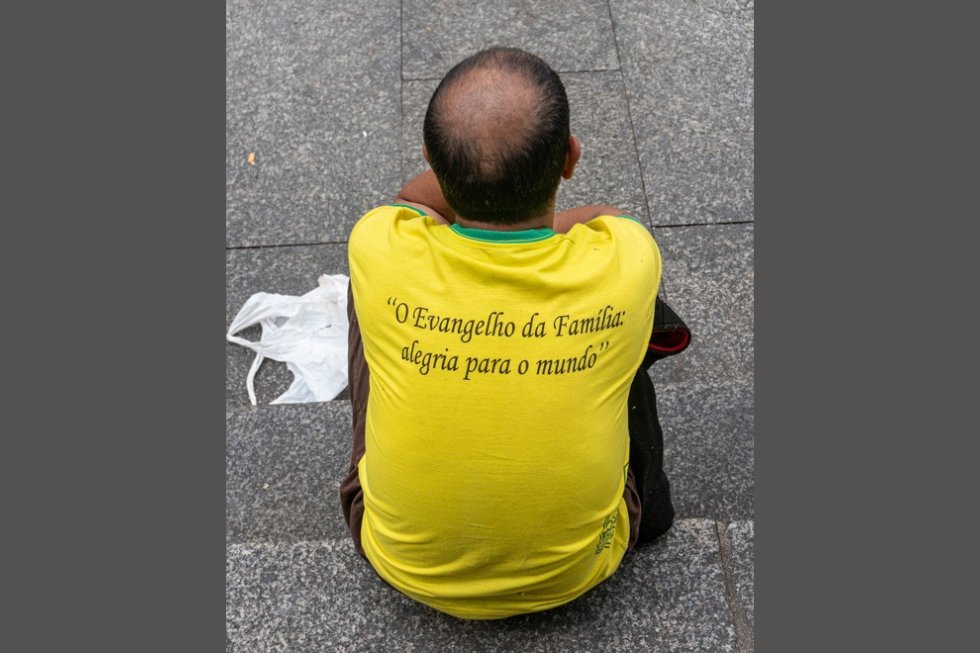
There is another piece of this Brazilian freakshow that deserves attention: the enormous popularity among some Pentecostal and neo-Pentecostal churches of the so-called “prosperity gospel,” a distortion of Christian principles according to which God wants us to become rich here on Earth.
And crucially, that process begins by sharing everything we have with the church and its pastors, because God will supposedly return it to us tenfold. What interests me about this theology is the exchange it produces. Suffering stops being a condition that society should confront collectively and becomes a failure in an individual relationship with God. Poverty appears as insufficient faith, while prosperity becomes a kind of divine receipt.
It is an extraordinarily efficient theology for a consumer society: You believe, you give, you receive. And if you did not receive, something must have gone wrong on your side. Is that what late capitalism looks like?
Here I need to make a distinction that the religious far right itself helps obscure: the problem is not Christians, not evangelicals and not even the participation of religious people in politics. Religion has always been a way of organizing values, communities and public action.
The problem begins when a particular religious interpretation becomes a moral authorization to strip an opponent of his humanity. At that point, faith stops being an identity and becomes a political weapon. Exactly as in that biblical passage about the Last Supper, when Jesus asked everyone to put all the bread in His bowl and told them to go for it with all the wine available. (I am obviously inventing that passage, but it helps explain the absurdity of turning the Gospel into a manual for personal enrichment.)
I would rather behave like Jesus when a fifth-act Rigoletto thunderstorm exploded over the Sea of Galilee while He and the disciples were in a boat. Jesus kept sleeping as if He had dropped two sleeping pills, until Peter woke Him in desperation. Jesus became seriously annoyed, stood up, ordered the waters to calm down and then gave them hell: “Men of little faith, why did you doubt?”
I think I would rather be woken up when all of this is over. Because at this point, it seems that only Divine Justice has any chance of getting the Brazilian fascists out of this mess.
[Lee Thompson-Kolar edited this piece.]
The views expressed in this article are the author’s own and do not necessarily reflect Fair Observer’s editorial policy.
God and the Bolsonaros in the Land of Dirty Money
It was recently revealed that the Jair Bolsonaro biopic Dark Horse is allegedly mired in financial fraud. Now there are...

Brazil’s 2026 Election Is Becoming a Competition for the Algorithm
Brazil’s 2026 election has pitted incumbent President Lula da Silva, Federal Senator Flávio Bolsonaro, and social media powerhouses Renan Santos...

Brazil at a Crossroads: The Farce of Amnesty and the Battle for Democracy
Supporters of former President Jair Bolsonaro demand amnesty for the January 8 rioters, while civil society rallies against it and...

The Trial of Jair Bolsonaro: The Future of Brazilian Democracy
The Supreme Federal Court in Brazil judges former President Jair Bolsonaro and other officials accused of planning a coup and...

The Bolsonaro Family’s Downward Spiral of Corruption
Graft charges against Flavio Bolsonaro throw wide open the web of corruption around Brazil’s first family.

Support Fair Observer
We rely on your support for our independence, diversity and quality.
For more than 10 years, Fair Observer has been free, fair and independent. No billionaire owns us, no advertisers control us. We are a reader-supported nonprofit. Unlike many other publications, we keep our content free for readers regardless of where they live or whether they can afford to pay. We have no paywalls and no ads.
In the post-truth era of fake news, echo chambers and filter bubbles, we publish a plurality of perspectives from around the world. Anyone can publish with us, but everyone goes through a rigorous editorial process. So, you get fact-checked, well-reasoned content instead of noise.
We publish 3,000+ voices from 90+ countries. We also conduct education and training programs
on subjects ranging from digital media and journalism to writing and critical thinking. This
doesn’t come cheap. Servers, editors, trainers and web developers cost
money.
Please consider supporting us on a regular basis as a recurring donor or a
sustaining member.
Will you support FO’s journalism?
We rely on your support for our independence, diversity and quality.




Comment