






When I began writing this piece, a headline appeared on my screen: “Company that moved funds for Bolsonaro film received money from organized crime.” The film the headline refers to is Dark Horse, a 2026 biographical drama directed by Cyrus Nowrasteh that follows the political career of former Brazilian president Jair Bolsonaro.
The headline seemed to have been written by someone who could read my mind and understand my difficulty in trying to explain the blindingly obvious financial fraud surrounding the film. The story of Dark Horse runs through a succession of characters and structures that, though complex, deserve attention, just like all the other stories involving the Bolsonaro surname.
The story is still under investigation, so it is worth respecting a word journalists learn early to handle with care: suspicion. Suspicion does not automatically turn anyone into a criminal, just as an investigation is not the same thing as a conviction. What exists at this point is a financial trail, and that trail needs to be clarified by the authorities.
This film, intended to tell the saga of Jair Bolsonaro, is connected to a financial trail running through people and resources that, according to the finance minister, are connected to structures fed by money from organized crime. This is not a verdict, but a call for an investigation. The Dark Horse case is a story that should not be disregarded.
Dark Horse revealed the machinery already at work
Dark Horse had been financed in part by Daniel Vorcaro, a banker charged with fraud that allegedly reached the top levels of government. When we began following Daniel Vorcaro’s money, the route already looked as if it had come straight out of the depths of hell.. Some of the funds associated with Vorcaro are under investigation for possible links to organized crime. With every new piece of the puzzle, that old metaphor of the basement becomes less useful. The basement has a basement of its own.
That is where the most grotesque dimension of the story lies. The money that allegedly circulated through Vorcaro’s web already carried, according to the investigations, the threat of affecting funds intended for working-class people who depend on their pensions to buy medicine, pay bills and put food on the table.
It is a kind of food chain of indecency: The money that people worked their entire lives to earn — public money — is now money connected to suspicious financial transactions and whose origins may be associated with organized crime. Plus, that money continues to find ways to circulate amongst the most powerful people in Brazil.
According to information released last week, Antônio Carlos Freixo Júnior, known as “Mineiro,” owner of Entre Investimentos, allegedly made seven transfers totalling $12.33 million to the American fund Havengate between January and September 2025. Havengate had been created in 2020 by Paulo Calixto, a lawyer connected to Eduardo Bolsonaro — son of Jair Bolsonaro and former federal police officer — and had remained virtually inactive until it began receiving money related to the production.
Federal Police identified Havensgate as a vehicle used to receive funds connected to the financing of Dark Horse. The investigation also indicates that Senator Flávio Bolsonaro, another son of Jair and current presidential candidate, maintained direct contact with Vorcaro to discuss financing for Dark Horse. Federal Police began investigating the senator’s role in structuring the funds intended for the film. An audio recording in which Flávio asks Vorcaro for financial support became public this year.
Now, put all of that together. One, there is a film intended to construct a narrative about Jair Bolsonaro. Two, a powerful banker whose conglomerate became the focus of a gigantic financial investigation is now in prison. Three, an American fund has been found to be connected to a lawyer close to Eduardo Bolsonaro and, according to the finance minister, possesses funds that allegedly received money associated with organized crime.
Brazilian reality has a terrible sense of humor.
And this is precisely when Olympic levels of political whitewashing enter the scene. A person uncomfortable with the facts or supportive of the Bolsonaros looks at all of this and immediately starts searching for something — anything — that might shift the accountability elsewhere. Suddenly, the origin of the money does not matter. What matters is who published the story. The connections do not matter. What matters is whether the minister likes Brazilian President Luiz Inácio Lula da Silva. The financial trail does not matter. What matters is the ideology of the journalist asking the question. It is like finding an oil spill on the kitchen floor and spending two hours investigating the sexual orientation of the mop.
The question of where the money comes from and where it is going, however, is much older than Dark Horse. This is where Brazilian memory becomes inconvenient. Because when you look at the political trajectory of the Bolsonaros, what emerges is a succession of episodes involving money, employees, real estate, militiamen, personal relationships and business dealings that stretched across years and governments. Each episode has its own legal status. Each episode generates its own investigations, indictments, court decisions, dismissed cases and discarded evidence.
Pretending that accountability disappears because an investigation was closed would be dishonest. Lumping everything together in one collective fraud case, as though it deserves only a single conviction, would be equally dishonest. So what comes next?
A morally corrupt trail as long as the Amazon River
Let’s start with Flávio.
Before reaching the Senate, he spent sixteen years in the Rio de Janeiro State Legislative Assembly. That was when Fabrício Queiroz, a military police officer and parliamentary aide, emerged as a central figure in the investigation into the so-called rachadinha scheme. The rachadinha mechanism was relatively simple: employees appointed to the office would allegedly return part of their salaries to the lawmaker or people connected to him.
There was an extensive investigation based on financial transactions considered unusual, cash deposits, real-estate dealings and Queiroz’s role as a central figure in the inquiry. Rio prosecutors charged Flávio with allegedly leading a criminal organization and accused him of diverting public funds. The case ultimately failed to proceed in its original form after court decisions invalidated evidence and procedural issues undermined the investigation. That distinction needs to be emphasized: Flávio was not criminally convicted in this case.
And then came the chocolate shop scandal. This is where we need to pause because Brazilians have a peculiar relationship with the word “chocolate.” Chocolate generally melts. Cash, depending on the temperature of an investigation, can melt, too. It is almost a ready-made joke, except that it was paid for with real money.
Prosecutors investigated a chocolate shop franchise owned by Flávio Bolsonaro after identifying a significant discrepancy between the revenue reported by the shopping mall the shop was in and the amounts deposited into the company’s bank account. Between 2015 and 2018, according to reporting cited by Folha, the mall recorded 4.9 million reals in sales while 6.5 million reals allegedly entered the company’s account. The investigation also drew attention to the volume and pattern of cash deposits, which investigators considered incompatible with the normal operation of a franchise.
Flávio denied the accusations. The investigation was ultimately affected by the annulment of evidence and did not result in a criminal conviction. That needs to be stated. It also needs to be stated that the investigation did exist and that prosecutors did present a money-laundering hypothesis. The investigation was built on concrete financial data, not on a Facebook post written by someone in pajamas at three in the morning.
The investigation found cash deposits associated with real-estate transactions. Folha, for example, reported 281,500 reals in cash deposits connected to property payments, along with other transactions investigators considered suspicious.
There is a particularly curious episode involving the purchase of two apartments in Copacabana in 2012. According to the investigation, the person who sold the properties allegedly deposited 638,000 reals in cash into their own account on the very same day as the transaction. The episode became part of the broader set of financial questions investigators tried to clarify.
There is something deeply Brazilian about that image: an apartment in Copacabana, cash, a Public Prosecutor’s Office investigation and a political family that built much of its public identity around fighting corruption. It is almost a scene that would have demanded the participation of Nelson Rodrigues, a famous Brazilian playwright, if he were still around.
There is also Flávio’s relationship with Adriano da Nóbrega, a former BOPE captain and central figure in investigations into Rio de Janeiro’s militias, to consider. Flávio awarded Nóbrega the Tiradentes Medal, one of the Rio Assembly’s most important honors, at a time when Nóbrega had already been arrested for the murder of Brazilian politician Marielle Franco.
Nóbrega also had relatives employed within the parliamentary structure. Raimunda Veras Magalhães, Nóbrega’s mother, and Danielle Mendonça da Costa, his then-wife, received salaries of more than 6,000 reals while in office. According to prosecutors, da Costa transferred at least 150,000 reals to Fabrício Queiroz, with part of that money being moved through accounts connected to Nóbrega.Again: this does not mean Flávio was convicted of participating in a militia. He was not. It means there was a documented political relationship with Nóbrega and that the former police officer’s name appeared within an investigation that already involved Flávio’s office.
Then another character appeared: Robson Calixto Fonseca, known as “Peixe,” convicted of participating in the murder of Marielle Franco. In 2026, the relationship returned to the headlines when an aide to Flávio Bolsonaro appeared in conversations with Calixto concerning the release of congressional budget amendments. Federal Police are investigating the allocation of those funds and have pointed to a close relationship between the aide, the militiaman and the senator’s office.
There is a pattern worth noticing when examining the problems surrounding the political and family group: cash, deposits, real estate, employees, companies, contracts, government amendments, funds and, now, international film financing. The story has begun to resemble a television series whose screenwriter has stopped worrying about the number of characters.
Political whitewashers can’t turn the other cheek for much longer
The script is becoming larger than fiction. We have an investigation into film financing, a banker under investigation, an international fund connected to a lawyer close to Eduardo Bolsonaro, money attributed to organized crime and, simultaneously, new evidence concerning relationships between Flávio’s office and a man convicted in the Marielle case. That is a lot of coincidence to fit under one rug. That rug is starting to bulge.
Once again: none of this evidence constitutes a conviction against Flávio. The central evidence in the rachadinha investigation was annulled. The courts closed the case without a conviction. But the argument, “there was no conviction, therefore nothing happened,” is about as clever as saying a fire never existed because the firefighter failed to discover who struck the match.
Brazilian political history is full of cases in which an investigation dies before reaching a verdict. There are procedural nullities, questions of jurisdiction, statutes of limitations, invalidated evidence, changes of venue and decisions by higher courts. All of this is part of the rule of law. And it should be. The problem begins when political defense turns those guarantees into a machine for erasing memory.Now let’s return to the present. The Dark Horse case adds a new layer because we are no longer talking only about money moving inside a parliamentary office or a chocolate shop. We are talking about an international film production.It is important to repeat that Dark Horse is the subject of an investigation, not a final conviction. But investigations exist precisely to establish what happened. Journalism consists of following the facts while they are being investigated, rather than manufacturing a verdict before the courts do — or prematurely acquitting someone because the story is uncomfortable.
That is where I become particularly intrigued by our professional political whitewashers. Much of this crowd spent years screaming about corruption, building memes about “good citizen” versus “criminal,” treating every suspicion involving political opponents as definitive proof of dishonesty and demanding immediate punishment. When the story knocks on their own door, they suddenly discover an almost Franciscan passion for due process.
How beautiful.
They discovered Montesquieu. They were introduced to the phrase “presumption of innocence.” They discovered that an investigation is not a conviction. I support all of that. I really do. I just wish they had discovered it earlier, because the presumption of innocence does not mean a presumption of amnesia. And that brings us to another part of this story that interests me: religion.
Religious rhetoric can be a tool for political whitewashing
There is something deeply strange about the marriage between a political rhetoric that invokes God every five minutes and a political trajectory marked by characters, practices and relationships that should, at the very least, make anyone who takes Christianity seriously uncomfortable.
When Jesus speaks about wealth and power, money appears as one of the great temptations capable of corrupting people’s relationships with others and with God. His criticism of hypocrisy occupies a central place in the Gospels. The poor repeatedly appear as a moral reference point. The merchants driven from the temple remain an uncomfortable image of the transformation of the sacred into business. The impossibility of serving both God and money remains a central theme two thousand years later. It sort of ruins the party for anyone trying to turn faith into a political marketing tool.
The contemporary problem lies precisely in this inversion. Entire communities have learned to live with political rhetoric that presents the leader as some kind of chosen one, turns opponents into moral enemies, treats every criticism as persecution and converts material success into evidence of divine approval. The result is one of the most convenient forms of political theology imaginable for anyone standing on the stage: the more money, power and influence appear, the easier it becomes to present them as signs of blessing.
This produces a remarkably efficient psychological mechanism. People stop evaluating a leader’s behavior according to external criteria and begin protecting him as part of their own identity. An accusation against him becomes an attack against the group; a news report becomes a personal insult; an investigation becomes political persecution; inconvenient information immediately demands an explanation capable of preserving the belief that existed beforehand.
Brainwashing, when it happens, rarely arrives carrying a sign that says “abandon your critical faculties.” It usually enters through the much wider door of trust. First comes the idea that only one particular group sees the truth, and then comes the recommendation to distrust everyone outside that group. At some point, the individual no longer needs to examine evidence because the identity built around that community has become a filter.
It is the psychological equivalent of putting your brain on airplane mode and then complaining that the world has stopped coming through. That is why the political whitewasher is such a fascinating figure.
Confronted with information about a politician they like, their first reaction is often to investigate the author of the story, the ideology of the investigator or the political party of whoever filed the complaint. The substance of the allegation becomes secondary. If the conversation reaches money, they bring Lula to the table. If an investigation appears, they ask who is investigating. If documentary evidence emerges, they want to know who published it. It is like being pulled over by the police for drunk driving and starting an argument about the bar owner’s drinking habits.
The Bolsonaro family built its political identity around the idea that there was a war between the good citizen and a corrupt elite. The problem is that, after all these years, the good citizen needs to start asking a simple question: who are the people my heroes chose to do business with, receive money from, ask favors of, honor, employ as relatives and establish political relationships with?
That question applies to every politician. Lula included. Actually, I take that back: it applies especially to Lula. It applies to the left, the right, the center, people wearing suits and people wearing politicians’ T-shirts as if they were football jerseys. The yardstick needs to be the same.Meanwhile, the professional defenders continue their argumentative CrossFit: they lift an accusation against Lula, do three squats with the word “communism,” run five kilometers after a 2018 social media post and finish the workout by shouting that the press is “left-wing.”
The money, poor thing, is left waiting for someone to ask where it came from. I would like to ask that question. Because there is an old rule in journalism, policing and life: follow the money.
That is why the Dark Horse case deserves close attention. Not because it automatically proves that Jair Bolsonaro or any member of his family committed a crime involving the money under investigation. It deserves attention because it once again places the Bolsonaro political circle close to a financial operation involving people under investigation for serious crimes, and because there are documents, transfers, messages and testimony that need to be examined by the authorities.
It does not matter whether the money wears a suit, a Brazilian national team shirt or a pastor’s dress shirt. It also does not matter whether it entered through a chocolate shop, passed through a real-estate transaction, circulated through parliamentary offices, appeared in budget amendments, moved through foreign funds or acquired a cinematic soundtrack. Money leaves a trail. And in the case of the Bolsonaros, there is already a story far too long for us to accept that every new chapter begins from scratch.
It is not only journalists who want to know. Federal Police want to know. Prosecutors want to know. Citizens should want to know too. Even evangelical voters who support them. Because if the Bible that person carries under his arm means anything beyond an electoral accessory, there should come a moment when he closes WhatsApp, puts down the pastor’s video, switches off the YouTube service and looks at the whole picture. Not at Lula or the Workers’ Party or even “Xandão,” but at the Bolsonaros.
And then a question emerges that is political, journalistic and, for anyone who genuinely believes in the Gospel, moral as well: What kind of money is making its way here? Because if God really is following this story, I sincerely hope He has a good accountant.
And plenty of patience.
[Cheyenne Torres edited this piece.]
The views expressed in this article are the author’s own and do not necessarily reflect Fair Observer’s editorial policy.
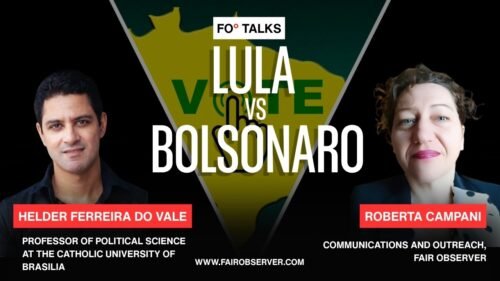
FO Talks: Lula vs Another Bolsonaro — Brazil’s 2026 Election
In this episode of FO Talks, Roberta Campani and Helder Ferreira do Vale examine Brazil’s presidential election between incumbent President...
Brazil’s 2026 Election Is Becoming a Competition for the Algorithm
Brazil’s 2026 election has pitted incumbent President Lula da Silva, Federal Senator Flávio Bolsonaro, and social media powerhouses Renan Santos...

Brazilian 2026 Election: Lula’s Soft Power Skills Threatened by a Hard-Power World
Brazil’s October election matches the polarized 2022 election, with incumbent Brazilian President Lula da Silva polling ahead of Senator Flávio...

Support Fair Observer
We rely on your support for our independence, diversity and quality.
For more than 10 years, Fair Observer has been free, fair and independent. No billionaire owns us, no advertisers control us. We are a reader-supported nonprofit. Unlike many other publications, we keep our content free for readers regardless of where they live or whether they can afford to pay. We have no paywalls and no ads.
In the post-truth era of fake news, echo chambers and filter bubbles, we publish a plurality of perspectives from around the world. Anyone can publish with us, but everyone goes through a rigorous editorial process. So, you get fact-checked, well-reasoned content instead of noise.
We publish 3,000+ voices from 90+ countries. We also conduct education and training programs
on subjects ranging from digital media and journalism to writing and critical thinking. This
doesn’t come cheap. Servers, editors, trainers and web developers cost
money.
Please consider supporting us on a regular basis as a recurring donor or a
sustaining member.
Will you support FO’s journalism?
We rely on your support for our independence, diversity and quality.





Comment