



• World
    • Africa
    • Asia Pacific
    • Central & South Asia
    • Europe
    • Latin America & Caribbean
    • Middle East & North Africa
    • North America
  • Coronavirus
  • Politics
    • US Election
    • US politics
    • Donald Trump
    • Brexit
    • European Union
    • India
    • Arab world
  • Economics
    • Finance
    • Eurozone
    • International Trade
  • Business
    • Entrepreneurship
    • Startups
    • Technology
  • Culture
    • Entertainment
    • Music
    • Film
    • Books
    • Travel
  • Environment
    • Climate change
    • Smart cities
    • Green Economy
  • Global Change
    • Education
    • Refugee Crisis
    • International Aid
    • Human Rights
  • International Security
    • ISIS
    • War on Terror
    • North Korea
    • Nuclear Weapons
  • Science
    • Health
  • 360 °
  • The Interview
  • In-Depth
  • Insight
  • Quick Read
  • Video
  • Podcasts
  • Interactive
  • My Voice
  • About
  • FO Store
Sections
  • World
  • Coronavirus
  • US Election
  • Politics
  • Economics
  • Business
  • Culture
  • Sign Up
  • Login
  • Publish

Make Sense of the world

Unique insight from 2,000+ contributors in 80+ Countries

Close

Has Europe Failed to Integrate Muslims?

By Tahir Abbas • Jan 18, 2015

© Shutterstock

European minorities and majorities are moving away from each other on matters of social cohesion and identity politics.

US President Barack Obama recently chastised British Prime Minister David Cameron about the failure of Europe to “integrate” its Muslims in the way the United States has managed.

But while both geographies possess similar problems in terms of nationalism, acculturation, religious freedoms, political engagement and economic activity in relation to minorities, the idea of “Muslim integration” differs widely between each context. It could be argued that the Americans have generally managed their affairs better but that Europeans have been less successful. So, what are the nuances?

European politicians have been lurching to the right to capture voters over the last two decades — and certainly since the events of 9/11. Perhaps it is the case that European culture reached its zenith a long time ago. Hence, it is looking inward.

Various countries project on the “other” what they most detest about themselves. The French ban on niqabs (face veil) or the Swiss banning of minarets reveals more about how these nations are possibly running out of ideas, combined with a great degree of self-loathing.

There would not have been the concept of a Europe were it not for the rise of Islam as it expanded westward. As Islam waned in the Iberian Peninsula, Europe benefited from Islamic science and philosophy. But for Western Europe, the age of discovery was the time of slavery, imperialism and colonialism.

Subsequently, for two centuries, Europe turned on itself. The 20th century was the bloodiest and most costly Europe encountered. Post-war immigrants, invited to take up unwanted employment, were subjugated, racialized, excluded, marginalized, vilified and humiliated. Today, 70 years later, they are beaten up, literally and figuratively.

It is true that only after 1965 did the United States start to open its doors again. The process encouraged highly-educated groups, including Muslims from Asia and the Middle East, to migrate in search of better labor market opportunities. In contrast, Western Europe incorporated its Muslim migrants from former colonies at the “bottom” of the job market.
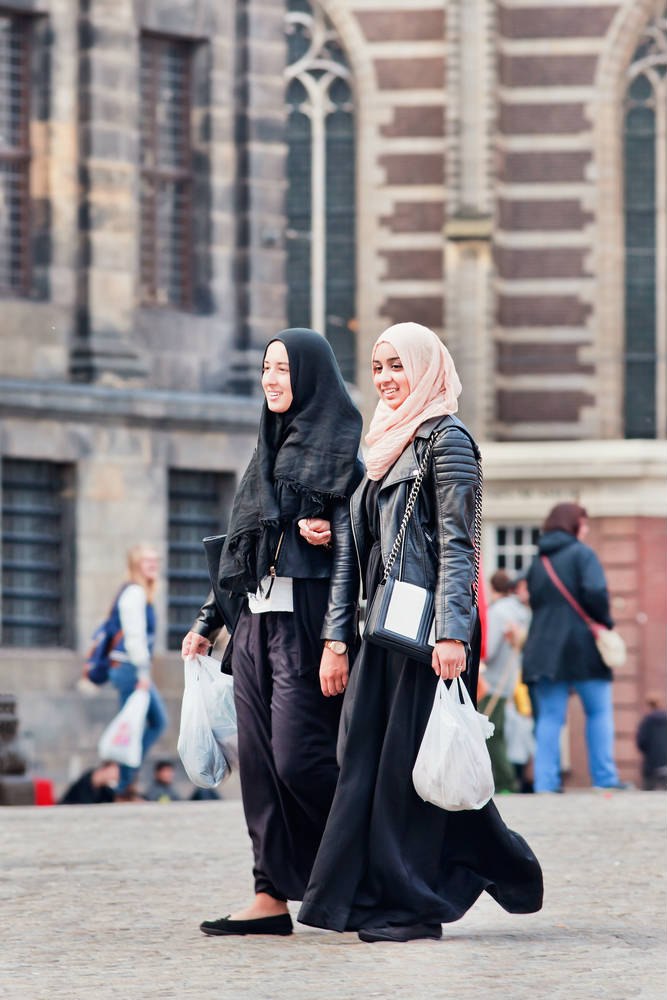
© Shutterstock

© Shutterstock

Matters worsened when those jobs disappeared and communities became trapped in poor areas, in similar vein to what happened to white-majority working-class communities. It is no surprise that due to cultural, social, political, economic and also geographical reasons, it is often the poorest and most marginalized white-majority groups who feel they have most to lose because of immigrant and minorities.

Rather than race, these minorities are identified by their faith first and foremost (although cultural, ethnic and racial genealogies remain in this narrative). Class often trumps, but class is not a neutral concept. Far from it. Class and race are hugely interrelated concepts; one cannot be detached from the other. Europe must be critiqued for not dreaming enough of a brighter future, but the socioeconomic fundamentals remain important.

French Muslims, who make up between 5-10% of the population in France, often live in the worst housing, work in the least paid jobs and suffer the lowest education levels. They are up to three-times more likely to be unemployed than the French average. As a highly racialized group, they are en masse acutely subjugated and disempowered by the French state. France is not protecting its so-called values equally for all. A racist satirical magazine was prosecuted for an anti-Semitic cartoon in 2008. Not long after, it prevented itself from lampooning Jesus Christ in case it upset certain populations. But Islam and Muslims are regarded as softer targets.

Charlie Hebdo undoubtedly pushed boundaries by attacking all sorts of influential and powerful figures. This is indubitable. French society exhibits Islamophobic tendencies, but there are many among the French majority who are pro-Palestinian or pro-integration about its Muslim population. However, as always, there is a need to look at the full picture to understand where matters are heading.

Here, evidence suggests matters are getting worse for Muslims in Europe — politically, socially and culturally — including France. The Kouachi brothers and Amedy Coulibaly, who murdered 17 people in Paris, were entirely “made in France.” But there is also an “Islamophobic industry” that prevents Muslims asking and dealing with serious questions from within. It creates polar opposites, fueling extremists on all sides.

It also negates the wonderfully positive contributions that many European-born Muslims are increasingly beginning to make. Through popular culture — fashion, music, food, dance, literature and film — these young Muslims are redefining what it is to be Muslim and European. There is plenty of hope in such a reality.

While the US and Europe both exhibit race and class struggles, they endure major Islamophobia problems, too. The United States is catching aspects of the European disease in this regard. Characteristics of European Islamophobia are connecting with the instruments of American Islamophobia — in other words, the Internet and the extensive synergy between media and politics. Parts of European society have remained intellectually open to Islam for centuries. This is indisputable. But all the conflicts are at the local level and this is where the greatest challenges prevail.

There is certainly divergence on how to deal with the problems, some of which could lead to redundant open-ended conversations about semantics. But agreeing on the nature of the problems and issues is noble enough for now.

In the end, there are many who understand and do what is best — for all. But too many minorities and majorities are moving away from each other on matters of social cohesion and identity politics. Much can be transformed by building real opportunities from below, and by politicians changing their tunes and delivering effective policy from above.

*[A version of this article was originally appeared on Tahir Abbas’ blog.]

Fair Observer is a nonprofit organization dedicated to informing and educating global citizens about the critical issues of our time. Please donate to keep us going.

The views expressed in this article are the author’s own and do not necessarily reflect Fair Observer’s editorial policy.

Photo Credit: Sorin Vidis / TonyV3112 / Shutterstock.com

Share Story
CategoriesBlog, Culture, Europe, Politics TagsEthnic Minorities, Islam, Islamophobia, Muslim, society
Join our network of more than 2,000 contributors to publish your perspective, share your story and shape the global conversation. Become a Fair Observer and help us make sense of the world.

Fair Observer Recommends

Hollywood in Black and White Hollywood in Black and White
By Ajay Kothari • Oct 06, 2016
Closing the Gaps: Nepal’s Marginalized Communities Closing the Gaps: Nepal’s Marginalized Communities
By Pema Abrahams • Jan 12, 2014

3 Replies to “Has Europe Failed to Integrate Muslims?”

  1. Avatar Denise Chaplin says:
    January 19, 2015 at 10:14 am

    ‘Various countries project on the “other” what they most detest about themselves. The French ban on niqabs (face veil) or the Swiss banning of minarets reveals more about how these nations are possibly running out of ideas, combined with a great degree of self-loathing.’
    I think you have missed an important issue regarding the the clash of cultures on the Niqab. In the west facial expression has always been a significant part of inter-personal communication for the majority of people. Prior to the niqab, people also used face coverings to enable them to enact crimes or scams and not be recognised.

  2. Avatar Zarina Bhatia says:
    January 19, 2015 at 11:44 pm

    Professor Tahir Abbass writes an admirable article on this subject. Indeed the image British Muslims give out is of alienation generally speaking, talking of majority of Muslims living in the western world. First of all they are far from an amalgamation of a single entity; they are made up of a variety of sub-groups from different backgrouds, countries of origin, of faith groups, ideology, with cultural norms even speaking different languages. But above all they portray a traditional image by the way they groups identify themselves via their observance of dress codes, as an example. Their obviously recognisable image makes them visible. Women many of them wear a head scarf, men grow beards/moustache or wear what is called Salwar Kameez in areas where they are concentrated. Each communal group adheres to what its heritage might be.

    One should not forget that this social image gives vibes to western countries as if Muslims remain aloof, and do not want to integrate with the host society. They may not assimilate but give an impression of not wanting to come half way and merge. I have deliberately generalised for ALL Muslims! This is far from the case as I have already clarified they are a pluralistic society and not a single entity.

    In conclusion, there are other communities like the Jews, Hindus, Sikhs but the Government in Britain today has taken upon itself to target the Muslim leaders of numerous Mosques asking their members to explain how they regard themselves as a part of British Society, or don’t they? What efforts are made to prove that British culture is part of theirs too! In my opinion, this is a very divisive step taken in the wrong direction of alienating them further.

    In case of a minority of Shia Ismaili Muslims, they have not just outwardly but also internally adapted assets such as western education, taken up various careers, professions or business enterprises. Thus they have ‘merged’ and amalgamated themselves with the host society. They have succeeded in retaining their practice of faith, culture, language, dietary norms but have made ‘friends’ with the local people. Most of them have acquired very high level of education and are now part of a Professional class of Citizens living in various European and North American countries. H H Aga Khan IV their hereditary Imam, in spiritual and worldly communal sense has always emphasised and guided them for generations on hand, to identify and adapt themselves with the people in countries of their abode. Ismailis are scattered over some 25 countries in many continents of the world. However, their adaptability is remarkable. Perhaps, other Muslim communities could take their example, regard them as a role model of this pace-making community. That will minimise Muslims being targeted as the ‘bad apples’ and ridiculed for their faith. What The west is doing is causing insult and aggravation by ridiculing their faith, in the name of ‘freedom’ that really amounts to license making not only these communities but their supreme religious leader namely Prophet Muhammad as an object of caricature pouring fuel to the fire of hatred and abuse in the name of ‘humour’.

  3. Avatar mhy129 says:
    April 25, 2015 at 2:19 am

    It is not Europe’s responsibility to ‘integrate’ Muslims. It is the Muslims’ responsibility to ‘integrate’ to European culture

Leave a Reply Cancel reply

You must be logged in to post a comment.

Post navigation

Previous PostPrevious Flogging for Blogging?
Next PostNext Memo to Sonia Gandhi: Your Hypocrisy is Showing
Subscribe
Register for $9.99 per month and become a member today.
Publish
Join our community of more than 2,500 contributors to publish your perspective, share your narrative and shape the global discourse.
Donate
We bring you perspectives from around the world. Help us to inform and educate. Your donation is tax-deductible.

Explore

  • About
  • Authors
  • FO Store
  • FAQs
  • Republish
  • Privacy Policy
  • Terms of Use
  • Contact

Regions

  • Africa
  • Asia Pacific
  • Central & South Asia
  • Europe
  • Latin America & Caribbean
  • Middle East & North Africa
  • North America

Topics

  • Politics
  • Economics
  • Business
  • Culture
  • Environment
  • Global Change
  • International Security
  • Science

Sections

  • 360°
  • The Interview
  • In-Depth
  • Insight
  • Quick Read
  • Video
  • Podcasts
  • Interactive
  • My Voice

Daily Dispatch


© Fair Observer All rights reserved
We Need Your Consent
We use cookies to give you the best possible experience. Learn more about how we use cookies or edit your cookie preferences. Privacy Policy. My Options I Accept
Privacy & Cookies Policy

Edit Cookie Preferences

The Fair Observer website uses digital cookies so it can collect statistics on how many visitors come to the site, what content is viewed and for how long, and the general location of the computer network of the visitor. These statistics are collected and processed using the Google Analytics service. Fair Observer uses these aggregate statistics from website visits to help improve the content of the website and to provide regular reports to our current and future donors and funding organizations. The type of digital cookie information collected during your visit and any derived data cannot be used or combined with other information to personally identify you. Fair Observer does not use personal data collected from its website for advertising purposes or to market to you.

As a convenience to you, Fair Observer provides buttons that link to popular social media sites, called social sharing buttons, to help you share Fair Observer content and your comments and opinions about it on these social media sites. These social sharing buttons are provided by and are part of these social media sites. They may collect and use personal data as described in their respective policies. Fair Observer does not receive personal data from your use of these social sharing buttons. It is not necessary that you use these buttons to read Fair Observer content or to share on social media.

 
Necessary
Always Enabled

These cookies essential for the website to function.

Analytics

These cookies track our website’s performance and also help us to continuously improve the experience we provide to you.

Performance
Uncategorized

This cookie consists of the word “yes” to enable us to remember your acceptance of the site cookie notification, and prevents it from displaying to you in future.

Preferences
Save & Accept

