


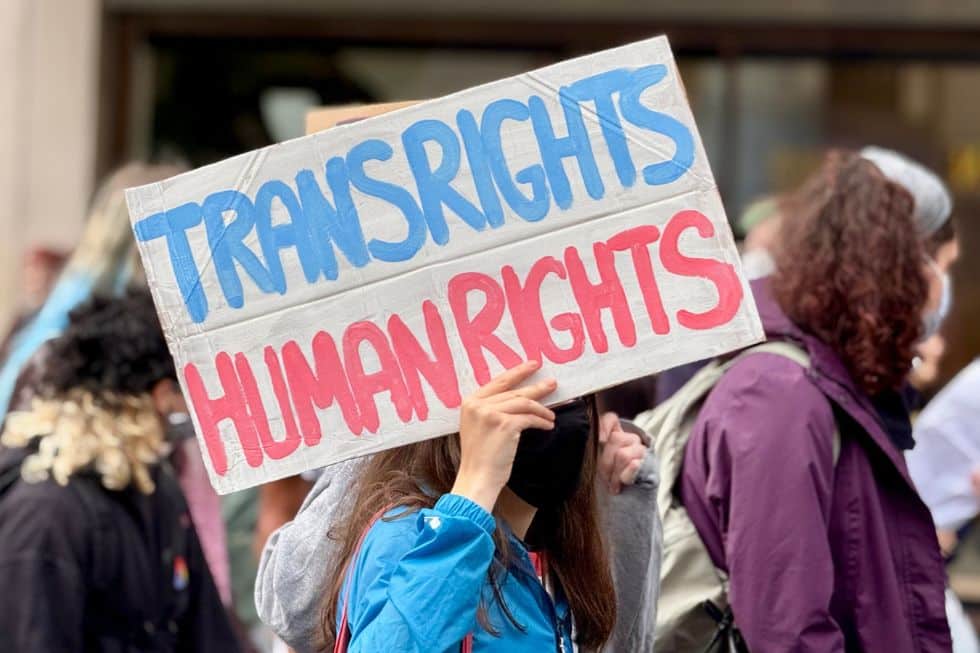



The parliament of India has recently passed a law that requires a transgender person to appear before the medical board and obtain a District Magistrate’s certificate before their identity is legally recognized. In doing so, the Parliament has reversed a right the Supreme Court declared “fundamental” in 2014. When the legislature strips away something it calls a fundamental right without consultation, what’s left of the rule of law? Does the Supreme Court no longer hold any power, or is it just blind? Let us understand how a government has placed the very existence of its most vulnerable citizens under state supervision — and called it protection.
On March 25, the Parliament of India officially passed a law which directly tells a transgender person they don’t know who they are.
For context, this was an amendment to the Transgender Persons (Protection of Rights) Act, 2019. This act was inherently not perfect, but it at least did the very basics of following the Constitution. It explained how gender identity was to be determined by oneself and that a person doesn’t require a doctor’s permission to know their own name. The amendment blatantly removes this. It eradicates self-identification and narrows the definition of transgender so radically that trans men, women and non-binary people are no longer recognized under Indian Law.
The Minister of Social Justice and Empowerment told Parliament that the objective was to protect transgender persons. Apparently, you protect a community by requiring them to prove their identity to a government-appointed doctor before the state will recognize them.
If the government has to appoint a doctor to determine who a person is, then the government has already decided the person cannot be trusted. This is not protection; it is suspicion in fancy words. The legislature does not undercut the judiciary without a constitutional amendment and without consultation with the communities whose existence the law governs, yet here we are.
Let’s now move to the Constitutionality of this amendment directly against the Supreme Court. But what demands questioning is the dishonesty — as the government claims that this law protects people while it controls them — the colonial ways of thinking this amendment restores and how every institution that could have stopped this — the Opposition, The National Council For Transgender Persons (NCTP), the President and more — are either blind or they too have fallen.
The parliament cannot erase what the Supreme Court has written into the constitution
To understand why this law is legally indefensible, we must look back to 2014 and the landmark judicial precedent that the current legislature has chosen to ignore.
In NALSA v. Union of India, a Constitution Bench of the Supreme Court held that the right to self-determination of gender identity is a fundamental right. Not a bureaucratic entitlement. Transgender people are entitled to full constitutional protection, including Article 14 (Right to Equality), Article 15 (prohibition of discrimination on the grounds of Religion, Race, Caste, Sex or Place of Birth), Article 16 (equality of opportunity in public employment), Article 19 (Right to Expression) and Article 21 (Right to Life with Dignity). The court was unambiguous. A person can assert their gender as male, female or transgender as they experience or perceive it, psychologically and socially, with no medical procedure as a condition. This ruling, since 2014, has been upheld by two constitutional benches in Navtej Singh Johar and Supriyo v. Union of India and by several High Courts across the country. It is settled constitutional law.
The 2026 amendment ignores all of it.
It removes Section 4(2) of the 2019 Act, which directly mentions the right to self-perceived gender identity. It replaces this with a system in which a medical board tests you, makes a recommendation and a District Magistrate then decides whether the state will recognize who you are. The parliament has legislated directly against a fundamental rights ruling of the Supreme Court, without a constitutional amendment, which is the only way the ruling could be overruled.
Let’s be specific about what this medical board actually would be, because the government would want you to think it’s just some administrative formality. The bill provides no clarity on the scope of the board’s examination, its procedure or what criteria it uses. There is no standard whatsoever. The Centre for Law and Policy Research correctly points out that this ambiguity “could result in invasive examinations and opportunities for harassment.” This also directly violates Puttaswamy v. Union of India, the Supreme Court’s 2017 ruling that established the Right to Privacy as a Fundamental Right. Submitting your body to an unofficial panel of government-appointed doctors, on no defined criteria, to receive permission to be yourself, is not, on any level, a fair process. It is a fundamental breach of bodily privacy and nobody — a man, a woman or a transgender person — should be put through that on moral and ethical grounds.
Then there is the arguably worse problem of definition. The amendment replaces the existing broad definition of transgender under the 2019 Act, which is “a person whose gender does not match the gender assigned at birth,” with a very narrow list of three categories: sociocultural identities like hijra (transgender, intersex, or eunuch people who live in communities that follow a kinship system known as the guru–chela system) and kinnar (a more respectful, modern term frequently used for transgender people who may not be part of that traditional structure), persons with five specific intersex variations and those “compelled” to present as transgender. This is very different from the previous definition, which acted as an umbrella. Trans people, women outside those communities and non-binary persons could all fall under it. Now there is no umbrella and just a narrow list; if you are not in that list, you do not exist under Indian law.
This creates two classes of transgender persons: The first are those who are legally recognized, entitled to identity certificates and protected under the act; the second are everyone else.
The purpose of this law is to “protect” transgender persons from discrimination. So what is the logic behind protecting a hijra but not a non-binary person? They are both oppressed in society and the bottom line is that they are both transgender. The classification offers no data, no evidence or a constitutional reason for this exclusion, only vague references to “complexities in enacting statutes.” That is the government admitting they don’t have a reason. Under Article 14, a classification that creates a hierarchy within a community with no intelligible basis is unconstitutional. A classification that determines who receives protection and who doesn’t is what this Article aims to prevent.
This law has picked which transgender people it will allow to exist and which it won’t, in direct violation of the fundamental rights granted by the Supreme Court. The same Prime Minister (PM) Narendra Modi, who took an oath in 2024 to “bear true faith and allegiance to the Constitution of India as by law established,” has turned a blind eye to something as unconstitutional as this.
A colonial law in democratic clothing
Let’s come to Section 18 of the amendment: The Criminal Provisions. This is where the government’s claim of protection almost completely collapses. The amendment introduces two new offenses. First, kidnapping and causing grievous hurt by emasculation, hormonal procedures or severe injury to force a person to assume transgender identity, punishable with ten years to life imprisonment. Second, using force or undue influence to compel someone to present as transgender and employ them in begging, solicitation or forced labor is punishable with five to ten years’ imprisonment. If the victim is a child, the penalty extends to life imprisonment.
This seems very reasonable. Forced identity and trafficking are real harms. Nobody argues that, but read the statements again. The offense is not just kidnapping or trafficking, but rather ambiguous. It is “compelling, forcing, or alluring” a person to present as transgender. Now, what do compelling, forcing and alluring refer to? Is a social worker helping a young child understand their gender identity alluring? Is a parent supporting their trans child compelling? Is a doctor providing gender affirming care forcing? The bill does not say. This ambiguity doesn’t seem accidental; it seems to be the very point.
This is very old thinking under a mask of child protection.
In 1871, the British colonial government passed the Criminal Tribes Act. It is presumed that entire communities, including gender non-conforming persons, were inherently criminal by nature. It penalized eunuchs (all persons of the male sex who admit themselves, or on medical inspection clearly appear, to be impotent) from having a boy under the age of 16 years in their house. It criminalized their relationship structures, their community networks and basically their way of existing. The Supreme Court in NALSA described it as plain brutal legislation with a vicious and savage mindset. In fact, it was one of the first laws that was repealed after independence.
The 2026 amendment builds on the same presumption. It looks at a trans person’s family, their network and support systems and it sees a criminal conspiracy. The same logic that was used to break apart gender non-conforming families in 1871 is now a law passed by an elected parliament in 2026.
The Telangana High Court, in Vyjayanti Vasanta Mogli v. State of Telangana, talked about similar criminalization provisions and declared that they held a direct chilling effect on freedom of expression and right to privacy and that they furthered derogatory stereotypes of the transgender communities. That ruling is on record, yet the parliament passed this bill.
Mind you, this is the same government that renames cities, rewrites textbooks and makes new parliament buildings in the name of decolonization. Then why this colonial thinking? Why are we reviving the legal architecture that the colonial government used to surveil and criminalize gender non-conforming people?
The reality
Now, what exactly does this amendment do to a transgender person on any Tuesday morning?
Let me take a few examples: You want to renew your Aadhaar Card, open a bank account, get admitted to a hospital, apply for a job or even book a flight. All of these require you to hold some kind of identity document. And under this amendment, these documents, which determine whether India recognizes you as who you are, can only be obtained after a medical board has examined you, however they want to and a District Magistrate signing off on your existence. This is not bureaucracy.
The French philosopher Michel Foucault wrote about what he called “biopower”, which is a state’s ability to control populations not through direct violence but through the management and surveillance of bodies. The state decides what a body is, what it can do and where it belongs. It does not control you but makes your ability to move conditional on its approval. This is exactly what this amendment does. It doesn’t put them in jail, but in a waiting room, indefinitely, till a government-approved doctor decides whether or not their identity is legitimate enough to be recognized.
In practice, a trans man who doesn’t fall within the amendment’s list of recognized categories has no path to a legal identity certificate. Everywhere he goes, he is presented with a document that doesn’t reflect who he is. He must either present as someone he is not or someone the country doesn’t recognize. There is no other option and the law has made sure of it.
Now, someone will argue that a trans man can simply identify as a male and get on with his life. This makes sense technically, but honestly, it means his transgender identity is permanently concealed due to legal functionality. It means the law doesn’t protect him but gives him a choice between being erased and being left alone. For any non-binary person, for any intersex person outside of the five listed variations, for trans people who cannot or choose not to strictly pass as male or female, even this choice is unavailable. And for every trans person, the moment their old documents resurface, there is no escape, but only a choice between two kinds of invisibility.
This is the so-called protection offered by the government; it is not protecting but caging transgender people to be something they are not.
The right to privacy supported by Puttaswamy v. Union of India was not about keeping your data safe. The Supreme Court made it clear that privacy includes preservation of personal intimacies, the sanctity of family life and, crucially, the right to define yourself without interference. The amendment does not just neglect this right due to the medical examination, but because it makes self-definition legally impossible.
The government has created a system that requires a person to obtain government permission before their existence is legally valid. This is not protection or welfare, but an older, almost ancient way of thinking, and this government has just found a way to say it in a cleaner way.
A few actors shouldn’t lead to a whole community being oppressed
Now, every time you talk about transgender rights, one argument that gets brought up, which needs to be addressed, is that if self-identification is allowed, without medical interference, bad-faith actors, specifically men, will fraudulently claim to be women to access women’s spaces, shelters, prisons, or sporting categories.
This sounds concerning; however, countries that have implemented self-identification laws, such as Argentina since 2012, Ireland since 2015 and Denmark since 2014, have produced no documented evidence of widespread fraudulent claims. None. These claims are driven by ideology and not documented harm. The apocalyptic scenario has had over a decade to prove true across multiple countries, yet it has failed to do so. What has been documented, extensively and in all of these countries, is that legal recognition improves mental health, economic stability and safety of transgender people. The harm from not allowing self-identification is real and measurable and from allowing it is, in most cases, still theoretical.
More importantly, even if this is a legitimate concern, the government’s response is simply not proportionate. To address the hypothetical bad faith of a small group of people, the parliament has caused every single transgender person in India to go through medical examination, certification and legal invisibility. It has punished millions for the crimes of a few. That is not policy but prejudice.
And if the concern genuinely is about safety, the law already clarifies it. Fraud isn’t a new crime. Using any legal process with the intent to deceive is already punishable. A person who enters a space to commit harm is committing a crime, irrespective of what their identity documents say. Removing self-identification does not stop a determined bad-faith actor; it just makes everyone else’s life harder. Practically, legal gender changes are recorded and traceable and might be the worst strategy for someone actually trying to hide their identity or history. And in a country like India, are we expected to believe that a predator would go through the discrimination, harassment and violence that a transgender person goes through? He would never go through this stigma to commit a crime.
When we come to sports, where physical characteristics actually create practical tensions, it is a valid argument. But those are conversations for sports bodies and federations to have. Parliament does not have to narrow down the definition of gender for every transgender person in the country. You simply do not take away a community’s right to exist in order to solve a challenge in athletics. The proportionality puzzles me because it is quite absurd.
The institutional failure
How did this law get passed? Because a law of this extent, which is constitutionally indefensible, does not pass both the Houses of Parliament in 13 days by accident. It requires a failure from every institution that could have stopped it.
Let’s start with the government. Union Minister Virendra Kumar walked into the Lok Sabha on March 13, introduced the bill, and 13 days later, it had cleared both the Houses and was on its way to the President. There was no standing committee referral, no consultation with the trans communities, no consultation with legal experts or civil society beyond what the government chose to hear. This is a dilution of Democracy. When asked to justify the situation, the Statement of Objects and Reasons offered “complexities in enacting statutes.” So the Government’s reason is complexity, for a law that determines the lives of millions. Complexities are not the problem of these people but a problem the government has to deal with.
Dr. Virendra Kumar then stood before the Rajya Sabha and said, “The government is compassionate towards the well-being of the transgender community” and that “the bill has provisions to empower transgender people and give them dignity.” Is this not the same bill that removes self-identification? The same bill that adds a medical board? The same bill whose own advisory council members resigned in protest the moment it passed. Compassion these days doesn’t require the consent of the people you’re being compassionate towards.
Then there is the Bharatiya Janata Party’s (BJP) Medha Vishram Kulkarni, who supported the bill in the Rajya Sabha and thanked PM Modi for bringing it forward to “ensure that the benefits reach the deserving people.” The deserving people? She also said there is a need for a law that “brings justice to real transgender individuals and punishes fake ones.” On the floor of Parliament, a person has openly said that some transgender persons are real and some are not and the government gets to decide who is fake and who isn’t. This is not my inference; this is a BJP member of parliament (MP) explaining the law in her own words.
How this law was passed puzzles me. Is our legislature blind or just blatantly ignorant?
The failure of the opposition, the President and the PM
Now let’s talk about the Opposition. Congress MP Renuka Chowdhury said the bill dilutes constitutional privacy and that self-identification cannot be taken away through bureaucratic certification. Dravida Munnetra Kazhagam (DMK) MP Tiruchi Shiva said the bill violates Articles 14, 15, 19 and 21 and predicted it would be struck down by the Supreme Court. Rashtriya Janata Dal (RJD) MP Manoj Jha made perhaps the most honest observation of the debate: “There is a fundamental difference between legislative majority and moral majority. Just because you have the numbers does not mean you are right.” These are not bad and in fact very valid arguments. The opposition identified every constitutional problem this paper laid out and then it walked out.
I understand that the opposition is in the minority and fully support them, but walking out, even after procedural resistance, is not just a statement of displeasure — it is one that, frankly, the other side doesn’t care about and wins anyway. Shiva made a motion to refer the bill to a select committee. It was defeated. The opposition raised the objections, registered their dissent and left. The bill was passed by voice vote. Thirteen days and two houses is all it took. It isn’t the opposition that is at fault, but still very disheartening.
And then there is the President. A group of 140 lawyers, law students, feminists and activists wrote to President Droupadi Murmu asking her not to give her assent and return the bill to Parliament for reconsideration. The Supreme Court-appointed expert committee on transgender rights asked the government to withdraw the bill entirely. The two members of the National Council for Transgender Persons (NCTP), the government’s own advisory body created specifically to guide policy affecting this community, resigned the moment the bill passed. Rituparna Neog and Kalki Subramaniam called it “a step backward for our fundamental rights to self-identification and dignity.” These are not opposition politicians; these are people whom the government has added to its advisory structure. Their resignation is the government’s own appointees telling it, clearly, that they got this wrong.
President Murmu signed it anyway, showing just how ceremonial her powers are and at the end of the day, she remains just a rubber stamp.
This is the same woman who speaks publicly about inclusion, dignity and constitutional values. She was presented with a bill that her own government’s advisory council resigned over, that 140 legal professionals had asked her to return and the Supreme Court’s own expert committee had asked to be withdrawn. She had every constitutional and moral basis to send it back, but she didn’t. She signed a law that tells us exactly how much institutional protection those persons can expect from the highest office in the country.
And then there is our prime minister, Modi, who said nothing.
On June 9, 2024, Modi stood before the nation, with his hand on the Constitution of India and took an oath for a third consecutive term. He swore that he would bear true faith and allegiance to the Constitution, without fear or favor, affection or ill-will.
We shouldn’t forget this, because when his government introduced a bill that goes against fundamental rights and the Supreme Court’s binding rulings, he said absolutely nothing.
Not even a statement or clarification. And a press conference? Who are we kidding? His minister introduced the bill. His party’s MPs thanked him by name for bringing it forward. And Modi, whose government and majority in the parliament made this possible, who’s always talking about Sabka Saath, Sabka Vikas, Sabka Vishwas — everyone’s support, everyone’s development, everyone’s trust — remained dead silent.
What does this silence mean? This isn’t one of those cases where the government was unaware of the controversy. The opposition walked out of the Lok Sabha and the Rajya Sabha produced some of the best constitutional criticism in years. We’ve already discussed the Supreme Court’s own expert committee’s demand for the withdrawal and the resignation of the members of the government’s own advisory council. Trinamool Congress’s (TMC) Saket Gokhale stood in Parliament and stated that 31% of transgender people in India have attempted suicide because of the discrimination they face and warned that the government was going to add institutional discrimination to social discrimination. All of this happened in Parliament, in public, on record. The Prime Minister heard none of it, apparently. Or chose not to.
Sabka Saath means everyone’s support. Not everyone except those whose identity India has decided to confirm. The oath Modi took does not say “do right to all manner of people except those whose fundamental rights are inconvenient to your political alignment.” It says all manner of people. Without fear or favor. Without affection or ill-will.
A Prime Minister who takes that oath and then uses his parliamentary majority to pass a law that the Supreme Court declared unconstitutional in principle 12 years ago has not honored that oath.
And then, on March 30, 2026 — a day before International Transgender Visibility Day — Murmu signed the bill into law. Whether this was intentional or simply that the government had already stopped paying attention, it is ironic how, one day before the day specifically dedicated to making transgender persons visible, the Indian government chose to make them permanently invisible.
Does this, folks, not tell us a lot? The legislature overrules the judiciary. Is this the doom of this country? The doom of this democracy?
What have we learned?
We have recently learned more about India’s relationship with its transgender citizens than ever before.
They tell us that a law passed in 2019 to protect a community can be removed in barely 13 days without consulting that community, a fundamental right granted by the Supreme Court can be taken away without a constitutional amendment. That a government can stand before Parliament and call control protection, call erasure precision and call surveillance dignity and face no consequence for any of it.
They tell us that the opposition can identify every constitutional violation correctly, make every right argument and then walk out, giving the government exactly the empty chamber it needed to pass the bill by voice vote. They tell us that a President can receive resignations from her own government’s advisory council, a petition from 140 legal professionals and a withdrawal request from a Supreme Court-appointed expert committee and sign the bill anyway. They tell us that a Prime Minister can take an oath to do right by all manner of people, use his parliamentary majority against the fundamental rights of some of his most vulnerable citizens and say nothing publicly.
The government knew exactly what it was doing and did it anyway.
The transgender persons this law governs did not ask for this amendment. They asked for the opposite. They were not consulted. They were not heard. Their own representatives on the government’s advisory council resigned rather than be associated with what was done in their name. And the communities most affected — trans people who no longer legally exist under this law, non-binary persons erased by a closed list, support workers who now risk life imprisonment for helping a young person understand themselves — will bear the cost of this law. While the institutions that failed them decide, at their own pace, whether to correct the error. This case has already been challenged in the Supreme Court by the famed activists Laxmi Narayan Tripathi and Zainab Patel. The constitutional fight is not over.
The Constitution of India does not belong to the government. It belongs to the people. All of us. Including the ones this government has decided do not deserve to know who they are.
We were told this was a democracy. We were told the Constitution was its foundation. We were told the three organs of government exist to check each other, to protect rights and to ensure no branch overreaches.
Look at what they did instead.
[Patrick Bodovitz edited this piece]
The views expressed in this article are the author’s own and do not necessarily reflect Fair Observer’s editorial policy.
Supreme Court of India: No Unlimited Right to Marriage
The Supreme Court of India reached a verdict in the case of Supriyo v. Union of India. Justice DY Chandrachud...

Are Online Spaces Safe for Queer People in India?
With the COVID-19 pandemic having haltered in-person queer events around the world, much of queer organizing, dating, socializing and networking...
India’s COVID-19 Vaccination Drive Is Failing the Transgender Community
The removal of vaccination data on non-binary individuals reveals just how problematic the transgender community’s situation in India is.

Support Fair Observer
We rely on your support for our independence, diversity and quality.
For more than 10 years, Fair Observer has been free, fair and independent. No billionaire owns us, no advertisers control us. We are a reader-supported nonprofit. Unlike many other publications, we keep our content free for readers regardless of where they live or whether they can afford to pay. We have no paywalls and no ads.
In the post-truth era of fake news, echo chambers and filter bubbles, we publish a plurality of perspectives from around the world. Anyone can publish with us, but everyone goes through a rigorous editorial process. So, you get fact-checked, well-reasoned content instead of noise.
We publish 3,000+ voices from 90+ countries. We also conduct education and training programs
on subjects ranging from digital media and journalism to writing and critical thinking. This
doesn’t come cheap. Servers, editors, trainers and web developers cost
money.
Please consider supporting us on a regular basis as a recurring donor or a
sustaining member.
Will you support FO’s journalism?
We rely on your support for our independence, diversity and quality.





Comment