




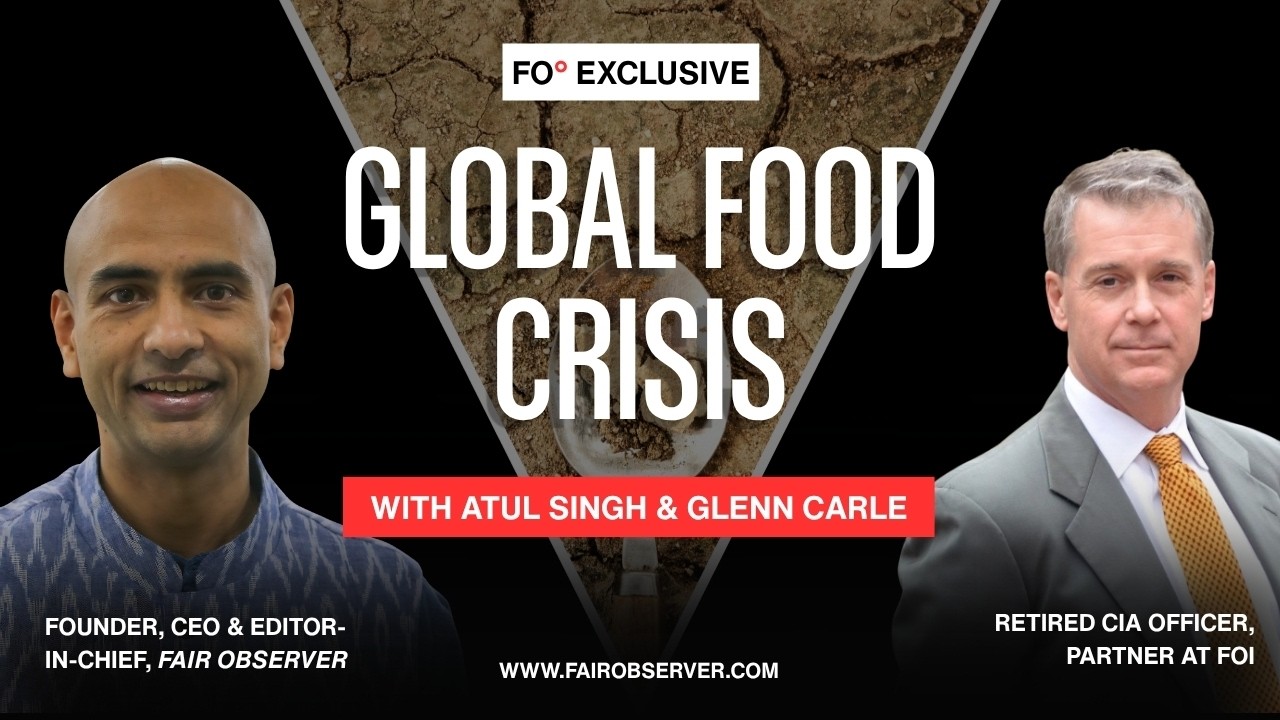
Fair Observer Editor-in-Chief Atul Singh and noted scholar Srinivas Reddy explore how the legacy of classical India survives today. They trace the historical boundaries of the classical era, reflect on the invasions that disrupted learning and examine how education, caste and elitism shaped access to Sanskrit. The dialogue also considers Indian Emperor Ashoka the Great’s moral example, contrasts the Indian system with the Western one, and highlights the need for reform and patronage if India’s heritage is to thrive again.
Defining classical India
Singh and Reddy start by deciding how they should define “classical India.” Reddy places it up to Emperor Harshavardhana; after him, Singh argues, India became “medieval” and entered “a slippery slope.” This period produced a flowering of Sanskrit literature, philosophy, architecture and spiritual traditions.
A turning point came with the Islamic invasions of the late 12th century. In 1192, Muhammad of Ghor established the Muslim empire known as the Delhi Sultanate in India, and great universities such as Nalanda were destroyed. Farsi and Arabic became the languages of administration in the North, and Sanskrit receded. Reddy stresses that while this destruction was immense, many manuscripts survive in libraries yet lie neglected. He laments that Indians express a desire to connect with the classical past, but “there’s no real transference of that desire into some action” to train students to preserve texts.
India’s Gurukul system
Education in classical India was rooted in the Guru–shishya parampara (teacher–student legacy), where students lived with teachers. Singh emphasizes that it was holistic: pupils memorized scriptures but also practiced discipline, manual labor and spiritual exercises. Oral tradition ensured continuity in an age before printing.
By contrast, Singh criticizes today’s education system, dominated by the Central Board of Secondary Education. He calls it “diabolically bad,” designed to test rote memorization and run by “exam monkeys” in the bureaucracy. Instead of cultivating curiosity, he argues, it produces graduates trained only to “remember and regurgitate.”
Who is studying Sanskrit?
Singh asks who studies Sanskrit today. Reddy replies that much philological research happens outside India, especially in Europe and the United States. Within India, it survives in universities and rituals, but mostly attracts students from modest backgrounds. He notes that Brahmans, who once monopolized Sanskrit, have abandoned it for careers in technology and business. “They want to be CEOs of Google … and Pepsi,” he remarks, which leaves Sanskrit vulnerable. Singh adds that yoga and philosophy have spurred renewed global curiosity, even as India itself neglects the field.
The legacy of Ashoka
The conversation turns to Ashoka. Reddy recalls that English scholar James Prinsep’s deciphering of the ancient Brahmi script in 1837 revealed the rock edicts and restored Ashoka’s story. Ashoka emerged as a conqueror turned moral ruler, spreading messages of tolerance and compassion. Singh even calls Prinsep the “father of modern India” for reviving this legacy. Both agree that Ashoka’s example shows how classical ideals can re-enter public life through scholarship.
How the West is different
Singh notes that his peers in the United Kingdom grew up with an “extraordinary connection” to their classical past, something he never felt in India. Reddy attributes this partly to colonialism, but also to India’s own elitism: Classical learning was confined to narrow groups, unlike the broader civic tradition in the West. Western classics emphasized politics, law and institutions, while India’s leaned toward philosophy and metaphysics. Singh suggests this helps explain why modern science developed in Europe, while India excelled in abstract thought and linguistics.
India’s caste system
Reddy emphasizes that caste was central to this exclusion. Sanskrit learning was monopolized by Brahmins, and even today, he hears arguments that only Brahmins should study it. Exclusivity preserved traditions but also bred “atrophying” and “incestuousness.” Singh suggests that rigid caste structures made India insular and ill-prepared to resist invasions. Reddy adds that while ancient texts like the Upanishads questioned hierarchy, in practice, caste severely limited access to learning. For both, caste remains one of classical India’s deepest contradictions.
Reviving classical India
What would revival look like today? Singh argues it must begin with education, with figures like mathematician Aryabhatta featured in textbooks to foster intellectual pride. Reddy agrees that such reform is “really, really important.”
Both criticize universities: Singh dismisses Indian Institutes of Technology and Indian Institutes of Management as trade schools, while Reddy calls academia “conservative” and “ideological,” failing to embrace a plurality of views. Singh also mocks both nationalist exaggerators in the Indian knowledge systems movement and “pretentious” doctrinaire leftists. Revival, both Reddy and Singh conclude, means serious scholarship free from mythmaking and ideology.
Preserving ancient texts
The preservation of Sanskrit is vital to India’s cultural history. Reddy notes that countless manuscripts sit in private or neglected collections. Singh criticizes the Archaeological Survey of India as corrupt and uninterested, while Reddy stresses that the greater problem is the lack of trained readers.
Preservation requires expertise as well as storage. Singh argues that, just as the Renaissance needed patrons like the Italian Medici family, India requires “new Medici” today — enlightened backers who see cultural rather than commercial returns. Reddy concludes that classical India will endure only if its knowledge is preserved, taught and lived.
[Lee Thompson-Kolar edited this piece.]
The views expressed in this article/video are the author’s own and do not necessarily reflect Fair Observer’s editorial policy.
































Comment