


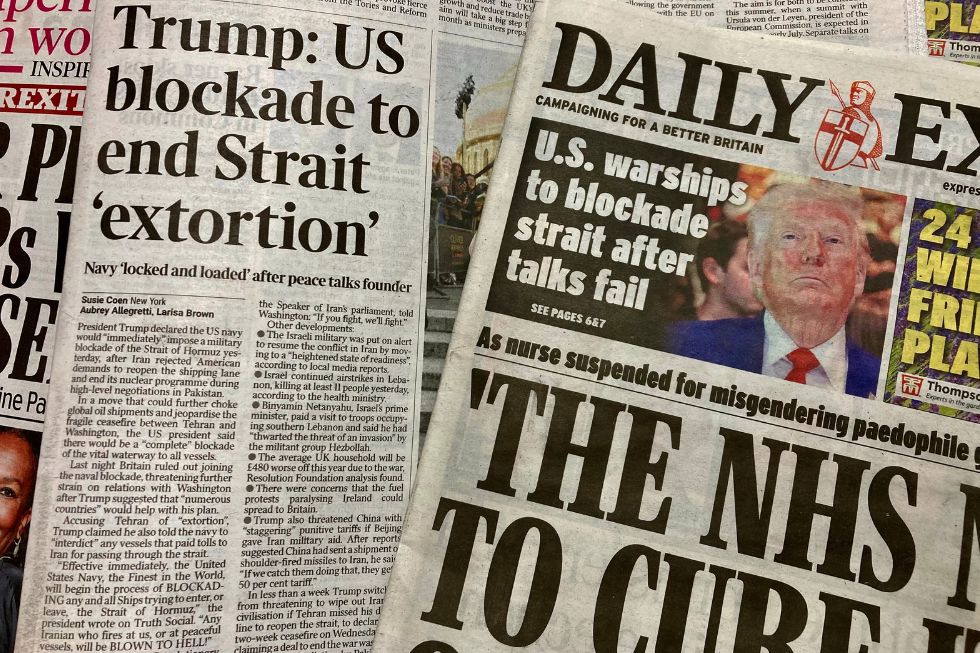



US President Donald Trump is back!
The world was waiting anxiously for his bombshell after the inconclusive talks in Islamabad. He didn’t take long to announce on his Truth Social: “Effective immediately, the United States Navy, the Finest in the World, will begin the process of BLOCKADING any and all Ships trying to enter, or leave, the Strait of Hormuz.” So, the US will now completely blockade the Strait of Hormuz, which Iran had only partially blockaded during the war.
Another strategic misadventure
Trump is a very capricious old man who will shamelessly renege on any position he has previously taken. He is also quite capable of throwing out the baby with the bathwater and shooting himself in the foot by making rash decisions that undermine his own efforts. Therefore, we can’t really say what the outcome of this situation will be. We are already hearing that the blockade will be limited to Iranian ports. But, if he presses ahead with this military action and stays the course — inspired by the US’ past blockade successes in Venezuela and Cuba — it is likely to prove to be another huge strategic miscalculation against Iran.
Iran, in my view, had initially attempted to take similar action, or at least wanted to. However, after the US and Western propaganda machine began to construct a narrative that Iran was disrupting global energy security and economy by closing the Strait of Hormuz, the country began to backtrack from its initial maximalist position. It gradually opened the strait to ease international ire and pressure by projecting a sense of normalcy along the Hormuz route, but this did not extend to its enemies.
Trump and his many advisers, it seems, have still not learned that the Middle East is not South America, and it is definitely not the US’ backyard.
Imperialist grudge
Perfected in the colonies, the Western powers — claiming to be civilized rather than savage — established a legal framework for exploiting the subjugated peoples, their lands and their resources. These laws were made by the colonial masters, who invoked, interpreted and applied them selectively to further their own metropolitan interests. In the post-colonial world, this Western imperialist practice has been institutionalized within the geopolitical landscape and extended to the whole globe, creating the so-called rules-based order that has governed international relations ever since.
After taking full control of the Strait of Hormuz during the war, Iran intends to maintain this dominance and impose a levy on tankers transporting oil and gas for safe passage. Iran argues that this is necessary to rebuild its war-ravaged country and views it as reparations for an imposed war. So far, Iran has made no rules, and it is allegedly levying transit fees selectively, exempting certain countries while charging others.
The US resents Iran’s attempt to impose its will in the region, viewing it as a disruption to the established international order. Only the US has the right to impose its will on other nations at the expense of international order; Iran cannot equate itself with the US. Moreover, this approach is seen as crude and unsophisticated compared to the Western way of “legally” advancing vested interests, although by the selective and discriminatory interpretation and application of laws and rules. However, it actually mirrors Trump’s tactics, from whom the world is quickly learning about arbitrary actions and bullying.
A coalition of international disorder
Trump claims that the Hormuz blockade will involve unspecified “other countries,” but he has not revealed which countries these partners might be. The United Arab Emirates? Bahrain? Kuwait? Who else, if the US’s European allies continue to shy away from involving their countries in the Iran war?
Israel is unlikely to act beyond securing its own national interest, and its participation in any operation to blockade Hormuz is highly doubtful. Trump can, of course, bring on board leaders such as Argentinian President Javier Milei, El Salvadoran President Nayib Bukele, Trinidad and Tobago Prime Minister Kamla Persad-Bissessar, and now acting Venezuelan President Delcy Rodríguez from his own hemisphere. He can also buy the participation of a few militarily insignificant countries in Africa, Oceania and Polynesia. However, if Trump’s Hormuz blockade coalition materializes, it will likely not represent the will of the so-called “international community.” Instead, it will harm more countries than it benefits, if it benefits them at all.
This US blockade of the Strait of Hormuz will negatively impact its own strategic partners, as well as strategic rivals and neutral countries. Disrupting the global economy will ultimately hurt the entire world. The blame for disrupting global oil and gas supplies will now fall on the US rather than Iran. After all, the Hormuz route was fully open before the Iran war.
Businesses and governments would rather pay to cross the Strait of Hormuz than have the US close the strait indefinitely. They are already facing a serious energy crisis, and a complete closure of the Strait of Hormuz would significantly exacerbate the situation. Oil is deemed more important than equality, after all.
Given the importance of the Strait of Hormuz to global energy supply, the implications extend far beyond just the businesses and governments directly involved. As tensions rise and the US maneuvers strategically in the region, another major player finds itself in a precarious position: China.
The Chinese dilemma
China may find itself cornered after this US strategic move in the Strait of Hormuz. Its Venezuelan oil supply was choked by the US just a few months ago, and now the Hormuz blockade will stop Iranian oil, necessary for powering China’s vast economic empire.
But, instead of confronting the US, China may once again chicken out as it did in Venezuela. While it verbally challenges the US with enthusiasm and responds firmly to economic pressures, it does not engage the US militarily. It seems China is waiting for its military muscle to grow bigger than that of the US. As an emerging superpower, China understandably appears to lack the confidence to directly confront a century-old reigning superpower.
However, it already has considerable military muscle, and all it needs is to flex it in the US. The right moment to act will arise, potentially in the Strait of Hormuz — though this seems unlikely, given China’s immense strategic patience and a long-term perspective. The descendants of the famous Sun Tzu, who wrote The Art of War, may strongly believe in his advice that “the supreme art of war is to subdue the enemy without fighting” and “the greatest victory is that which requires no battle.”
The Iranian response
Iran has been battered by the US and Israel’s bombing, while inflicting far less damage to its enemies. Despite this, it has won the battle of perception by staying in the fight and successfully positioning itself to negotiate directly with the US in a third country for a long-term peace agreement. Iran’s morale is high, and its image has improved significantly, surpassing that of Israel after this war. Iran has presented itself as a tough and steely nation. Israel earned a name for itself by carrying out assassinations and defeating weak Arab nations, but Iran has successfully fought both the reigning superpower and Israel. Iran has displayed its unparalleled sacrificial courage, insurmountable will to resist and inexhaustible military arsenal in an all-out war.
Iran has shown us that it is quite capable of taking on the US militarily, and its Islamic Revolutionary Guard Corps (IRGC) has indicated as much after Trump’s Hormuz blockade announcement. Iran has other options, too. To make things worse for the world, besides the Strait of Hormuz, Iran can also block the Red Sea route involving the Bab Al-Mandab Strait with the help and support of its ally Ansar Allah (the Houthis). But what if Iran prefers to sit tight and see the world react? Then, in my view, this new US military venture is unlikely to last long because the entire world, already fed up and frustrated by Trump’s unending tantrums, would likely unite against the US and force it to withdraw.
On the other hand, if Trump is employing his trademark bullying tactic to extract maximum concessions from the other party and get the most favorable deal for himself, this approach is unlikely to work against Iran, as previous military threats and actions didn’t. This behavior only shows that he and his coterie of yes-men don’t understand the character of the Iranian nation. He seems to be a prisoner of his past pressure-tactic successes. A better strategy would be to reach out in good faith and with sincere intentions, treating Iranians as equals rather than trying to intimidate them into submission for a durable peace agreement. The US has recently bombed Iran twice in the middle of negotiations, and there is absolutely no reason why they should trust the US again.
Washington’s strategic incompetence
The Iran War and the ongoing crisis in the Middle East — largely created by the US — highlight a severe strategic incompetence in Washington that is unprecedented in history. Ironically, this is the superpower with decades of accumulated collective experience in controlling the world and the best pool of geopolitical strategists, yet it finds itself in a dire situation. But what can these experts do if they are booted out, intimidated, forced to quit or altogether ignored by their government? This contradiction lies at the heart of the declining US empire, a decline that has been largely self-inflicted.
The disruption of an established order is the surest sign of the decline of a geopolitical power that had built and maintained that order. A new world order is born from the ruins of the old. The world dominated by the West is gradually realizing — and reluctantly accepting — that the locus of geopolitical power is shifting eastward, with China emerging as the new global superpower. Historically, incompetent rulers accelerate the decline of a fading empire and hasten the transition to a new power structure.
The stories we read in history about incompetent rulers at the end of a weakened empire differ from those of today in one fundamental sense: In the past, ordinary people had no say in choosing their rulers. In contrast, the US has a system in which citizens elect their leaders. Therefore, it is the citizens of the US — shaped by their educational and cultural systems — who must take responsibility if their country fades into mediocrity in the coming decades.
But who knows? Maybe I will be proven wrong, and this will not be the end of the US’ hegemony over the world. Maybe the people who voted for Trump really did want to “Make America Great Again.” The only problem with their desire is how do you make an already great thing great again? You can only make it greater, and that doesn’t seem to be happening in any sense right now, at least.
[Kaitlyn Diana edited this piece.]
The views expressed in this article are the author’s own and do not necessarily reflect Fair Observer’s editorial policy.
Beware Hubris: Trump’s Iran War Has an Ozymandias Flavor
Never short of hyperinflated self-praise and self-adulation, US President Donald Trump has been true to form regarding his blitzkrieg joint...
Nobody Cared: A Letter to the Enablers of American Collapse
This letter is addressed to America’s elite — CEOs, billionaires and politicians — who have enabled President Donald Trump’s corruption,...
Trump’s Biggest Gift to the World: Eighty-Year US Protective Shield Shattered by Iran in Eight Days
Iran’s decisive retaliation against US and Israeli military aggression has shattered the long-standing perception of the US as a global...
Support Fair Observer
We rely on your support for our independence, diversity and quality.
For more than 10 years, Fair Observer has been free, fair and independent. No billionaire owns us, no advertisers control us. We are a reader-supported nonprofit. Unlike many other publications, we keep our content free for readers regardless of where they live or whether they can afford to pay. We have no paywalls and no ads.
In the post-truth era of fake news, echo chambers and filter bubbles, we publish a plurality of perspectives from around the world. Anyone can publish with us, but everyone goes through a rigorous editorial process. So, you get fact-checked, well-reasoned content instead of noise.
We publish 3,000+ voices from 90+ countries. We also conduct education and training programs
on subjects ranging from digital media and journalism to writing and critical thinking. This
doesn’t come cheap. Servers, editors, trainers and web developers cost
money.
Please consider supporting us on a regular basis as a recurring donor or a
sustaining member.
Will you support FO’s journalism?
We rely on your support for our independence, diversity and quality.





Comment