


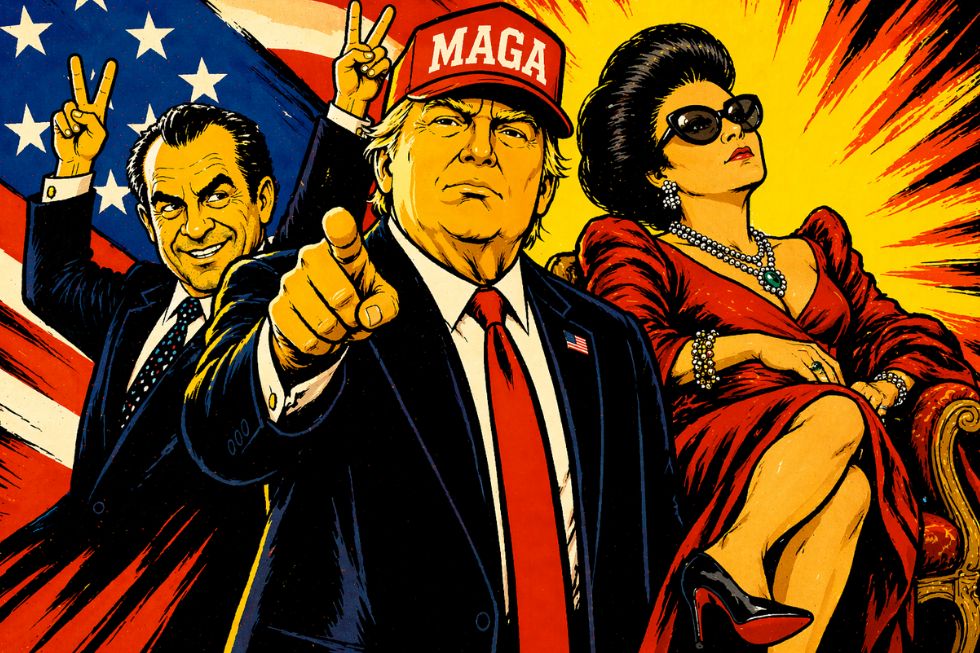


Russian President Vladimir Putin launched Russia’s invasion of Ukraine on February 24, 2022. Donald Trump assumed the US presidency on January 20, 2025. Would Putin have risked a years-long war if Trump had been in the White House at the time of his attack?
As journalist Janan Ganesh recently wrote in the Financial Times, “Trump is the one US president elected this century under whose watch Russia has not launched a foreign invasion. Putin attacked Georgia under George W Bush, Crimea under Barack Obama and Ukraine entire under Joe Biden.” The pattern is suggestive, if not conclusive.
Calculated unpredictability
Many observers have portrayed Putin as a deranged autocrat bent on restoring a lost empire, surrounded by subservient aides too intimidated to challenge him. Yet, over time, his behavior has come to seem grimly legible. His aims are extreme but comprehensible; his methods brutal but procedural. He is consistent — consistently malign, perhaps, but consistent.
Trump, by contrast, presents a different figure. He is erratic, self-contradictory and prone to sudden shifts in manner and position. Where Putin’s menace is intelligible, Trump’s is properly inscrutable. And that difference raises the possibility that not knowing someone may itself function as a form of power.
This is the essence of what Ganesh calls Madman Theory. More a strategy than a theory, it involves a political leader deliberately cultivating the appearance of irrationality so that neither adversaries nor allies can reliably anticipate responses. All they can do is act with caution. The leader need not be mad, but others must not be certain. The seed of doubt is crucial.
Ganesh illustrates this with former US President Richard Nixon, who presided over the nation from 1969 to 1974, a period overshadowed by the Vietnam War. Nixon’s Secretary of State, Henry Kissinger, was tasked with negotiating American withdrawal. Nixon, with Kissinger, incubated a stratagem: to convey to North Vietnam that the president was unstable, beyond even Kissinger’s control. Thus, Kissinger could imply in negotiations that Nixon might take extreme measures — even nuclear ones — regardless of advice.
Picture it: After hours of high-level talks with Vietnamese negotiators Lê Đức Thọ and Xuân Thủy, Kissinger concludes, “Excellent. I’ll take this back to the president. But honestly—he might throw it in the trash.” The goal was simple: force concessions by making the consequences of resistance unknowable and potentially catastrophic.
This was Madman Theory in its purest form: calculated unpredictability. Nixon himself did not appear overtly unhinged to the American public, at least not before the Watergate scandal. But he wanted adversaries — and even allies — to believe that he might be. The performance of instability was designed to create leverage.
Yet even here, the results were ambiguous. The war dragged on; the costs were immense; the strategy failed to produce decisive gains. As Ganesh observes, the problem is built into the logic: If the threat is too extreme, it lacks credibility; if carried out, it becomes catastrophic.
Genghis Khan, Stalin, Hitler and Marcos
In the 1532 political treatise The Prince, philosopher Niccolò Machiavelli argued that rulers must sometimes act immorally, inconsistently and against expectation. It’s safer to be feared than loved, if one can’t be both. Appearances matter. Machiavelli understood the uses of terror, ambiguity and deliberate inconsistency. He admired deacon Cesare Borgia, whose ruthlessness and unpredictability helped secure his power.
While Machiavelli didn’t cite Genghis Khan, the latter embodies many of these principles. Khan’s backdrop was the tribal, wind-scoured steppe of Inner Asia in the late 1100s. His reputation for sudden, overwhelming violence was not incidental to his success — it was central. Cities that resisted could expect annihilation; those that submitted might be spared.
The effect was psychological as much as military. Opponents did not merely calculate their chances; they confronted the possibility of total destruction at the hands of a leader who seemed to operate beyond restraint. Whether Genghis Khan was irrational is beside the point; others behaved as if he might be.
Joseph Stalin operated in a very different setting: the bureaucratic, industrializing Soviet state of the 20th century, where power was exercised through institutions, purges and fear. As General Secretary of the Communist Party, he inherited the machinery of Vladimir Lenin but took it in a direction few anticipated. His Five-Year Plans transformed the economy at immense human cost, while purges eliminated enemies, real and imagined. Even fellow revolutionaries were not safe: Leon Trotsky was exiled and eventually assassinated.
Crucially, Stalin’s rule was characterized not just by brutality but by unpredictability. Decisions appeared arbitrary; loyalties could reverse overnight. No one could be certain of the limits, because there were none.
Adolf Hitler followed a different path but produced a similar effect. His rise depended on fusing charismatic authority with national identity. Once in power, he defied conventional constraints. His impulsive, ideological and often strategically baffling leadership confounded allies and enemies alike. There were assassination attempts, even from within his own ranks, yet he retained intense loyalty from figures such as Luftwaffe Commander-in-Chief Hermann Göring.
In all of these cases, the pattern is evident: power reinforced by the perception that the leader might act beyond reason, beyond norms, beyond comprehension. The onus is on the leader to sustain that image — psychopath, megalomaniac, obsessive — but never a rational, calculating figure. Madman Theory doesn’t depend on whether the image is true or make-believe. What matters is that others believe it. And the others include followers, friends and, most importantly, enemies.
A more modern and very different case is Imelda Marcos, the former First Lady of the Philippines. She doesn’t belong in quite the same category as the great tyrants of the 20th century, nor did she wield power in the same way. Yet her public persona introduced a distinct, perhaps unique, form of unpredictability. Her rule, alongside President of the Philippines Ferdinand Marcos, was marked not only by abrupt interventions but by extraordinary extravagance. Where others projected menace through violence, Marcos added theater: excess itself became a signal, unsettling in its disregard for restraint. She famously owned 1,000 pairs of shoes, bought perfume by the gallon and once splurged $7 million on jewelry.
This was not madness in any clinical sense: It was performative extravagance, an idiosyncratic form of power that kept her followers in awe. Madman Theory need not be fully realized; even its partial expression can shape how others respond.
Trump and the value of uncertainty
And so to today — and a plan that seems crazed, until it starts working. Trump has certainly unnerved the world. His expletive-loaded posts alone betray the lack of dignity and respect typically associated with world leaders. Then there is his penchant for fabrication, and his unfulfilled threats. Often, his hyperbole is excused as “tough rhetoric,” but is that all it is? Trump’s impulsivity seems almost too outlandish to be genuine. Surely no human being, never mind an elected president could think and behave so preposterously. Surely.
To be fair, he is not the only political leader to unsettle observers. Putin’s prosecution of the Ukraine war has raised persistent concerns about escalation. North Korean Supreme Leader Kim Jong Un, has long alternated between provocation and restraint, keeping adversaries uncertain whether they face calculated brinkmanship or something less controllable. Trump belongs, at least in part, in this company.
So, is Trump’s apparent madness real or strategic? His record allows for both interpretations. Allies are praised, then rebuked, sometimes in language that veers from jocular to incendiary. Even high-stakes diplomacy is reduced to the language of “deals,” as if geopolitical conflict were a used car sale.
Surely, other politicians suspect Trump’s departures from established norms are sometimes so aberrant that it’s hard to imagine he actually meant them. But even if they suspect design, they remain uncertain regardless.
It’s not difficult to imagine how this might shape decision-making in Moscow. Let’s return to the question raised in our opening paragraph. Picture Putin at his long table in the Kremlin, advisors gathered at a careful distance.
“We should anticipate what Trump will do,” he begins.
“Nothing,” one replies. Ukraine is not part of NATO.
“You think a technicality constrains him?” another asks. “He may arm them heavily. He may even place American missiles within reach of Moscow.”
“That would be crazy.”
“And…?”
Silence.
That silence is the point. The problem with a “madman” is not that he will act, but that he might — and that no one can be sure how far he would go. Faced with such uncertainty, even a nerveless leader may hesitate.
This doesn’t mean Trump has consciously revived Nixon’s strategy. The simpler explanation that he is erratic rather than strategic remains plausible. Nor does it mean Madman Theory always works; history offers as many warnings as endorsements.
But it does suggest an answer to the opening question. Would Putin have invaded Ukraine if Trump had been in the White House? Probably not. Not because Trump would certainly have acted, but because Putin couldn’t have been certain that he wouldn’t.
[Ellis Cashmore is the author of The Destruction and Creation of Michael Jackson.]
[Lee Thompson-Kolar edited this piece.]
The views expressed in this article are the author’s own and do not necessarily reflect Fair Observer’s editorial policy.
TRUMP vs. the BBC
US President Donald Trump’s lawsuit against the BBC is scheduled to see trial in February 2027. Trump is suing Britain’s...
Should FIFA Pull the World Cup Out of the US?
Former FIFA President Sepp Blatter is urging fans to boycott the 2026 World Cup in the United States, citing recent...
No, the Ban on Russian Athletes Should Not Be Lifted
International competitions are sources of national pride and national prestige, particularly for countries with autocratic regimes.

Support Fair Observer
We rely on your support for our independence, diversity and quality.
For more than 10 years, Fair Observer has been free, fair and independent. No billionaire owns us, no advertisers control us. We are a reader-supported nonprofit. Unlike many other publications, we keep our content free for readers regardless of where they live or whether they can afford to pay. We have no paywalls and no ads.
In the post-truth era of fake news, echo chambers and filter bubbles, we publish a plurality of perspectives from around the world. Anyone can publish with us, but everyone goes through a rigorous editorial process. So, you get fact-checked, well-reasoned content instead of noise.
We publish 3,000+ voices from 90+ countries. We also conduct education and training programs
on subjects ranging from digital media and journalism to writing and critical thinking. This
doesn’t come cheap. Servers, editors, trainers and web developers cost
money.
Please consider supporting us on a regular basis as a recurring donor or a
sustaining member.
Will you support FO’s journalism?
We rely on your support for our independence, diversity and quality.





Comment