



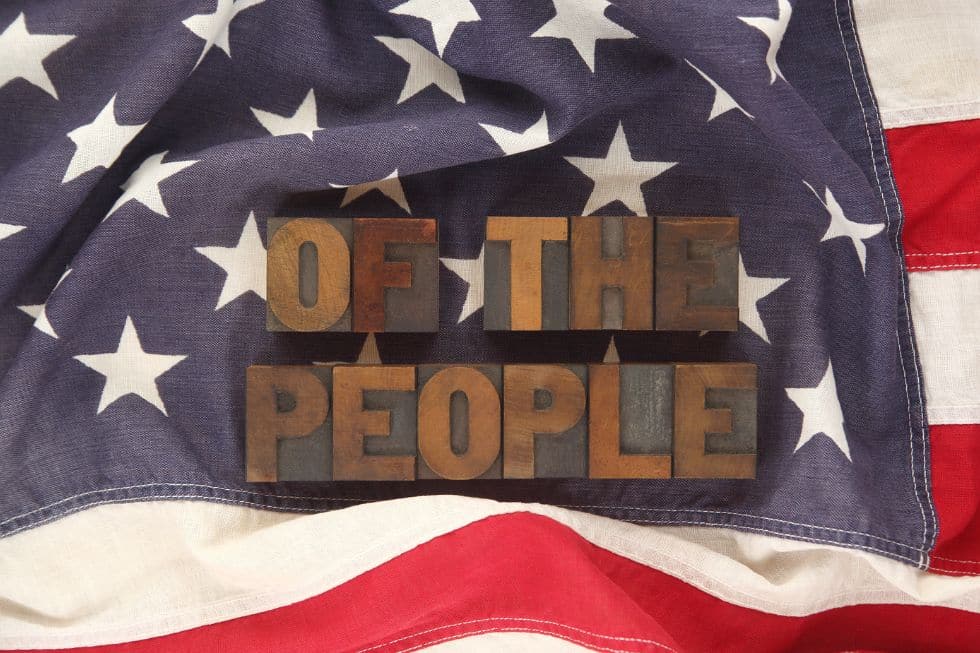



When citing famous historical quotes that have had a deep influence on the way we all think about democratic institutions as well as democracy itself, it may sound like captious quibbling to point to a problem with the use of prepositions. Who hasn’t been inspired by US President Abraham Lincoln’s elegant assessment of democracy in his Gettysburg Address as “a government of the people, by the people, for the people?” Amidst a murderous civil war, the most costly in the nation’s history, Lincoln reminded the world that it was the people who ruled.
Or did he? Most people remember the phrase as “government of the people, by the people, and for the people.” This is a misreading. Lincoln’s text did not include the word and. Perhaps he intended to include a fourth preposition to complete the idea that equates democratic institutions with the realization of the popular will? If so, logic tells us the missing preposition can only be with.
What precisely was Lincoln’s message besides cheering on the troops? A government “of the people” points to the demography of democracy. The government consists of common people, not a designated ruling class. A government “by the people” appears to refer principally to the legislators who write the laws. Just as we say King Lear is “by” William Shakespeare, we see the government in the United States as the creation of ordinary citizens, who write and enforce its laws.
Lincoln’s third phrase — “for the people” — signifies that the US government is focused on responding to the needs and interests of the citizenry. The three prepositions — of, by and for — make it clear that all Americans have a stake in the government. Lincoln’s formulation also informs us that the government, so long as it does not “perish from the earth,” will always be under popular control.
So, what about the fourth preposition Lincoln failed to mention: with? A democracy that sees itself as being with the people is one that seeks actively to include their voice in a collaborative way. It goes further than the somewhat deceptive concept of “representative democracy,” a phrase that has become something of a stale formula. Pedantically reminding people that the US is a republic that practices representative democracy may be tantamount to telling people simply to “Shut up and vote!”
In the age of electronic communication and social media, we may be justified in believing that a true democracy not only recognizes but positively seeks to affirm the communicative role the people are called upon to play. And by people, I’m not referring to a majority faction or a party with a platform. The “people” Lincoln had in mind were the vast majority, which tellingly also includes and embraces minorities, even former African slaves.
Politicians who seek to govern “with” the people will not think of themselves as an elite coterie of sages designated through elaborate electoral processes and empowered to make decisions on their own and amongst themselves. In a true democracy, responsible politicians should see themselves as agents engaged in a permanent state of creative dialogue with the citizenry.
Majorities, minorities and inclusion
It would be abusive on my part to expect a speech composed during wartime on the back of an envelope to be the occasion for defining a nation’s system of governance. (Granted, the envelope in the train is just a charming myth dismissed by serious historians). More to the point, Lincoln’s 1863 Emancipation Proclamation decreeing the end of slavery had the effect of redefining the meaning of “people.” It would be formalized five years later in the Fourteenth Amendment.
Thomas Jefferson’s own proclamation that “all men are created equal” took on a new meaning. The founders had a far less popular view of both “all men” and “people.” They understood that Americans involved in politics, endowed with an equal right to govern, were white, male, literate, English-speaking property owners. After Lincoln, the very idea of “the people” (and who could be included among them) was expanded. A government of, by, for and eventually with the people would henceforth take on a different meaning.
It took a French aristocrat, Alexis de Tocqueville, half a century after the nation’s birth, in the 1830s, to offer the first comprehensive analysis of how democracy actually functioned in the US. He understood that democracy was not just a clever innovation or political gimmick. He saw clearly that it represented the wave of the future. In his iconic book, Democracy in America, he predicted that France itself was trending away from traditional monarchy towards a democratic system that would seek to avoid the destructive revolutionary fervor his nation had painfully experienced.
Despite his own aristocratic roots, Tocqueville appreciated the idea that US democracy aimed at the “well-being of the greatest number” rather than the glory of a few. He was fascinated by the energy of Americans and their capacity to form associations, build things and participate in civic life. He noted that Americans respected laws because they believed they had a hand in making them. He admired the idea of government of, by, for and even with the people. But not without a few qualms and reservations. He famously remarked that he knew of no country where there was “less independence of mind and true freedom of discussion than in America.” And that was a century before the rise of mass media and the rise of a powerful “cancel culture.” Both of these forces now appear conjoined to suppress “independence of mind” by controlling the topics and terms of discussion.
Tocqueville saw the democratization of politics in the West as an inexorable trend that it would be futile for defenders of the established order to oppose. He saw democracy as a source for welcome creativity. But he had no illusions about some of the jingoistic claims to ensuring human liberty in the “home of the brave and land of the free.” He analyzed in detail the power of the new democracy to impose and enforce “conformity of thinking.” He called it the “tyranny of the majority.” “Despotism,” he wrote, “lies at both extremes of sovereignty: when one man reigns, and when the majority governs. Despotism is tied to omnipotence, whatever its bearer.” When the “brave” majority achieves omnipotence, it ends up ruling and even abusing the “free.”
The new omnipotent order
A lot has happened on both sides of the Atlantic Ocean since the publication of Democracy in America. Without being explicit, the secular, egalitarian, democratic West has created a modern equivalent of the traditional Christian Nicene Creed, a litany of dogmas designed to encapsulate the beliefs to which the faithful should adhere. The new unwritten secular Western creed, conveyed by force of repetition through the discourse of politicians and the reporting of the media, stresses four key notions we are all called upon to believe in: democracy, human rights, freedom of speech and economic progress provoked by capitalistic competition.
Most people perceive these as wonderful things to believe in, which is what a creed is all about. But how real, complete or even compatible are they? Do they translate into coherent behavior? Some people use the noble idea of human rights to instill the simplistic and misleading belief that the world is neatly divided into democracies who rigorously apply human rights and autocracies who abuse them. This induces the derivative belief that “We’re fully human and the others aren’t.”
As for freedom of speech, Tocqueville already noted the gap between speech and thought. The relative anarchy of thought implied by the First Amendment had the unfortunate effect of dumbing down America’s political culture. “The characteristics of the American journalist,” Tocqueville writes, “consist in an open and coarse appeal to the passions of the populace.” At the same time, he dared to proclaim his “love” of freedom of the press. “I admit that I do not feel toward freedom of the press that complete and instantaneous love which one accords to things by their nature supremely good. I love it from the consideration of the evils which it prevents more than from the goods which it does.”
Freedom of the press two centuries later
As Tocqueville predicted, over the past two hundred years, the formerly monarchic nations of Europe have broadly adopted the “democratic ideology” forged initially in the US. Today’s evolved democracies have reformulated the ideology as a virtual creed intended to differentiate us from all those other nations we condescendingly refer to as autocracies. This was the distinction that US President Joe Biden and UK Prime Minister Boris Johnson mobilized to justify their first, Biden’s refusal to negotiate a common security architecture with Russia that might have avoided war, and a few months later to dismiss an already initialled peace plan that would have halted the hostilities following Russia’s invasion of Ukraine. The credo did its intended job, making it possible to extend the war far into an undefined future.
European governments continue to proclaim their commitment to the four core values of what has become the tacitly accepted “transatlantic creed:” democracy, human rights, freedom of speech and progress. Since we all agree on the basics, we might expect that all should be fine and dandy in the peaceful climate Europe has enjoyed so continuously since the end of World War II. Haven’t we achieved a state of permanent tranquillity sealed by the harmonious association of the 27 independent nations currently grouped together in the European Union?
But when we look at the way the core value of freedom of expression plays out today, we have to wonder whether the creed still makes any sense. Governments and private interests collaborate routinely, through their control and manipulation of official media, to impose a “tyranny of the political majority” that disseminates the credo. We call it “manufacturing consent.” But if that wasn’t enough, they are increasingly resorting to extrajudicial acts to silence individuals who question any of the acts of the democratically-elected majority, to say nothing of the undemocratically appointed rulers who make up the European Commission.
Three prominent cases of the flagrant subversion of freedom of expression have earned public attention just in the past year. The new Trump administration imposed on United Nations rapporteur and Italian national Francesca Albanese a range of debilitating sanctions which she describes as “civil death.” They include a total block on all her property and interests in property subject to US jurisdiction, prohibitions on US persons or entities providing her with any funds, goods or services, and a travel ban. Her crime consisted of doing the job she was hired to perform: to investigate and report on the reality of the situation in occupied Palestine. She failed to realize that, in today’s American democracy, freedom of speech did not extend to using words such as “apartheid” and “genocide” when speaking about Israel, even when observable conditions justified their use.
Although neither the European Commission nor European nations have applied or even approved Trump’s sanctions, European banks have almost universally complied. This is known as “over-compliance” or the “extraterritorial effect.” Perhaps those words belong somewhere in the credo.
Then there’s the case of Swiss citizen, former NATO intelligence officer, Jacques Baud. He doesn’t share the point of view of his ideological masters concerning the historical context of the war in Ukraine, about which he happens to be particularly knowledgeable. But knowledge, he now understands, cannot be used as a pretext to contradict elements of the credo. He too has been subjected to an Asset Freeze as his bank accounts in the EU were frozen, leaving him, by his own account, unable to buy food or pay for basic necessities initially. Although a Swiss citizen, because he was working in Brussels when the sanctions were passed, he finds himself currently “trapped” in the EU, unable to travel through the Schengen Area or return to Switzerland. EU entities are prohibited from providing him travel services. Like Albanese, Baud was sanctioned via an executive “designation” rather than a criminal conviction or a court trial, leading his lawyers to argue a violation of the “presumption of innocence.”
Another European citizen subjected to similar treatment, this time by Germany, is Hüseyin Doğru, a German citizen of Turkish-Kurdish origin based in Berlin. His crime, much like Baud’s, is to have written things leaving the impression for some that he may be a “Russian disinformation agent.” Even more irritating for the German government is his reporting on the Israeli occupation of Palestine. This enables them to claim he has “systematically spread false information on politically controversial subjects with the intent of creating ethnic, political and religious discord among its predominately German target audience.”
Doğru too has been subjected to an Asset Freeze as all his bank accounts were frozen instantly, a “Provision Ban” that makes it a criminal offense for anyone to provide him with funds or economic resources. The German authorities (the Central Office for Sanctions Enforcement) also seized his wife’s bank accounts.
The case of Fair Observer author, Dr. Valery Engel
The most recent case strikes close to home for the team at Fair Observer. We regularly publish articles by historian Dr. Valery Engel. Although an Israeli and Russian citizen, he has made his home in Latvia since 2008 after marrying a Latvian citizen. The state has now declared him Persona Non Grata and placed him on a blacklist, effectively banning him from entering or residing in the country. His wife and two children live in Latvia and depend on him for their livelihood.
In April, Engel wrote to us to share the following information. “I finally received a letter from the Latvian political police, citing three of my publications in Fair Observer as the reason for my blacklisting.”
As readers of Fair Observer should know, our editorial team respects and practices the kind of freedom of expression the authors of the US constitution appeared to believe in. The constitution’s First Amendment specifically mentions “the freedom of speech, or of the press.” We respect the freedom of expression of our authors, while at the same time requiring that they respect the facts. Moreover, as an organ of the press, we expect that our own freedom to publish authors with a diversity of points of view will be respected, especially by governments that claim to believe in democratic values.
At Fair Observer, we do not discriminate against any political or ideological position, even ones our editors find abhorrent, so long as the author respects the facts and avoids recognizable disinformation. Engel’s columns for us have all been edited with the utmost editorial rigor. We found nothing in his writing that violated our strictest standards. We stand by our judgment that these articles contained well-reasoned discussions of issues of real interest to our readers. We understand that some people and indeed some governments may interpret the facts differently and may wish that certain issues be passed in silence.
I personally appreciate the historical perspective that Engel, an expert in minority rights, has brought to our attention. Just as I appreciate the lessons a French aristocrat whose book published in 1840 taught me about possible abuses of democracy in my own home country due to an unfortunate tendency towards tyranny of the majority.
The Fair Observer team has seen the accusations the Latvian government leveled at Engel on the basis of articles we have published. We find those accusations to be the result of misreading the text. The fact that such misreading can be used to justify persecution of an individual, for whom the profoundly democratic idea of “presumption of innocence” has been suspended, leaves our editorial board speechless. We sincerely hope that the Latvian government will find inspiration from the transatlantic credo celebrating human rights that is increasingly abused to justify actions taken in clear violation of the credo’s spirit.
*[The Devil’s Advocate pursues the tradition Fair Observer began in 2017 with the launch of our “Devil’s Dictionary.” It does so with a slight change of focus, moving from language itself — political and journalistic rhetoric — to the substantial issues in the news. Read more of the Fair Observer Devil’s Dictionary. The news we consume deserves to be seen from an outsider’s point of view. And who could be more outside official discourse than Old Nick himself?]
The views expressed in this article are the author’s own and do not necessarily reflect Fair Observer’s editorial policy.
Questioning the “One Person, One Vote” Principle in Western-Style Democracies
It’s irrational to think that a mere majority of voters can make informed, rational decisions about which leaders can solve...

The Biden Report: No Wars To Be Seen
Under pressure from the tenors of his party’s establishment, Joe Biden officially committed to becoming a lame duck. That political...
This Is Why the Russian People Chose Imperialism for Survival
Russia's anti-Western sentiment has become a unifying ideology that justifies its aggressive foreign policy. However, traditional values promoted by the...
From Revolutionary War Victory to Now, America Carries On
Growing up in small-town Oklahoma and now living in Washington, DC has shaped the author’s perspective on the United States....

Big Danger After Biden’s Broken Promise on Russia
Joe Biden promised to avoid war with Russia. However, the US and NATO are increasingly involved in Ukraine. The escalation...
Support Fair Observer
We rely on your support for our independence, diversity and quality.
For more than 10 years, Fair Observer has been free, fair and independent. No billionaire owns us, no advertisers control us. We are a reader-supported nonprofit. Unlike many other publications, we keep our content free for readers regardless of where they live or whether they can afford to pay. We have no paywalls and no ads.
In the post-truth era of fake news, echo chambers and filter bubbles, we publish a plurality of perspectives from around the world. Anyone can publish with us, but everyone goes through a rigorous editorial process. So, you get fact-checked, well-reasoned content instead of noise.
We publish 3,000+ voices from 90+ countries. We also conduct education and training programs
on subjects ranging from digital media and journalism to writing and critical thinking. This
doesn’t come cheap. Servers, editors, trainers and web developers cost
money.
Please consider supporting us on a regular basis as a recurring donor or a
sustaining member.
Will you support FO’s journalism?
We rely on your support for our independence, diversity and quality.





Comment