





US President Donald Trump built a chunk of his political identity on being embraced by the hardest men in America: Ultimate Fighting Championship (UFC) champions, cage fighters, action stars built like tanks. That embrace is starting to break, and it’s breaking loudest from the men who are supposed to be its most reliable messengers.
This week, actor Alan Ritchson — six-foot-two, the man who plays Jack Reacher on Amazon, a character built to be the most physically dominant person in any room he enters — said on a podcast that Trump is raping the world for his own personal gain. Weeks earlier, Sean Strickland, the reigning UFC middleweight champion, described standing inside a Trump rally and realizing, in his words, that he could see exactly how German Dictator Adolf Hitler happened. Not a rally, he said. A cult.
Two of the most physically imposing men in American pop culture, using the same register of alarm, within weeks of each other, about the man their world spent a decade helping put in office.
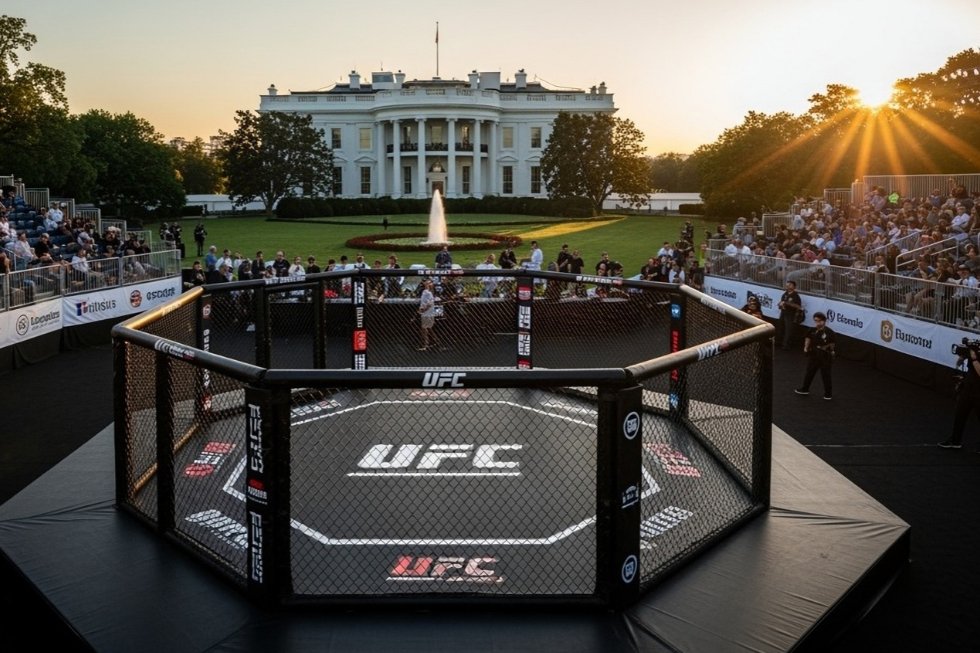
Ritchson wasn’t finished. On the same podcast, with actor Dax Shepard, he said the White House itself was “in ruins,” a UFC cage bolted straight onto the lawn, and that nobody involved was facing any consequences. A few days before that, on a different show, he’d gone further and demanded the release of the Epstein files, all but saying Trump belonged in prison over them.
Conservative fans of his own show and fellow actors turned on him within hours. Kevin Sorbo told him to keep his mouth shut. Dean Cain, who recently announced he’d been sworn in as an honorary Immigration and Customs Enforcement (ICE) agent, told him to take a pill and disappear. The White House put out a statement calling him a hack.
Strickland’s break runs deeper, because he’s not an actor playing a tough guy. He’s the actual UFC middleweight champion, a man who campaigned for Trump on camera in 2024. This year he claims he was banned from Trump’s White House birthday event over comments he made about Israel and the Epstein files. He showed up anyway, and the Secret Service walked him out while the crowd booed the agents, not him.
Bryce Mitchell, a UFC fighter who once said publicly he’d take a bullet for Trump, spent the back half of last year calling him the Antichrist. This year he came out in support of Strickland’s break from the movement.
Three of the most physically dominant men in American pop culture right now (a reigning UFC champion, a ranked UFC contender and network television’s biggest action star) are all cracking on the exact same fault line within weeks of each other. That’s not a coincidence. To understand what’s actually splitting apart here, you have to understand what this sport is, where it came from and why a certain kind of man has always been drawn to watching other men hurt each other for sport.
The oldest show on earth
That draw isn’t new, and it isn’t really about Trump. Two thousand years before anyone built an octagon, Rome packed 50,000 people into the Colosseum to watch gladiators, most of them slaves or condemned men with nothing left to lose, fight to serious injury or death for a crowd that came specifically to see who could take the most punishment and still keep standing. It wasn’t really about violence for its own sake. It was about proving something: that some men are simply built tougher than others, and that watching that proof happen live, close enough to feel it, does something to a crowd that no other form of entertainment quite matches.
Modern combat sport is a direct descendant of that impulse, sanded down and legislated into something a state athletic commission will license, but the appeal hasn’t changed much. Men who feel unseen or unimportant in their daily lives can watch two extraordinary athletes settle an argument the oldest way there is, with nothing but skill and will between them, and feel something like a proxy for their own toughness. That’s not an insult to the fans. It’s just an honest account of why this sport pulls the crowd it pulls, and why the men at the center of it get treated less like athletes and more like living myths.
Where mixed martial arts actually started
If you’ve never watched a fight and don’t know your jiu-jitsu from your judo, here’s the short version. In 1993, a Brazilian family called the Gracies put together an event in Denver built around one argument: their family’s style of grappling, quiet and patient and nothing like the punching matches audiences expected, could beat any other fighting style on earth no matter how much bigger the opponent was.
Royce Gracie, skinny even by normal standards, choked out much larger men in an eight-man, one-night tournament with almost no rules at all. No weight classes. No time limits. No gloves. The only real fouls were eye-gouging and groin strikes, and even those weren’t strictly enforced.
It was sold as a freak show, a way to settle drunken bar arguments about karate versus wrestling versus boxing. It worked well enough to draw serious backlash. Senator John McCain got the whole enterprise banned in 36 states by calling it human cockfighting on the Senate floor.
The sport survived because a casino owner in Atlantic City didn’t care what senators thought of blood sport. Trump agreed to host an event there in November 2000, the same year the sport adopted the rulebook it still uses today in modified form: weight classes, five-minute rounds (three for a normal fight, five for a title bout), judges scoring on a ten-point scale and a real list of banned moves — no eye-gouging, no groin strikes, no headbutts, no strikes to the back of the skull or spine. Trump sat cageside for every fight, both nights he hosted, and the UFC’s president, Dana White, never forgot it.
Japan’s other cage, and why it mattered
While the American version was cleaning itself up with rules and regulations, Japan built its own version that stayed closer to the sport’s brutal roots. From 1997 to 2007, a promotion called PRIDE Fighting Championships ran enormous, packed events in Tokyo, and for a stretch it was arguably bigger and more prestigious than the UFC. PRIDE fights allowed things American commissions wouldn’t: knees and stomps and soccer-style kicks to the head of an opponent who was already down on the ground, the exact techniques the American rulebook eventually banned outright.
PRIDE collapsed for reasons that had nothing to do with the fighting and everything to do with who was funding it. A Japanese tabloid published allegations tying the promotion’s ownership to the yakuza, the country’s organized crime syndicates, and once the accusations went public, Fuji Television dropped PRIDE’s broadcast deal entirely, cutting off the money that kept it running. Without television revenue, the company couldn’t survive, and in 2007 it sold its entire operation, including its biggest stars, to Zuffa, the UFC’s parent company, for somewhere around $70 million. That’s part of why old mixed martial arts (MMA) footage from Japan can look shockingly violent by today’s standards: For a decade, the sport’s biggest stage allowed things it doesn’t anymore.
The stars who built the myth
American MMA’s own rules produced a run of fighters who were genuinely frightening to watch and somehow still likable. Chuck Liddell knocked people unconscious standing up because he refused to fight anywhere else, even when it would have been smarter to. Anderson Silva got so far ahead of the sport during a seven-year unbeaten title reign that he’d drop his hands and dodge punches for fun mid-fight. Georges St-Pierre was so clinical he barely seemed to break a sweat.
Ronda Rousey deserves more than a passing mention because she genuinely changed what the sport was allowed to be. Before her, the UFC didn’t have a women’s division at all, and Dana White had said publicly, more than once, that it never would. Rousey, an Olympic judo bronze medalist with a signature armbar that ended fights in seconds, made that position untenable simply by being undeniable. She ran her record to 12 wins with zero losses, finished most opponents in under a minute and became the first UFC women’s champion in history, dragging an entire division into existence around her. Then, in 2015, Holly Holm caught her with a head kick that ended the run in one night. But the damage to the old assumption was already done. Women’s MMA exists as a mainstream draw today because Rousey made it impossible to argue otherwise.
Brock Lesnar tells a different, stranger story about how far a body alone can carry someone. Already a former World Wrestling Entertainment (WWE) champion and an actual National Collegiate Athletic Association (NCAA) heavyweight wrestling champion before he ever set foot in a cage, Lesnar turned pro in MMA in 2008 and, in only his fourth professional fight, knocked out Randy Couture to win the UFC heavyweight title, an almost unheard-of speed of ascent in a sport where most champions need years to earn a title shot. His career ended in controversy: he came out of retirement in 2016 for one fight against Mark Hunt, won by decision and was then flagged for multiple failed drug tests around the event, with the result eventually overturned to a no contest. He went back to WWE and never fought in the UFC again.
Then there’s Jon Jones, probably the single most talented fighter the sport has ever produced. In 2013, defending his light heavyweight title against a Swedish underdog named Alexander Gustafsson, Jones got taken down and outboxed for four rounds, cut and bleeding for the first time in his career, and had to fight from behind to survive a split decision in what’s still argued over as one of the greatest title fights the sport has ever seen.
That same appetite for chaos and control defined Jones’s whole career, on both sides of the ledger. Failed drug tests, a hit-and-run arrest, a title stripped after a backstage cocaine incident hours before he was supposed to defend it, all of it happening around a fighter nobody could actually beat in the cage. His last fight came in November 2024, against former two-time champion Stipe Miocic at Madison Square Garden, with Trump himself sitting cageside. Jones dismantled a 42-year-old Miocic across three rounds, worked his body with punches until Miocic’s hands started dropping and finished him with a spinning back kick to the ribs that folded him in half, the kind of strike that looks almost impossible until you watch it land. Miocic retired on the spot. Jones, celebrating, broke into an impression of Trump’s campaign-rally dance in the middle of the Octagon. He retired himself in June 2025, still unbeaten in every contest he’d finished clean.
Then Conor McGregor arrived and did more to make this sport a global phenomenon than anyone since the Gracie family. His breakthrough came in December 2015 against Jose Aldo, the featherweight champion who hadn’t lost a fight in a decade and had beaten 18 opponents in a row. McGregor had spent months publicly guaranteeing he’d end it fast. Aldo swung first. McGregor slipped it and landed one short left hook on the button, and Aldo simply collapsed, out before he hit the canvas, 13 seconds into the biggest fight of both men’s lives, still the fastest finish in UFC title history.
McGregor’s other defining fight is remembered less for what happened in the cage than for what happened after it. In October 2018, at UFC 229, he challenged Khabib Nurmagomedov for the lightweight title after a build-up so venomous it included McGregor throwing a hand truck through the window of a bus carrying Khabib’s teammates. Khabib dominated him for three rounds and choked him unconscious in the fourth, then climbed the cage wall and leaped into the crowd to attack a member of McGregor’s team, setting off a full-scale brawl, fighters and cornermen throwing punches inside and outside the Octagon while security tried to pull bodies apart. It remains one of the ugliest and most-watched endings in the sport’s history, a night when the theater of hatred the two men had built to sell the fight stopped being theater.
McGregor’s career effectively ended in July 2021, in a trilogy fight against Dustin Poirier that had nothing dramatic happen until the final ten seconds of round one. McGregor threw a check kick, stepped back to reset, and his own leg simply gave out beneath him, the tibia snapping under his weight in a way neither man nor the referee initially understood. He sat propped against the cage, screaming that it wasn’t over as he was stretchered out, but it was. That injury, more than the loss itself, is the reason his comeback took five years, and why the 69-second collapse against Holloway this July landed as such a bleak echo of the same leg giving out all over again.
How Trump and the UFC actually built each other
None of this history explains why a sitting president would eventually host a fight card on the White House lawn, and that runs through one specific friendship. Trump and Dana White have known each other since roughly 2000, when Trump gave the struggling UFC a stage at his casino when nobody else would. White has called Trump one of the only real friends he has, and in 2016 he repaid the favor by speaking at the Republican National Convention, introducing Trump as a man with a fighter’s mentality.
That friendship did real work for both men. White got a president who showed up to UFC events constantly and gave the sport mainstream legitimacy it had spent decades chasing. Trump got access to exactly the audience his 2024 campaign wanted most, and Joe Rogan, the UFC’s longtime broadcast commentator and the host of the biggest podcast in the country, helped deliver it: a three-hour interview with Trump that drew tens of millions of views, followed by a last-minute endorsement on the eve of the election. Between White’s decades of friendship and Rogan’s reach into a young male audience, the UFC’s ecosystem didn’t just support Trump’s political rise. It functioned as one of the actual engines of it.
The lawn
On June 14, 2026, Trump’s 80th birthday, the sport that survived being branded human cockfighting finally arrived at the actual seat of American power: a full fight card staged on the White House’s South Lawn, marketed as celebrating 250 years of American independence, funded with more than $60 million from the company that now owns the UFC, a company Trump had disclosed buying stock in the month before.
It was the fullest expression yet of a friendship that started with a casino deal in Atlantic City 25 years ago, two men each convinced the other’s rise was good for his own brand. And it’s the same event that the sport’s own reigning champion says he wasn’t allowed to attend, the same one Bryce Mitchell called a disgrace, the same one that had Alan Ritchson, sitting nowhere near it, calling the man hosting it a rapist of the world.
Rome’s emperors understood one thing about a crowd that comes to watch blood: cheer for it long enough, and eventually the eyes in the stands drift up to the box seats. Trump spent a decade borrowing the hardest, most physically dominant men in the country to build his myth. Now three of them, unprompted, are staring back.
[Swapnarka Arnan edited this piece.]
The views expressed in this article are the author’s own and do not necessarily reflect Fair Observer’s editorial policy.
The Imperial Logic of “Lake America”
US President Donald Trump’s renaming of Lake Ontario to “Lake America” reflects coercive, unpredictable tactics resembling mafia-style intimidation rather than...
Donald Trump, the End Times President
US President Donald Trump generally avoided stoking pointless wars in his first term, but he abandoned that stance with his...
Pete Hegseth’s Desperate Crusade for Masculine Validation
Pete Hegseth joined the US military to bolster his masculinity, but he didn’t grasp from America’s failures in Iraq and...
Support Fair Observer
We rely on your support for our independence, diversity and quality.
For more than 10 years, Fair Observer has been free, fair and independent. No billionaire owns us, no advertisers control us. We are a reader-supported nonprofit. Unlike many other publications, we keep our content free for readers regardless of where they live or whether they can afford to pay. We have no paywalls and no ads.
In the post-truth era of fake news, echo chambers and filter bubbles, we publish a plurality of perspectives from around the world. Anyone can publish with us, but everyone goes through a rigorous editorial process. So, you get fact-checked, well-reasoned content instead of noise.
We publish 3,000+ voices from 90+ countries. We also conduct education and training programs
on subjects ranging from digital media and journalism to writing and critical thinking. This
doesn’t come cheap. Servers, editors, trainers and web developers cost
money.
Please consider supporting us on a regular basis as a recurring donor or a
sustaining member.
Will you support FO’s journalism?
We rely on your support for our independence, diversity and quality.





Comment