


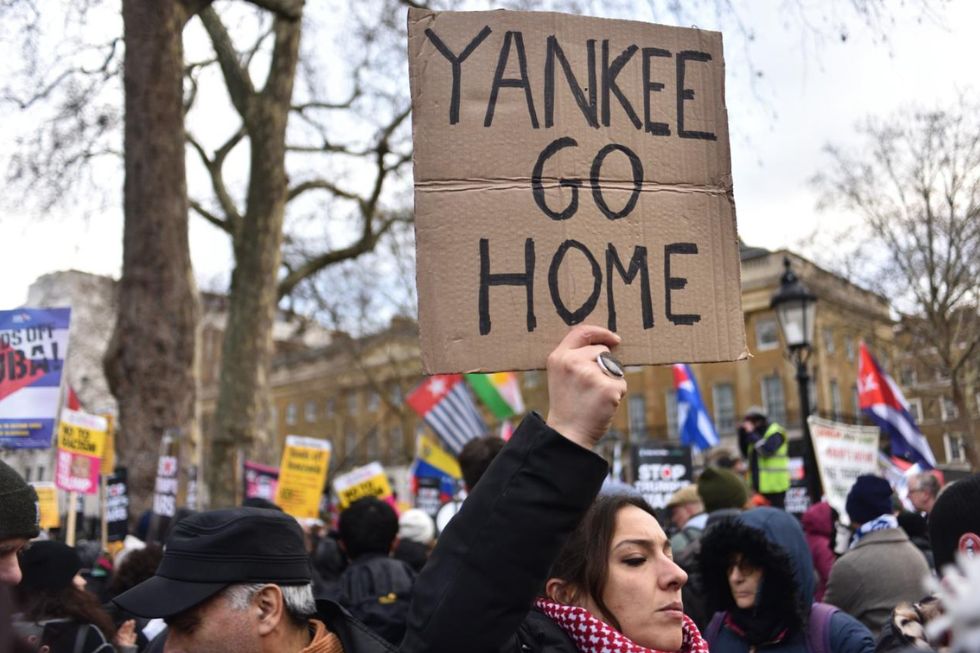


Cuba undoubtedly reached a critical juncture in January 2026, when Venezuelan President Nicolás Maduro was captured, and Venezuela suspended its oil supplies. These developments pressured Cuba, creating a growing sense of urgency and instability that reached a new level in March, coinciding with rising tensions in the Middle East due to military action by the US and Israel against Iran. If a change in the Cuban regime actually materializes, it will be gradual rather than abrupt, and the process will have begun long before Maduro’s capture. As history shows, watershed events are usually the result of cumulative factors. Cuba’s geographical insularity has always made self-sufficiency difficult for the country. Coupled with the fact that its societal fabric is deeply interwoven with its unique application of Marxism, an eventual transition would be a journey filled with contradictions and gray areas.
Today’s situation, with the loss of Venezuelan energy support, is somewhat reminiscent of Cuba’s experience with the devastating economic impact of the Soviet Union’s collapse in the 1990s, and it may be tempting to draw comparisons between the two periods. At that time, the Castro regime was forced to confront similar challenges: material shortages, isolation and civil unrest. However, today’s reality is characterized by new factors: the physical absence of Fidel Castro and Raúl Castro; the widespread use of social media; resumed flights to and from the US since 2016; and increased liberalization and warmer diplomatic relations.
No matter how valuable ending the longest-running communist government in the Americas may seem, US President Donald Trump seems to be trying out a new strategy for foreign intervention: decapitating regimes while keeping the establishment intact. This model clearly prioritizes business opportunities over democratic values. However, it’s not only uncertain whether it could be applied to Cuba, but also whether this is actually the plan. All of which makes it particularly difficult to imagine what could happen next.
Historically, international observers have oscillated between fascination and outrage towards Communist Cuba. In the early years of the revolution, this fascination was understandable. Cuba was a potent symbol for activists in the 1960s and for the global civil rights movement. However, as the revolution shifted toward military autocracy rather than democratic ideals, the initial romanticism faded. This group of observers, largely comprising European baby boomers who rebelled against post-World War II imperialism, has seen its initial fervor tempered by time. Reflecting a broader evolution in leftist thought, they continue struggling to reconcile Cuba’s social achievements with its authoritarian political regime and the continuous, increasing and deepening impact of the US trade embargo on these revolutionary ideals since 1962.
The Cuban Revolution officially began with the 1953 takeover of the Moncada Barracks by a group of revolutionaries led by Fidel Castro, who was relatively unknown at the time. The uprising aimed to overthrow Fulgencio Batista’s illegitimate military dictatorship and the systemic corruption and poverty it fostered. Specifically, the movement demanded economic independence from US imperialist interests and the restoration of political liberty through an armed uprising of the working class.
After the attempted coup, Castro, a trained lawyer, was tried and imprisoned by Batista’s regime. During this trial, he delivered an iconic defense speech that ended with the famous words, “History will absolve me.” Indeed, he was pardoned after 22 months due to a general amnesty and went on to lead Cuba for life. However, total absolution by history is doubtful and yet to come.
After his release from prison, Castro adopted July 26 — the date of the attack on the Moncada Barracks — as the name of his revolutionary movement: the Movimiento 26 de Julio. By January 1, 1959, the rebels, including the iconic Comandante Ernesto “Che” Guevara, had successfully overthrown the dictatorship. In response to Batista’s pro-US regime, the revolutionaries had campaigned with slogans such as: “Cuba sí, yanquis no!” (“Cuba yes! Yankees no!”) and “Yanquis, vayanse!” (“Yankees, go away!”).
Shortly after Castro and his group took control, the US intervened militarily in 1961, but was defeated at the Bay of Pigs. This defeat solidified the first self-proclaimed communist revolution in the region, which would become the longest-standing regime of its kind in the Western world. It is now approaching its seventh decade.
The revolution as an unfinished process
After years of rumors that he was dead and that his government was keeping him alive to prevent a political collapse, Castro died on November 25, 2016, at the age of 90. Following Castro’s illness in 2006, his younger brother Raúl assumed provisional power. By 2011, Raúl had solidified his position as leader of both the presidency and the Communist Party. This appointment communicated a strong stance on hierarchy and kinship. Yet, Raúl ultimately delegated governance in 2019, eight years later.
Miguel Mario Díaz-Canel Bermúdez, Cuba’s current president, is a direct descendant of the Castro regime, having been personally appointed by Raúl Castro. Born in Villa Clara Province on April 20, 1960, Díaz-Canel was born one year after the Cuban Revolution of 1959. Although Díaz-Canel holds onto the revolutionary ideals of his predecessors, he is facing unprecedented times. Amid escalating instability and unrest, he called for dialogue on Monday, March 23, while not capitulating on the Revolution, stating:
We don’t want war; we want dialogue. But if that space isn’t provided, we are ready. I tell you this with the deep conviction that I hold, which I have shared with my family, that we would give our lives for the Revolution.
Díaz-Canel said this in a conversation with Pablo Iglesias, the Spanish founder of the left-wing political party Podemos, and former vice president of Spain. Iglesias arrived in Cuba on March 24, 2026, as part of the Nuestra América humanitarian convoy. There, he interviewed Díaz-Canel on behalf of his media organization, Canal Red. With the support of figures like Iglesias and British politician Jeremy Corbyn, the Nuestra América mission delivered 20 tons of aid, including solar panels, to help alleviate the island’s severe energy crisis.
The convoy’s name invokes the legacy of José Martí (1853–1895), the “Apostle of Cuban Independence” and a foundational figure in the development of the nation’s identity. In his influential 1891 essay, Nuestra América, or “Our America,” Martí contended that Latin American nations should develop governance systems grounded in their unique social realities instead of imitating foreign models. By warning against “the giant of the north” and calling for cultural sovereignty, Martí’s manifesto remains a powerful symbol that the modern mission seeks to reclaim. In fact, both Díaz-Canel and Iglesias reiterated Martí’s accusations that the US is responsible for Cuba’s structural problems of the past several decades, arguing that the 1959 Revolution eliminated “all miseries and evils.”
The blockade of all trade and diplomatic relations with the US, coupled with the nationalization or expulsion of the private sector, did not stop the steady stream of tourists, primarily from Europe, from arriving on the island. Despite the gradual disenchantment of many, a sense of mysticism about Cuba as an oasis outside of capitalism began to emerge.
For as long as I can remember, I have heard the same tropes in stories by foreigners who visited the island in the ‘90s and ‘00s. One recurring theme was the idea that Cuba was “suspended in time.” People often mentioned the old cars, which were rare in other urban landscapes. In a dimmer note, Fidel, who had once vowed that Cuba would no longer be the “brothel of the Western Hemisphere,” later used that same imagery in a 1999 speech, infamously stating, “Cuba has the cleanest and most educated prostitutes in the world.”
In his 1965 work, The Whole Island, Virgilio Piñera famously referred to “the curse of being completely surrounded by water.” Writing from a first-person perspective while sitting in a café in Havana, Piñera captured an insular reality that visitors, often distracted by the island’s tropical allure, could never truly grasp. This metaphorical curse reveals a less paradisical side of the nation, grounding its international isolation in a bittersweet reality.
Piñera’s sentiment mirrors the devastating truth in Fidel’s later remarks about the island’s “cultured” prostitutes. Both the poet’s verses and the leader’s words acknowledge a reality that, despite its high ideals, remains trapped by its circumstances. Piñera’s image remains profoundly expressive today, as Cuba faces renewed media attention and political turmoil, making this sense of cursed isolation feel as relevant as ever.
Following a period of diplomatic warming that began in 2015, US–Cuba relations shifted from a hopeful path toward greater understanding to extreme hostility under the Trump administration. By 2025, Marco Rubio, a former senator from Florida and Cuban American, had become one of the loudest advocates for this shift. A Gen Xer, Rubio belongs to the first generation of diaspora children who have historically migrated to Miami. This group has traditionally been fiercely opposed to the regime they fled.
Today, many of them see the current moment as the opportunity they’ve been awaiting for decades. Hispanic outlets Univision and Telemundo Miami have covered the various demonstrations, many of which were led by Cuban activist Ramón Saúl Sánchez, who called on the exile community at the iconic Cuban restaurant Versailles to support the protests occurring on the island. The Free Cuba Rally, which marched through Washington, DC, featured slogans such as “Trump” and “Cuba Next!” calling for US action.
Founded by Cuban exiles in Valencia, Spain, in 2014, the news outlet Cibercuba has been a relevant source that divulges information from inside the island. It has extensively covered the protests of the last few weeks against constant outages and the growing precarious situation. According to Cibercuba, there have been pot-banging protests, fires started in the middle of roads, and people taking to the streets regardless of the significant military and police presence.
Though their demands are diverse and sometimes conflicting, protesters in Cuba and the diaspora are united in their response to the same lack of coherence embodied by an unfinished revolution and an authoritarian regime. Unlike the diaspora, protesters on the island largely reject US intervention. They call for freedom and anti-authoritarianism, yet they never question their own autonomy. They correctly believe that their future is in their hands, focusing more on immediate needs than on challenging the entire economic system. Despite its flaws, the revolution’s accomplishments should be recognized, such as ensuring that healthcare and education remain free for all.
Taking all of this into account, it’s reasonable to conclude that Cuba is experiencing its most severe economic and social crisis in decades. Nevertheless, Díaz-Canel has taken a defiant position against Washington, considering the one-party political system and the decades of cultural and structural revolution that sustain him. Even as it prepares for potential American aggression, the Cuban government refuses to negotiate its political system and its national sovereignty.
Perspectives from the Island: the case of Beto
I traveled to Cuba for the first and only time in January 2018, spending the first eight days of the year in Havana. I flew from Miami, a route that had only resumed direct service in December 2016. I remember the other passengers, most of whom were not tourists, rushing to stand up as soon as the plane landed. Their urgency seemed to reflect the extraordinary experience of taking a direct flight after decades of needing to take indirect routes, such as via Cancún, or of being unable to travel at all due to visa constraints or the risk of state retaliation for those in exile.
Coming from a place where unlimited internet access was the norm, the intermittent service during that short trip felt unusual. Access was a luxury; you had to go to a hotel or somewhere with Wi-Fi, or buy a $5 data card that lasted 30 minutes. For the majority of Cubans, this was a significant expense, as average monthly salaries remain among the lowest in the world. According to a 2025 BBC report, this digital divide persists as Etecsa, the national telecommunications enterprise, continues to restrict and raise the price of monthly data top-ups.
This atmosphere of restricted access and slow change makes the current shift in US foreign policy feel like a long-awaited opportunity. However, the notion of a tipping point once again reveals its tantalizing and procrastinatory nature. To understand how this pivotal turning point was perceived beyond the official headlines, I reached out to my Cuban friends living abroad.
One of them is Beto, a chef and restaurant owner who has lived in Madrid for over 20 years. When he responded on Monday, March 16, he was visiting family in Cuba, 30 minutes outside Havana. He stayed in touch throughout his week-long trip, and I am fortunate to be able to share some of his insights here.
Beto began his testimony by recounting how difficult it was to move around the island. His brother had to buy fuel on the black market just to pick him up from the airport, paying between eight and ten dollars per liter. Beto could only afford this expense because of his life in Spain. This corroborates reports of a severe decline in fuel supply, despite Beto’s testimony that money was circulating.
On the drive from the airport to his hometown, which usually takes place on a busy highway toward Havana, there were no other cars. In a video he shared, the empty horizon could be seen in both directions, interrupted only by a car that eventually passed them. According to Beto, the airport itself also felt empty. His Iberia flight, designed to carry over 200 passengers, landed with only 60 people on board. The rental lots were empty, yet filled with cars no one was renting. “Havana doesn’t even have fuel for the planes,” Beto explained. He noted that his flight had to detour to the Dominican Republic just to refuel for the return trip to Madrid. He added that due to limited resources, tourism and travel for non-urgent matters have become extremely difficult these days.
This perception of a shortage is indicative of a broader energy crisis in which access to electricity depends on having the right technology. This takes us back to Diaz-Canel’s recent interview with Pablo Iglesias. Overall, the Cuban President’s tone was optimistic. Diaz-Canel mentioned that even amid an intensified blockade, Cuba is on the path to energy sovereignty. He highlighted the importance of solar panels, electricity generated from sugarcane fields and the increased use of electric motorcycles for various services, describing all of it as a form of “creative resistance.”
Overall, listening to Beto confirmed both Diaz-Canel’s description of advancements in renewable energy and the fact that it is insufficient. During the most recent national blackout, Beto said that only people near power plants or with solar panels were able to power their electronics. This was the case in his father’s village. To cope with the heat, he said he used a battery-powered fan for up to five hours at a time in his father’s house. A tropical storm on Monday night also helped cool the air.
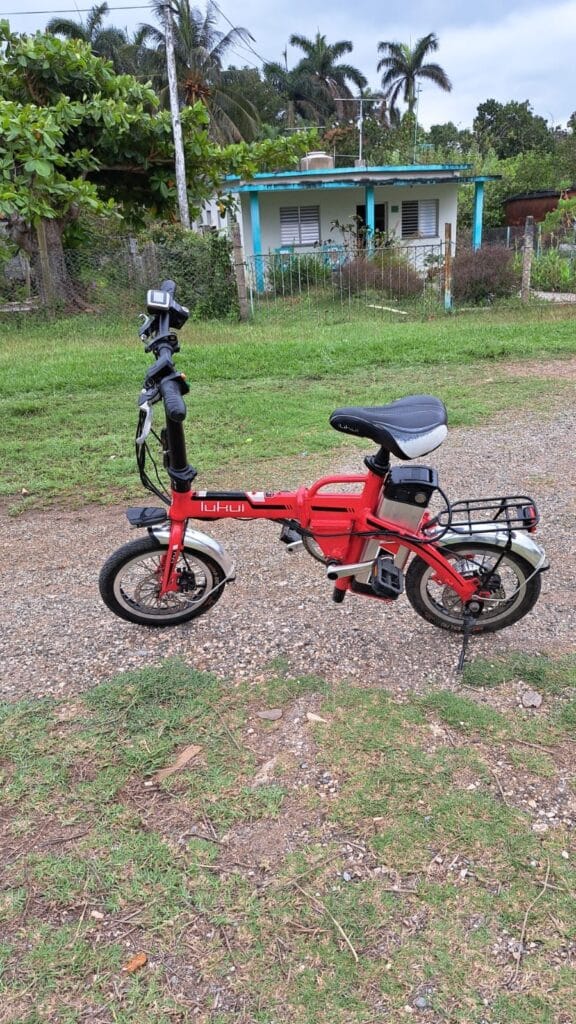
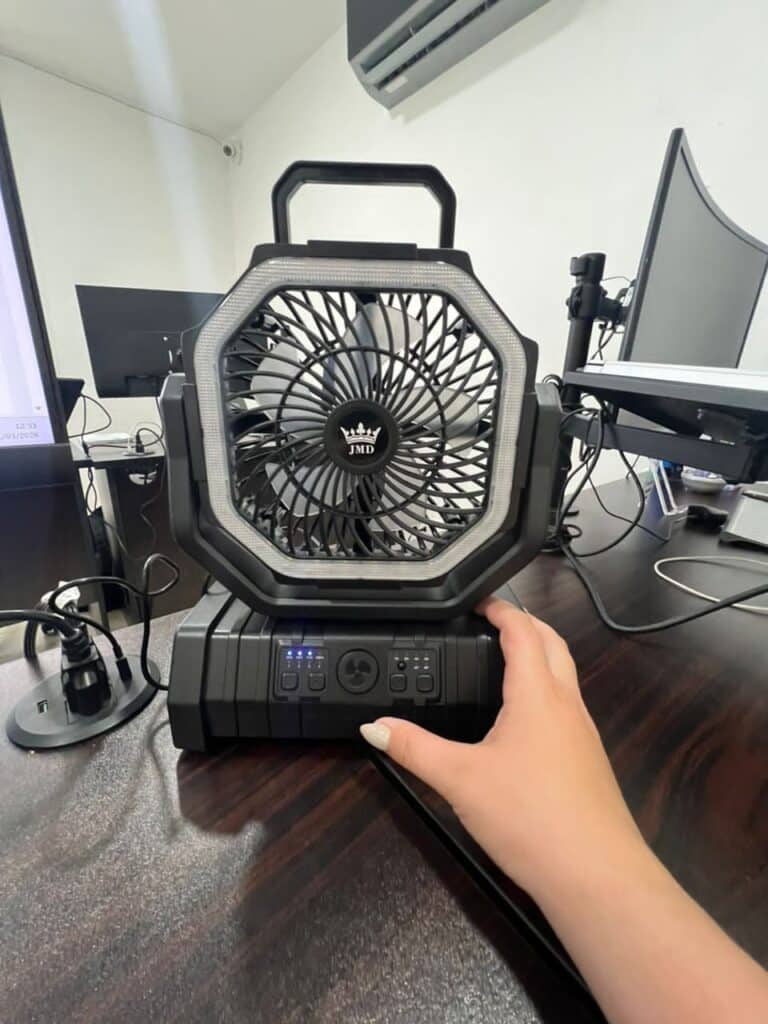
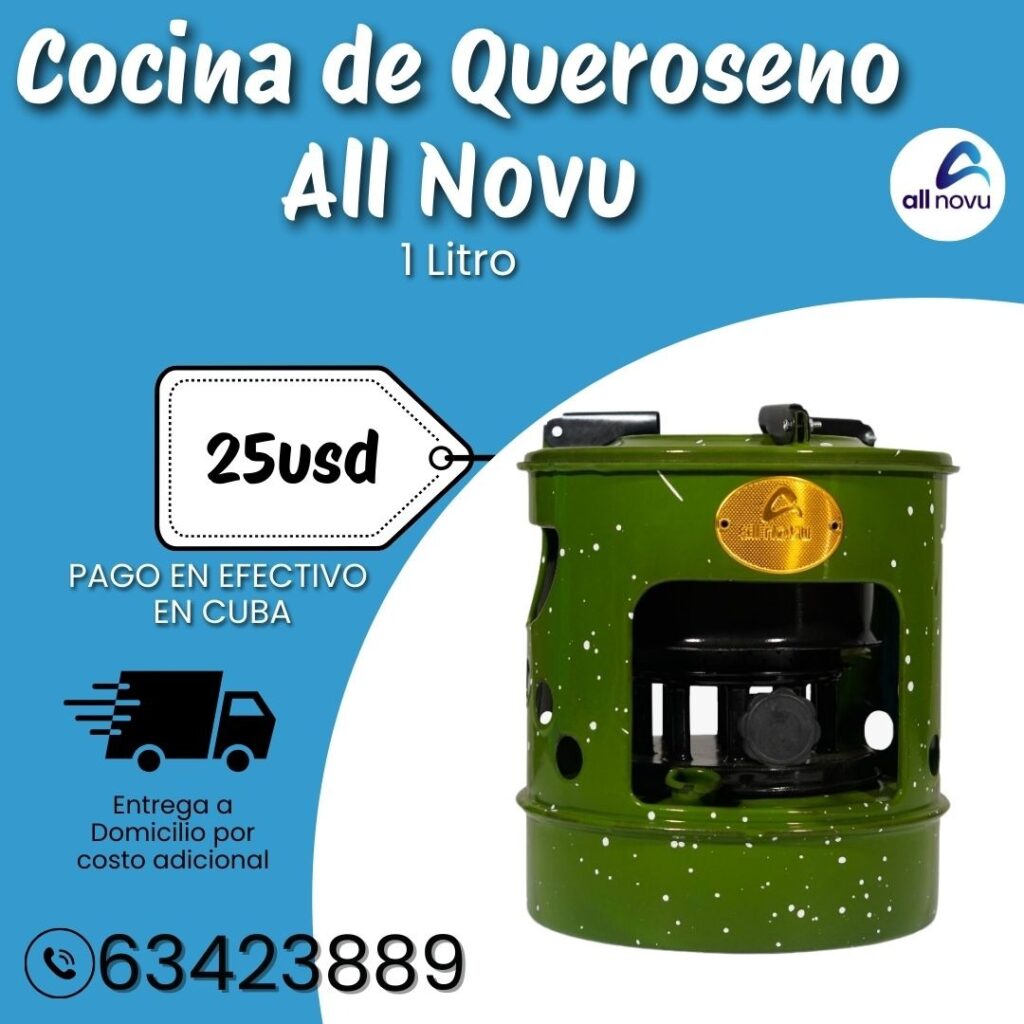
Based on what he saw and experienced on this trip, the state-run food supply system, which used to equitably distribute food despite its imperfections, has nearly vanished. A new reality has emerged in which private enterprises import food and sell it at higher prices than in Madrid. Beto also shared photos of solar energy kits and kerosene stoves being sold on social media. The flyers provide contact information and state that payments must be made in cash in US dollars, and that delivery is available for an additional cost.

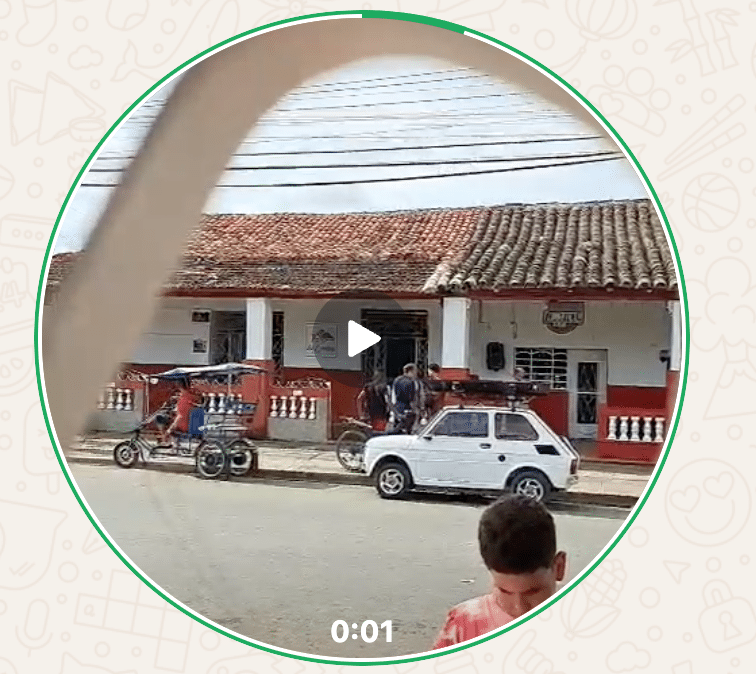
In addition to the photos of electronics, Beto shared a video with me depicting the unique blend of eras and economic systems found on Cuban streets. In the video, bicycle-powered taxis rattle past an old Polish Fiat, an iconic Soviet-era car, that has been modified to include a solar panel on its roof. The car was parked outside a bar called Tómatela Fría, where reggaeton music played from a speaker. During my short visit in 2018, I noticed that music, mostly reggaeton, was always playing on the streets. Seeing that it’s still the norm gave me a sense of reassurance that other reports didn’t.
Throughout the week, Beto and I were able to communicate with each other more than twice a day, albeit intermittently. He relied on airport Wi-Fi or Etecsa offices for internet access. There, you can pay 40 cents an hour for a connection to their Wi-Fi, which is powered by generators. When he described this situation to me, he paused and said it was all a “strange, high-speed transformation caught between socialism and capitalism.” As citizens increasingly take to the streets, Beto’s ambiguity sums up the reality of existing in the long-term middle ground between the two systems that polarized the second half of the 20th century.
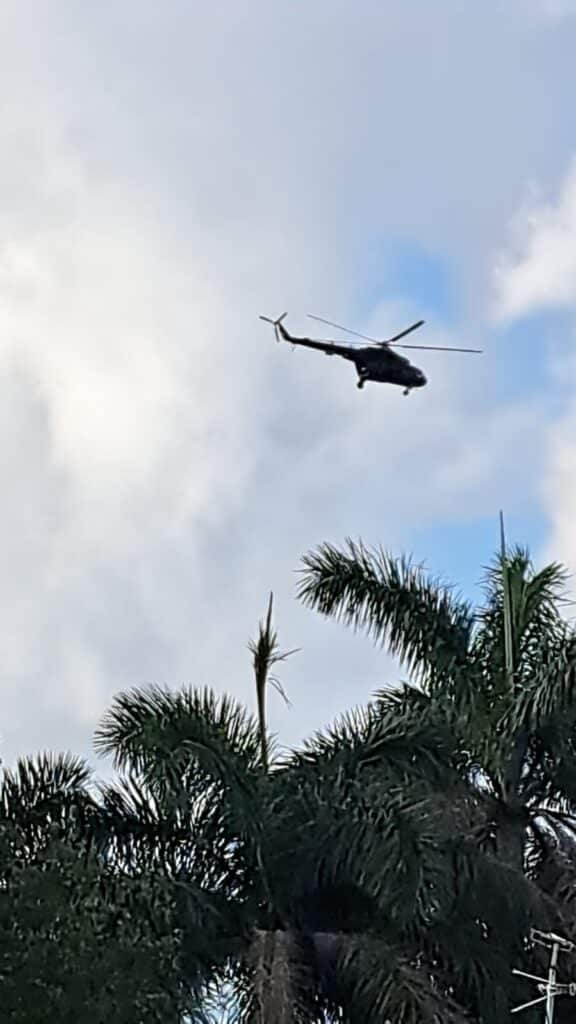
As proof of the exceptional circumstances due to intensified protests and government dissent in the days prior, Beto sent a picture showing military helicopters circling overhead and armored vehicles moving through his father’s neighborhood. While the townspeople attempt to maintain a facade of normalcy by selling everyday goods in private stalls, intermittent electricity and the shadow of helicopters serve as constant reminders that the country is transforming into something entirely unknown.
Against this backdrop, Beto told me that when people in Cuba talk about the importance of money from family members abroad, they often ask each other, “¿Tú tienes fe?” While “fe” means “faith” in English, it actually stands for Familiar en el Extranjero, or “family member abroad.” This refers to receiving remittances from places such as Miami or Madrid. The double meaning of faith speaks to the concept of the hybridity of the two systems that Beto mentioned earlier. The anecdote also conveys a sense of truth when considering that faith may be the only unifying factor among the different positions, regardless of the indeterminate results.
The curse of being completely surrounded by water
The curse of being completely surrounded by water condemns me to this café table. If I didn’t think that water encircled me like a cancer, I’d sleep in peace. In the time that it takes the boys to strip for swimming, twelve people have died of the bends … The eternal misery of memory. If a few things were different and the country came back to me waterless, I’d gulp down that misery to spit back at the sky … The uniform of the drowned sailor still floats on the reef. It makes you want to jump out of bed and find the main vein of the sea and bleed it dry.
— The Whole Island, Virgilio Piñera
In closing, I would like to return to Virgilio Piñera’s poem and his words: “The curse of being completely surrounded by water.” In the poem, he also speaks of finding “the main vein of the sea and bleeding it dry,” building to a crescendo of intensity. Following the success of the Revolution, Piñera was one of many intellectuals who initially supported the movement. However, the revolutionary promise soon turned into systematic censorship. Piñera was arrested at the beginning of a period of state repression that intensified throughout the ‘60s and ‘70s.
In his posthumous memoir, Before Night Falls (1993), Reinaldo Arenas, a writer of a later generation, explains how he, like Piñera, was imprisoned because of his homosexuality and his stance as a dissident public writer. The title, Before Night Falls, refers to how he had to write by the last rays of sunlight while hiding in parks as a fugitive. It wasn’t until 1980 that the Cuban state stopped considering homosexuals criminal figures, and the Ley de Ostentación Homosexual was repealed.
However, prosecutions due to sexual orientation didn’t stop overnight (it was not until 2019 that a new constitution was approved in Cuba that included reforms regarding gender rights, and it wasn’t until 2022 that same-sex marriage was legalized). Arenas was able to flee during the 1980 Mariel Boatlift exodus, which began when a bus crashed into the Peruvian embassy, causing a massive refugee crisis. To be granted permission to leave through Mariel, Arenas had to “prove” his homosexuality. He eventually settled in Miami and then New York, where he died by suicide while awaiting death from AIDS in 1990. In his suicide note, he explicitly blamed Fidel Castro for his death.
It’s hard to reconcile heartbreaking stories like Arenas’s with the continued loyalty of other prominent figures. As I have striven to convey in this piece, we find ourselves in limbo, torn between disillusionment and faith. Silvio Rodríguez, a renowned musician, exemplifies the latter. The government recently gifted him a Kalashnikov rifle in recognition of his loyalty. Interestingly, in his popular 1993 song “El Necio,” or “the fool,” Rodriguez sang that deciding what the world deems foolishness may also be a stance: “Could it be that foolishness was born with me?/The foolishness of what now seems foolish/The foolishness of embracing the enemy/The foolishness of living without a price.”
On March 16, the day I spoke with Beto, Trump escalated his rhetoric, claiming he could “take Cuba in some form” and do as he pleased there, adding that such a thing would be “an honor.” Once again, when we bring together the rhetoric of Rodríguez and Trump, we feel as though we are traveling in time. As the “giant of the North,” in Martí’s words, confronts Cuba, the island remains caught between the remnants of communism and an emerging informal capitalism. Cubans are resisting creatively, as they always have, even when struggling in the context of an accentuated decades-long blockade. Currently, their system of governance is holding strong, albeit while being cornered in their search for a path forward.
[Kaitlyn Diana edited this piece.]
The views expressed in this article are the author’s own and do not necessarily reflect Fair Observer’s editorial policy.
Suffocating an Island: What the US Blockade Is Doing to Cuba
My partner and I took a humanitarian mission to Holguín, Cuba. It was eye-opening: The sanctions and oil blockade US...
FO Talks: Is Sovereignty Dead? Trump’s Maduro Arrest and the End of Global Norms
In this episode of FO Talks, Atul Singh and Leonardo Vivas examine US President Donald Trump’s extraction of Venezuelan President...
Cuba, 10 Years In, After Castro: Beyond the Headlines of a Collapsing Nation
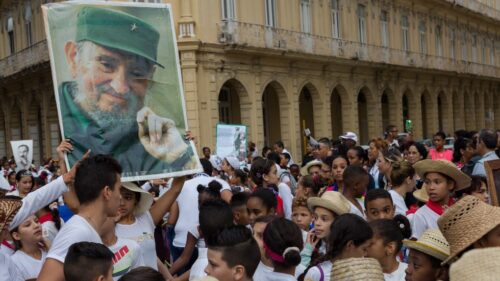
Nine years after Former Cuban President Fidel Castro’s death, Current President Miguel Díaz-Canel leads the country under the shadow of...
Support Fair Observer
We rely on your support for our independence, diversity and quality.
For more than 10 years, Fair Observer has been free, fair and independent. No billionaire owns us, no advertisers control us. We are a reader-supported nonprofit. Unlike many other publications, we keep our content free for readers regardless of where they live or whether they can afford to pay. We have no paywalls and no ads.
In the post-truth era of fake news, echo chambers and filter bubbles, we publish a plurality of perspectives from around the world. Anyone can publish with us, but everyone goes through a rigorous editorial process. So, you get fact-checked, well-reasoned content instead of noise.
We publish 3,000+ voices from 90+ countries. We also conduct education and training programs
on subjects ranging from digital media and journalism to writing and critical thinking. This
doesn’t come cheap. Servers, editors, trainers and web developers cost
money.
Please consider supporting us on a regular basis as a recurring donor or a
sustaining member.
Will you support FO’s journalism?
We rely on your support for our independence, diversity and quality.





Comment