






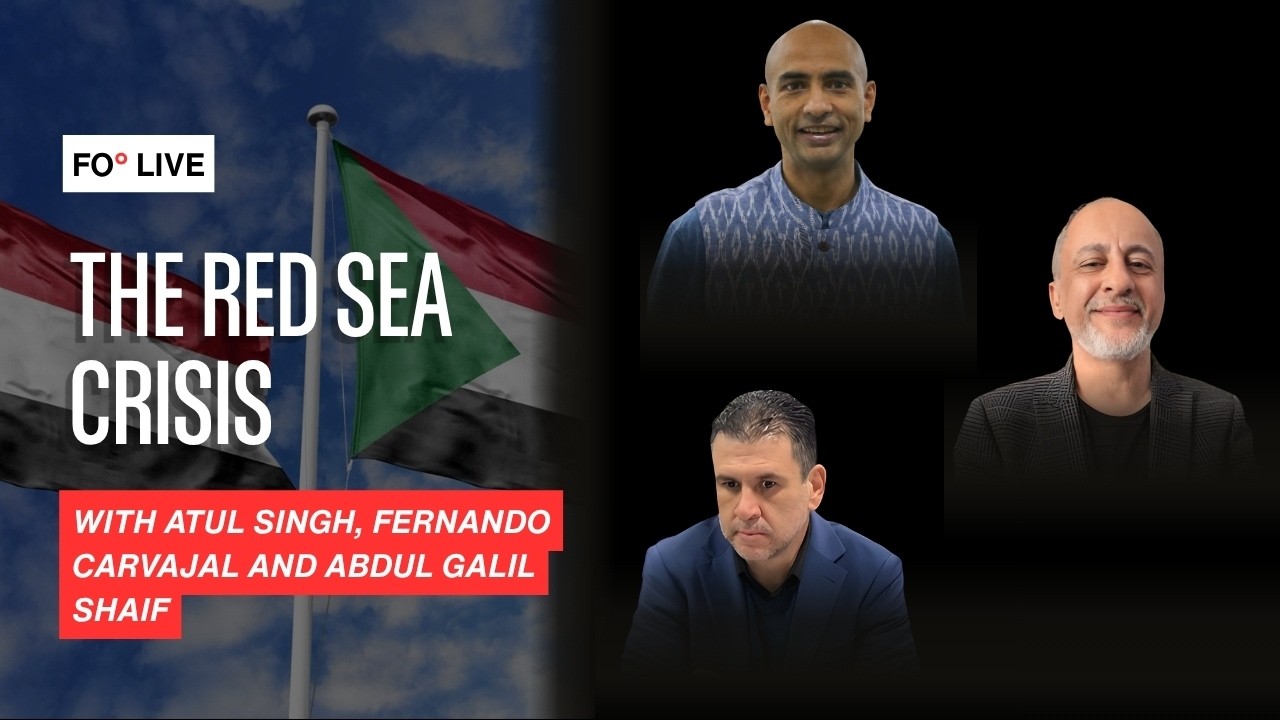
Fair Observer’s Video Producer Rohan Khattar Singh moderates an FO Live discussion on the US–Israel war with Iran. He is joined by Fernando Carvajal, executive director of The American Center for South Yemen Studies; Eric Jeunot, a professor at Abu Dhabi University; and Heena Lotus, a geopolitical analyst. Khattar Singh pushes the panel to assess whether Yemen’s Houthis will enter the conflict, how Iran is calibrating its proxy network and why Gulf states are working to contain escalation. What emerges is a picture of a war no longer defined by direct strikes alone, but by chokepoints, indirect leverage and long-term strategic positioning.
The Houthi dilemma
Jeunot frames the discussion around a fundamental tension shaping Houthi decision-making. The movement is strengthening itself amid fragmentation in South Yemen, using the lull to consolidate territory, recruit fighters and rebuild capacity. Yet it faces a strategic choice between ideological alignment with Iran’s “Axis of Resistance” and its own domestic priorities.
That tension is not abstract. The Houthis must decide whether to demonstrate commitment to Iran by joining the war or instead focus on expanding control toward resource-rich areas such as Marib in Yemen. Jeunot states, “The Houthi are for the moment at a crossroads in terms of objectives.” Entering the war may reinforce their ideological legitimacy, but it could also undermine their long-term economic and political stability.
Fighting capacity and ideological momentum
Lotus shifts the focus from strategy to motivation. While previous US and Israeli strikes degraded Houthi military infrastructure, she argues that capability alone does not determine action. The group’s ideological drive remains intact and may even outweigh material constraints.
She emphasizes that the Houthis are deeply embedded in the broader narrative of resistance aligned with Iran and Palestine. As she puts it, “They’re very passionate about being part of the Axis of Resistance.” That passion, however, exists alongside practical constraints, particularly the risk of reigniting conflict with Saudi Arabia.
Jeunot reinforces this point by describing the Houthis as a system sustained by conflict. War is not simply an activity, but a mechanism of governance and legitimacy. A prolonged peace could weaken the movement internally, making the presence of an external enemy central to its survival.
Geography, Saudi Arabia and strategic restraint
Carvajal grounds the discussion in geography and political reality. Yemen remains divided, with the Houthis controlling a smaller share of territory but the majority of the population. Meanwhile, South Yemen has shifted into Saudi-managed security control following the displacement of UAE-backed forces in late 2025.
This balance helps explain the Houthis’ current restraint. Despite their alignment with Iran, they have not targeted Saudi positions or escalated attacks in the Red Sea. For Carvajal, the key lies in their relationship with Riyadh, the Saudi capital. The Houthis may see more value in securing a stable arrangement with Saudi Arabia than in immediate participation in a regional war.
This creates a paradox. The group maintains ties with Iran while preserving flexibility to negotiate with Gulf powers. The result is a calibrated ambiguity that allows the Houthis to remain relevant without overcommitting.
Chokepoints and the global economy
Khattar Singh introduces the broader strategic stakes by focusing on the Bab el-Mandeb strait. If the Houthis were to disrupt this maritime corridor, the consequences would extend far beyond the Middle East, affecting global trade, energy flows and major economies such as China and India.
This raises the possibility that Iran itself may be exercising restraint. Rather than encouraging escalation, Tehran may prefer to keep the Bab el-Mandeb as a latent threat. A simultaneous disruption of both the Strait of Hormuz and the Red Sea would approach systemic economic shock.
The panel also considers whether Israel might attempt preemptive strikes on Houthi positions. Lotus warns that such a move could trigger a domino effect, pulling Yemen fully into the conflict. Jeunot, however, questions the strategic logic of opening another front, noting that escalation in the Red Sea would draw in a far wider set of international actors.
Yemen as a long-term battleground
The discussion closes with a broader reflection on Yemen’s enduring strategic importance. Carvajal situates the country as a historic crossroads, long contested by regional and global powers. Its position along critical trade routes and its complex internal divisions make it both valuable and volatile.
Looking ahead, the panel diverges on whether the war could redraw borders. Lotus sees a shifting geopolitical landscape in which rapid changes in alliances could produce unexpected outcomes. Jeunot is more cautious, arguing that sovereignty remains deeply entrenched and that meaningful territorial change would require large-scale ground operations rather than air campaigns.
What the panel agrees on is the scale of the conflict’s potential trajectory. Yemen is not yet the central battlefield, but it is no longer peripheral. If the Houthis enter the war, the consequences will not be contained locally. They will reverberate across trade routes, regional alliances and the global economy, transforming an already dangerous conflict into something far harder to control.
[Lee Thompson-Kolar edited this piece.]
The views expressed in this article/video are the author’s own and do not necessarily reflect Fair Observer’s editorial policy.


































Join the conversation
Share your perspective
Log in to share your thoughts and take part in the discussion.