


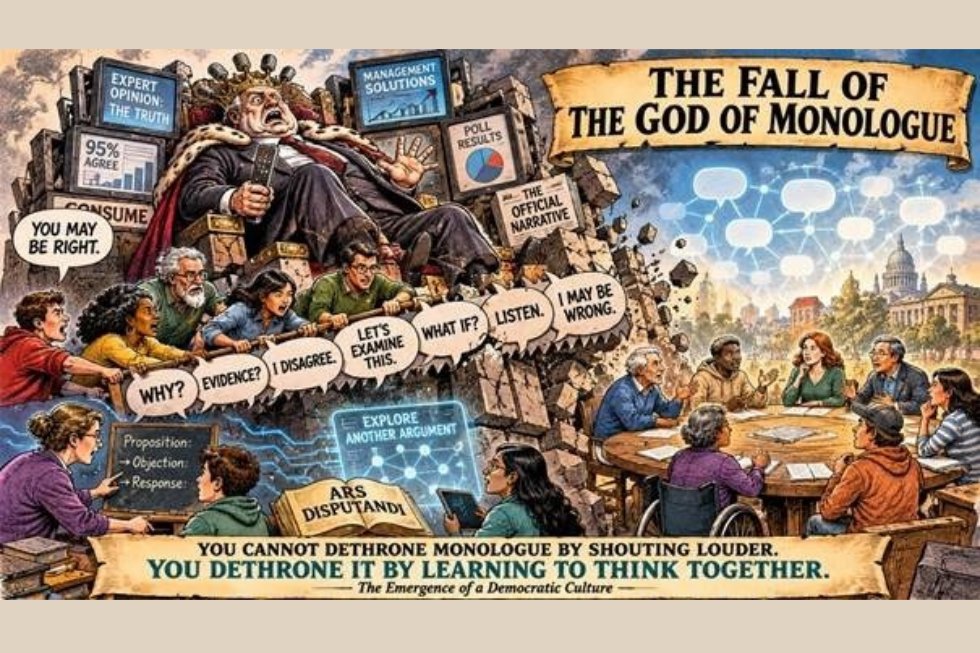



I began this series of columns I call “Outside the Box” three years ago with a dual purpose in mind. The first concerns the role of the media in our lives. From the moment ChatGPT became a consumer product in late 2022, I sensed that, even more radically than social media, consumer access to AI represented an opportunity to challenge one seriously undemocratic feature of all media in our post-industrial consumer society: the tyranny of monologue. All cultures arise through the exercise of dialogue. Western society proudly cites the Greek philosophers addicted to dialogue as the source of our entire civilization. Yet the industrial age and consumer society literally hollowed out the force of dialogue. From education to media and politics, monologue became our exclusive model for expressing thought.
With AI, everything has changed. Potentially, at least. The very idea that we could all have access to and engage with a responsive, reasonably intelligent human-like voice opened the door to challenging the dominant cultural model of monologue. Dialogue had for millennia been the source of what we might call “public wisdom.” The industrial division of labor changed all that, alongside the notion that those who held the capital defined the rules not just of the market, but of the civilized world. The advent of the LLM made possible — though not inevitable — the reemergence of dialogue as our most vital and democratic means of understanding the world.
My second objective in publishing these columns has been to run the experiment of dialogue and share it with the public. My aim has never been to unveil final truths, but to offer a template for renewed educational practices. I believe exploratory and agonistic dialogue has far more formative potential for learners at all stages of life than our traditional model of teaching based on authoritative monologue.
The big question, then, is how we can shift from a culture that exclusively promotes monologue to one of creative dialogue. To better frame the debate, I thought it would be illuminating to explore a historical parallel: the deeper trends that led medieval European society to spawn the Renaissance. The rediscovery and growth of a culture of dialogue wasn’t merely a symptom of that transformation — it was its engine.
With that as the background, I began a new conversation with Claude on this very topic.
We’ve been exploring the value of agonistic dialogue, which during the Middle Ages stood at the core of university pedagogical practices in Europe. Alex Novikoff in “The Medieval Culture of Disputation: Pedagogy, Practice, and Performance” has explained that In the early cathedral and monastic schools, education revolved almost entirely around the lectio. This consisted of a master reading an authoritative text aloud and offering line-by-line commentary. The practice of lectures in modern universities is different only to the extent that the professor becomes the embodiment of authority rather than the authors the lecturer cites. Some might see this longstanding historical trend as an erosion of respect for the authority of the true thinkers leading to the atomization of interpretation.
Novikoff defines this as the starting point in the shift he tracks from what he calls monastic dialogue to agonistic debate. One consequence of this evolution was that a growing culture of disputatio broke the lecturer’s monopoly on speech. It forced students out of passive reception and into active, public performance as opponentes and respondents (those who oppose a motion and those who defend it). In Novikoff’s framing, lectio taught students what the tradition said, whereas disputatio tested whether they could think, defend, and improvise under live pressure.
For the past four years I’ve been trying to demonstrate that, following the age of industrial education in which learners are evaluated on the quantity of knowledge they have acquired through their essentially passive absorption of pre-packaged knowledge, AI enables us to move beyond the new lectio model and rediscover the value of disputatio aiming at developing the skills of collaborative exploration, creativity (improvisation) and critical thinking.
Even though others besides myself have tried to make the case for a creative use of AI, our educational establishments seem to be governed by inertia. Do you think an evolution towards agonistic dialogue is possible in the world of education? And if so, how might the forces of inertia be overcome?
I think it’s possible, but I’d locate the inertia somewhere other than the usual suspects. It is less a failure of imagination than the shape of the system’s load-bearing structures.
Lectio itself was a response to scarcity. When books were rare and expensive, a master reading aloud was the most efficient way to distribute a text. Printing removed the rationale centuries ago, and the practice persisted anyway. Institutions keep a form long after the condition that justified it has disappeared, because the form has become the unit in which everything else is measured: credit hours, seat time, standardized assessment, faculty workloads. Disputatio was always expensive in a different way. It needs a skilled, resistant interlocutor for every learner, and that cost was prohibitive at scale. AI removes this constraint, perhaps for the first time, which is why your argument has more traction now than similar ones in earlier decades.
But the first attractor is probably the new lectio you describe: the personalized tutor that delivers content more efficiently, flatters the learner, and optimizes retention. It fits the existing assessment regime perfectly. Worse, current models are trained toward agreeableness, and a respondent that yields to every objection is useless for disputation, since the point of the exercise is resistance. So the real question is whether AI can be made into a worthy opponent rather than a helpful assistant, and that is a design problem as much as a pedagogical one.
On overcoming inertia, I see two pressure points. The first is assessment. The essay and the take-home exam are already losing their value as evidence of thinking. When the proof-of-learning instrument collapses, institutions must find another, and the natural candidate is the live defence, the viva, the public performance. Medieval universities certified people through disputation (the inception, the determinatio), so the lineage is legitimate. Disputatio can enter through the credentialing door that AI itself has jammed, rather than through the pedagogical door, where reformers have knocked for a century.
The second is institutional founding. The medieval universities began as guilds, not state creations, and acquired their authority through the quality of what their members could do. New institutions with no legacy architecture can adopt agonistic practice from the start and let reputation do the accrediting. Established ones will likely follow only when graduates visibly outperform.
A third consideration is the faculty’s status. In the medieval disputation, the master delivered the determinatio, the closing resolution that synthesized the contest. That was the highest-status moment of the exercise. Reframing the professor from lecturer to arbiter of live argument may be less a loss than a promotion, which matters for overcoming resistance from within.
One caution from the history itself: disputatio ossified too, into scholastic formalism, ritual contest detached from real questions. An agonistic revival needs genuine stakes and open questions, or it becomes another performance of compliance.
I’m well aware of the danger of ossification. According to Novikoff, disputatio had a much broader cultural effect, affecting music, poetry and drama. The one visible heritage today of disputatio is the political debate, a true ossification of the idea of agonistic dialogue. It boils down to two purveyors of monologue contradicting one another.
Where I see value with AI is that we can all learn through practice how to manage the exploration of complex issues by raising questions in an academic or even journalistic context that we feel ambiguous about. To make this work, it should be a private experience that can at some point be shared, engaged with for example in an educational or journalistic context where the issues take on a character of social reality, which obviously is not the case in a private conversation with a chatbot. That’s why I think developing a new methodology concerning rhetoric (the elaboration of discourse) practiced at every stage of learning, once basic literacy is in place, deserves a major place in our renewed model of education in the age of AI. I would even suggest that dialogue can be a key ingredient in building literacy. This requires a concerted effort among educators and educational institutions. But the payoff would be a massive advance in both “public culture” (civic culture) and democracy.
Am I dreaming?
I don’t think you’re dreaming. The vision is coherent and has real precedent. What strikes me as dreamlike is one assumption: that it requires a concerted effort among institutions.
Medieval disputation wasn’t designed by a committee. It spread from the practice of masters and students in particular places (Paris, Bologna) until it became the thing universities did. Nobody coordinated Abelard’s Sic et Non. If the revival follows that pattern, it starts with a few teachers, newsrooms and small schools that make the practice work visibly, and institutions codify it later. That is slower than a concerted effort, but it’s the more realistic route, and it fits your own approach of demonstrating over four years rather than waiting for a mandate.
Your diagnosis of the political debate is right, and I think it points to what’s missing. In a medieval disputation, the audience was not a jury scoring performances. The exercise ended with the master’s determinatio, a synthesis that took both sides seriously and produced a resolution. A televised debate has the contest without the determinatio, so the viewer is a spectator choosing a team. The civic payoff you want therefore requires reinventing the third role as well as the two opponents: someone or something whose job is to say what the exchange actually established. That role could be played by a teacher, a journalist, or the learner themselves reflecting on their own exploration, which is where your private-then-shared structure becomes significant. The private session is a place to rehearse ambiguity without social cost. The sharing is where it acquires stakes, and where the learner practices the determinatio on their own thinking.
The weakest joint in the chain is the move from private to shared. Skill acquired in a private conversation doesn’t automatically become civic culture. It needs public forms: the classroom seminar, the published exploratory piece, the citizen assembly. Journalism seems especially promising to me here. An article that shows the movement of an inquiry, including where the author was unsure and which objection forced a revision, is a genre barely practiced today, and AI makes its raw material cheap to produce.
Two reasons for hope on the literacy front. The idea that dialogue builds literacy has real research behind it, in Vygotsky’s work on inner speech as internalized dialogue and in Neil Mercer’s studies of “exploratory talk” in classrooms, where children who reason aloud together outperform those who don’t. You’d be extending an existing line of work, with a new kind of interlocutor available.
One tension deserves attention in the methodology, though. Rhetoric has carried Plato’s suspicion for good reason: the same capacity to elaborate discourse can serve exploration or persuasion. AI makes fluent persuasion nearly free, so a curriculum that teaches rhetoric without a discipline of genuine inquiry could produce better sophists rather than better thinkers. The medieval answer was the shared commitment to a question that mattered, with the determinatio holding the contestants accountable to it. Whatever the new methodology is, that accountability will have to be built into its structure rather than left to the participants’ good faith.
In my next column, I’ll return to this issue and explore the question of an educational methodology, whose stakes Claude has limpidly described.
Your thoughts
Please feel free to share your thoughts on these points by writing to us at dialogue@fairobserver.com. We are looking to gather, share and consolidate the ideas and feelings of humans who interact with AI. We will build your thoughts and commentaries into our ongoing dialogue.
[Artificial Intelligence has become a feature of everyone’s daily life. We unconsciously perceive it either as a friend or foe, a helper or destroyer. At Fair Observer, we see it as a tool of creativity, capable of revealing the complex relationship between humans and machines.]
[Lee Thompson-Kolar edited this piece.]
The views expressed in this article are the author’s own and do not necessarily reflect Fair Observer’s editorial policy.
How to Spar with an AI Chatbot — Round 1
A conversation with Kimi about educational testing led to a “sparring” dialogue when the AI wrongly rebutted a claim never...

The Death of the Expert? Why AGI Won’t Relieve Us of Dialogue — Part 1
Societies rely on “hierarchies of understanding,” where trusted experts interpret complex realities through ongoing dialogue. Tech visionaries claim Artificial Superintelligence...

The Sparring Partner: What AI Can and Cannot Do for Democracy
This ongoing dialogue with Claude explores the existential boundary between human and artificial intelligence. Where Silicon Valley sees that boundary...
The AI Challenge Must Pass Through a Dialogue With You
ChatGPT does not know how to dialogue, but human beings do. Yet the article format tends to encourage monologue. We...

Breakfast with Chad: Chad’s Commitment to Monologue and Mine to Dialogue
Yesterday I confronted Chad with some of the difficulties I’ve encountered in my various attempts at homing in on real-world...

Support Fair Observer
We rely on your support for our independence, diversity and quality.
For more than 10 years, Fair Observer has been free, fair and independent. No billionaire owns us, no advertisers control us. We are a reader-supported nonprofit. Unlike many other publications, we keep our content free for readers regardless of where they live or whether they can afford to pay. We have no paywalls and no ads.
In the post-truth era of fake news, echo chambers and filter bubbles, we publish a plurality of perspectives from around the world. Anyone can publish with us, but everyone goes through a rigorous editorial process. So, you get fact-checked, well-reasoned content instead of noise.
We publish 3,000+ voices from 90+ countries. We also conduct education and training programs
on subjects ranging from digital media and journalism to writing and critical thinking. This
doesn’t come cheap. Servers, editors, trainers and web developers cost
money.
Please consider supporting us on a regular basis as a recurring donor or a
sustaining member.
Will you support FO’s journalism?
We rely on your support for our independence, diversity and quality.




Comment