






Prabowo Subianto marked two years as Indonesia’s president on October 20. At the same time, oil prices pushed up by the Middle East conflict are draining the state budget. Drivers in Bali waited for hours to buy petrol last week, and on October 16, the Jakarta stock market had its worst day in almost 30 years. One problem came from abroad, and the other is domestic. Together, they test whether investors and citizens can still trust the government to manage the economy.
An oil shock the budget did not plan for
Let us begin with oil. Indonesia uses about 1.6 million barrels of oil a day but produces only around 600,000, so it must import the rest. The 2026 state budget depended on oil costing about $70 a barrel. Last month, Energy Minister Bahlil Lahadalia admitted that prices had climbed to around $106 and that Indonesian crude had averaged $85 to $90 a barrel this year.
Even so, the government has promised not to raise the price of subsidized petrol before the end of 2026. Someone has to pay the difference. Finance Ministry estimates suggest that every $1 rise in the oil price adds roughly 6.8 trillion Indonesian rupiah ($400 million) to the budget deficit.
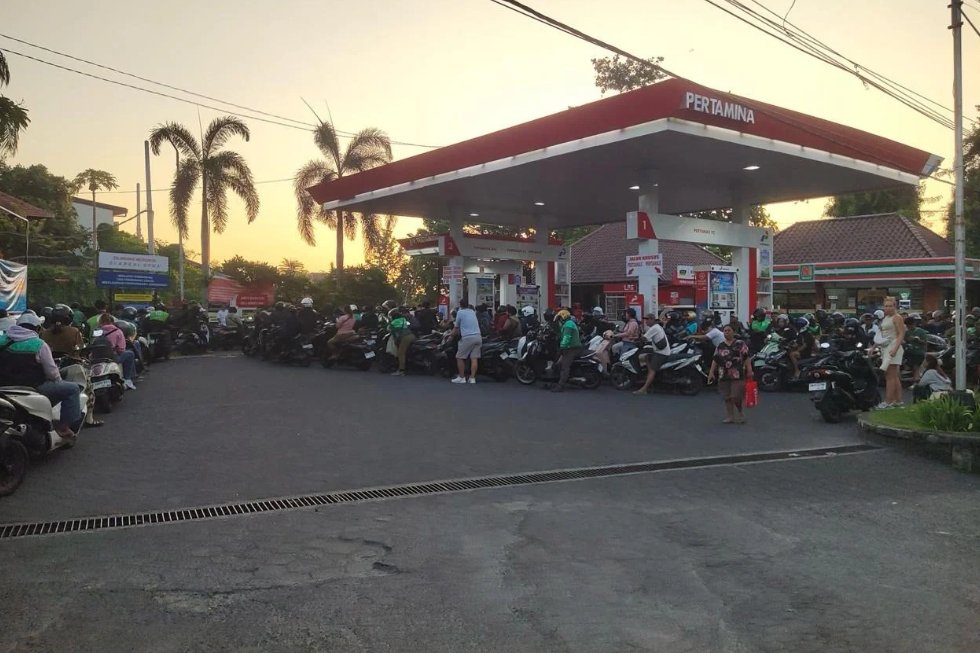
The pressure is now visible at the petrol station. Long queues formed across Bali and other regions in mid-October. Officials blamed a delayed tanker, bad weather and strong demand rather than a lack of fuel. But the shortages came while Indonesia struggles to secure imports through disrupted shipping routes. A country this dependent on foreign oil has little room for error.
A market that investors no longer trust
The second crisis is about trust. MSCI is a company whose stock indexes guide many large global funds, directing where they invest their money. On October 16, it warned that it may move Indonesia from “emerging market” status straight to “standalone” status, skipping the lower “frontier” level. This would put Indonesia in the same group as Lebanon and Zimbabwe. It pointed to suspected coordinated trading and weak enforcement of promised reforms.
The main stock index fell 11.6% that day, and its losses this year are close to 40%, the worst of any market in the world. Goldman Sachs estimates that a full removal could push $5.6 billion out of the country through funds that simply copy MSCI indexes. Foreign investors have already sold almost $4.9 billion of Indonesian shares this year, the biggest yearly outflow in at least 16 years.
Recent deals make the worry worse. In early October, a company controlled by Andi Syamsuddin Arsyad, a coal tycoon widely seen as close to Prabowo, bought 30.25% of Bayan Resources, one of the country’s largest coal miners, for about 26 trillion Indonesian rupiah ($1.45 billion). Some economists link the deal to MSCI’s harsh view, saying it shows small shareholders face poor protection practices. It risks deepening the suspicion that political connections matter more than rules.
At the same time, Danantara, the new state investment fund, has told the Indonesia Stock Exchange that it wants to become a shareholder. A document that circulated earlier mentioned a stake of about 40%. The financial regulator says any owner of more than 5% needs its approval and that the exchange must stay independent. Investors will still ask whether a referee can be fair when one of the biggest players also owns a large part of it.
Ordinary Indonesians will feel these problems the most. A weaker rupiah makes imported goods and raw materials more expensive. Higher energy costs push up food and transport prices. Companies will likely delay investment and hiring, especially in factories that employ many workers.
Indonesia’s middle class has already been shrinking since the pandemic. If prices rise while jobs stay scarce, more families will slip down and spend less, slowing the economy further. That would put Prabowo’s promise of 8% growth even further out of reach.
What Indonesia must do now
There is no easy way out, but there is a clear direction. First, the government must restore confidence in the stock market. That means punishing market manipulation, requiring full disclosure on large deals such as Bayan, and keeping the stock exchange free from state control. Danantara should step back from its plan. Second, the government must rebuild trust in its budget by respecting the legal limit on the deficit and being honest about the true cost of fuel subsidies.
Third, relief should be targeted. Cheap petrol for everyone mostly helps car owners. Direct cash support, help with transport costs and cheaper credit for small businesses would protect the lower middle class at a lower cost.
Finally, Indonesia must reduce its dependence on imported oil. Better public transport, electric motorbikes and renewable power can create jobs and protect the country from the next shock. Prabowo still has three years left in his term. How he responds in the coming months will decide whether people remember these two years as a warning or as the start of a long decline.
[Aliyah A. Omar edited this piece.]
The views expressed in this article are the author’s own and do not necessarily reflect Fair Observer’s editorial policy.
Indonesia Needs Japan’s Technical Expertise to Modernize its Power Grid
Indonesia is moving quickly toward a renewable energy transition, but its success depends on its electricity networks. Without advanced system...
FO Exclusive: Global Economy Teetering on Brink of Major Crisis
In this section of the August 2026 episode of FO Exclusive, Atul Singh and Glenn Carle warn that mounting debt,...

Disaster-Prone Indonesia, Reckless Fiscal Policy
Indonesia’s recurring disasters are predictable risks worsened by inadequate funding. The National Disaster Management Agency’s 2026 budget has plummeted 75%...

Support Fair Observer
We rely on your support for our independence, diversity and quality.
For more than 10 years, Fair Observer has been free, fair and independent. No billionaire owns us, no advertisers control us. We are a reader-supported nonprofit. Unlike many other publications, we keep our content free for readers regardless of where they live or whether they can afford to pay. We have no paywalls and no ads.
In the post-truth era of fake news, echo chambers and filter bubbles, we publish a plurality of perspectives from around the world. Anyone can publish with us, but everyone goes through a rigorous editorial process. So, you get fact-checked, well-reasoned content instead of noise.
We publish 3,000+ voices from 90+ countries. We also conduct education and training programs
on subjects ranging from digital media and journalism to writing and critical thinking. This
doesn’t come cheap. Servers, editors, trainers and web developers cost
money.
Please consider supporting us on a regular basis as a recurring donor or a
sustaining member.
Will you support FO’s journalism?
We rely on your support for our independence, diversity and quality.




Comment