


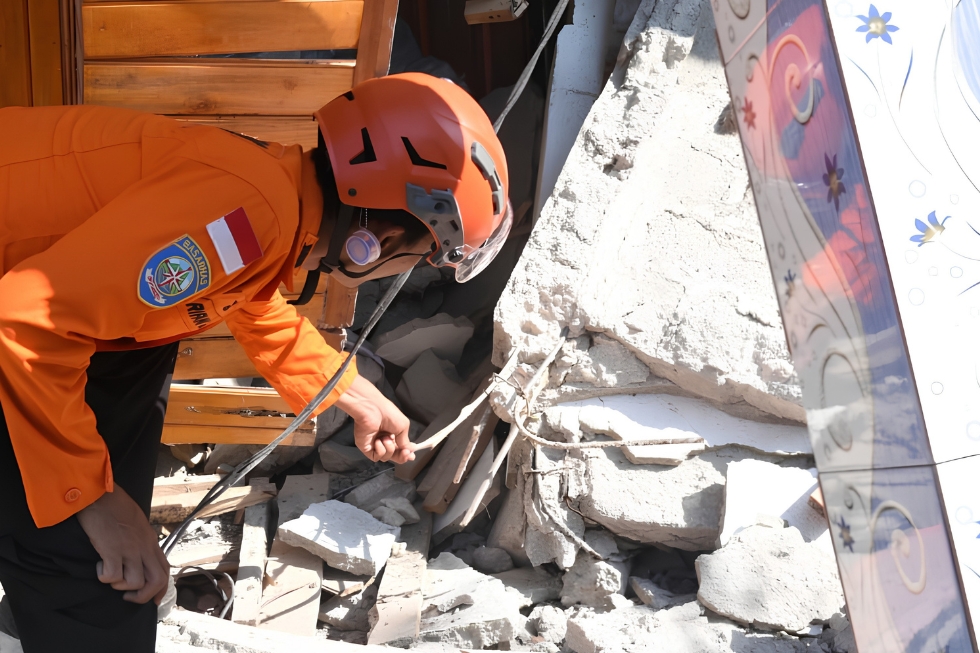




Indonesia’s disasters keep outrunning its budget. The country had not even finished recovering from the Sumatra floods when another disaster struck: On August 15, a magnitude 7.7 earthquake hit the sea off Flores, an island in East Nusa Tenggara province. At least 73 people died, and more than 1,100 were injured. The quake also set off a tsunami warning along the coast, and hundreds of smaller aftershocks have continued to shake the region since.
None of this is simply bad luck. Indonesia sits atop several active fault lines where the Earth’s plates push against each other, which is why earthquakes and volcanic eruptions occur so often across the country — this is a known, recurring risk, not a black swan. The same is true of the fires: Indonesia is experiencing unusually dry, hot weather driven by El Niño, and by June, fire had already burned through 107,465 hectares of land, an area larger than Jakarta, according to Ministry of Forestry data. Smoke and haze have covered several regions, with the city of Palangkaraya in Central Kalimantan hit especially hard.
In other words, both disasters were foreseeable risks — geological and seasonal — that Indonesia has faced for decades. What turns them into crises is not the hazard itself but how little the government has set aside to meet it: No national disaster status has been declared for either event, cutting off the faster funding and coordination that status would trigger.
A budget that does not match the risk
The government’s ability to respond to disasters is held back by its own spending choices. In 2026, the budget for Indonesia’s National Disaster Management Agency, the government body responsible for handling disasters, is only 491 billion Indonesian rupees, a drop of about 75% from 2025. That is roughly the lowest this agency’s budget has been in more than ten years, even though disasters are happening more often, not less.
The cost of this cut is already visible in Sumatra. In Aceh Tamiang, a district hit hard by recent floods, rebuilding homes is moving slowly, and roads and rice fields are still buried in mud. The government is handing out subsidized fertilizer to farmers, but that does little good when their fields are still covered in mud and flood debris and cannot be planted.
Cement prices in flood-hit parts of Aceh have jumped to two and a half times the normal rate due to supply disruptions. Many residents still ask why the Sumatra floods have not been formally declared a national disaster, a status that would unlock more central government support.
Funding for disaster rebuilding is being squeezed by two large government programs. One is the Free Nutritious Meal program, which provides meals to millions of children and pregnant women nationwide. The other is a nationwide network of new village-level cooperatives, called Red and White Village Cooperatives, meant to run local businesses and services. Both programs cost enormous sums while giving little attention to disaster needs. The free meal program alone is budgeted at 240 trillion Indonesian rupees, with part of that money diverted from education and health spending. Even the savings from disaster funds have been redirected into this meal program.
Local governments are also running short of money for basic services. Indonesia is meant to follow a system in which the central government allocates a fair share of the national budget to provinces and districts, so they can fund their own local needs. But as the central government has been keeping more of the budget for itself, regions find it harder to prepare for disasters, let alone rebuild after one hits.
Local budgets have faced heavy cuts, with transfers from the central government to the regions dropping by 18% over the past year. The 2027 national budget is also 13.4% lower than in 2025, which does not align with the promise that regions should receive a fair, growing share of national spending. Money set aside for repairing schools damaged by disasters is smaller than the budget for a new chain of showcase schools that President Prabowo Subianto is building as one of his signature projects. It is hard not to conclude that the president cares more about his own flagship projects succeeding than about the people living through disasters.
Aceh’s anger, unfinished promises
On August 15, Aceh province marked the 21st anniversary of a 2005 peace agreement signed in Helsinki, Finland, that ended almost three decades of armed conflict between the Indonesian government and separatist fighters seeking Aceh’s independence. This year, what should have been a quiet ceremony turned into unrest. Crowds tried to raise the flag once used by the separatist movement alongside the Indonesian national flag; soldiers moved to stop them, and the clash ended with tear gas and warning shots.
Behind the anger was frustration over the slow response to flooding in Aceh Tamiang and nearby areas, along with long-standing demands that the central and Aceh governments finish parts of the 2005 peace agreement that are still unresolved, including Aceh’s right to use its own symbols and to keep the special governing powers it was promised.
Disasters in other regions, including Kalimantan, have also brought back symbols linked to calls for regions to break away and govern themselves, such as a flag associated with the island of Borneo.
Will Flores now face the same kind of anger and unrest that Aceh is facing today? That is the test the government cannot afford to fail, and it should treat Flores as the moment to act rather than the next province to manage. Jakarta should restore the disaster standing budget to a level proportionate to Indonesia’s disaster risk rather than relying on post-disaster reallocations from programs like the Free Nutritious Meals initiative, and it should do so as preparation for the next earthquake, not after.
[Kaitlyn Diana edited this piece.]
The views expressed in this article are the author’s own and do not necessarily reflect Fair Observer’s editorial policy.
Indonesia’s Government Seeks Public Donations for NTT Disaster: Where Are Its Priorities?
The Indonesian government’s response to the East Nusa Tenggara earthquake exposes a troubling imbalance in priorities: Flagship programs like the...

Jamaica Needs Digital Disaster Infrastructure
Hurricane Melissa exposed critical gaps in Jamaica’s disaster communication infrastructure, leaving many communities unreachable during the crisis. Drawing on successful...
A Nation’s Rivers Remember What Was Cut Away: Indonesia’s Flood Crisis
Legal deforestation has stripped Sumatra’s watersheds of natural flood defenses, turning extreme rainfall into a predictable humanitarian disaster. Plantation expansion...
Support Fair Observer
We rely on your support for our independence, diversity and quality.
For more than 10 years, Fair Observer has been free, fair and independent. No billionaire owns us, no advertisers control us. We are a reader-supported nonprofit. Unlike many other publications, we keep our content free for readers regardless of where they live or whether they can afford to pay. We have no paywalls and no ads.
In the post-truth era of fake news, echo chambers and filter bubbles, we publish a plurality of perspectives from around the world. Anyone can publish with us, but everyone goes through a rigorous editorial process. So, you get fact-checked, well-reasoned content instead of noise.
We publish 3,000+ voices from 90+ countries. We also conduct education and training programs
on subjects ranging from digital media and journalism to writing and critical thinking. This
doesn’t come cheap. Servers, editors, trainers and web developers cost
money.
Please consider supporting us on a regular basis as a recurring donor or a
sustaining member.
Will you support FO’s journalism?
We rely on your support for our independence, diversity and quality.





Comment