


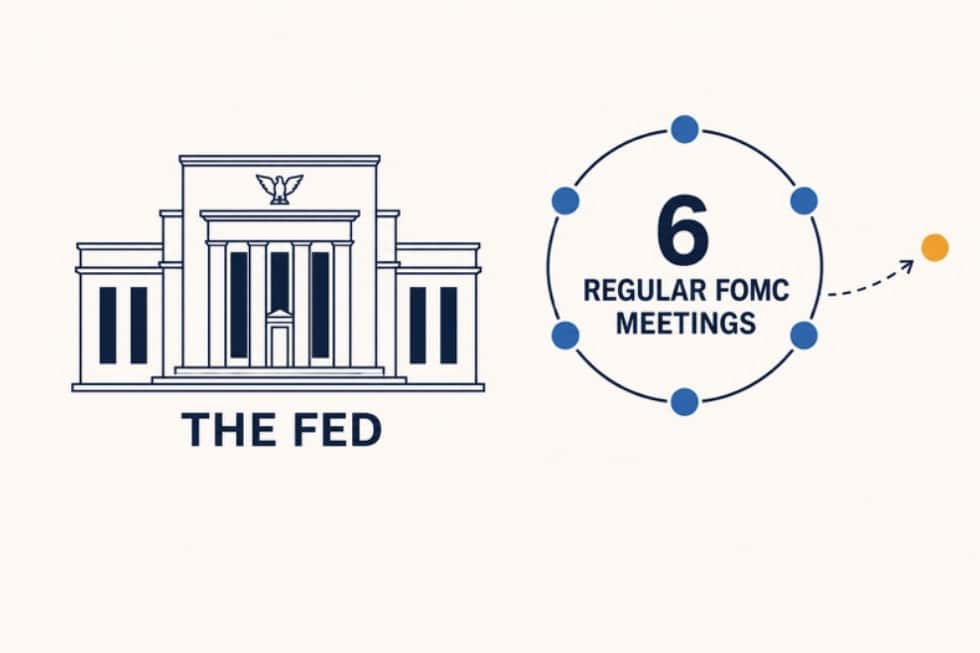



Federal Reserve (the Fed) Chair Kevin Warsh has reportedly raised an important question: Should the Federal Open Market Committee reduce its regular policy meetings from eight to six each year? Warsh raised the possibility of six annual meetings as a subject for discussion rather than as a formal proposal. The idea would represent a significant change because the Fed has followed its current eight-meeting calendar since 1981. But the proposal is neither arbitrary nor dangerous. Six regular meetings would give policymakers more time to evaluate incoming information, while the Fed would remain free to convene additional meetings whenever conditions require urgent action. My research supports this approach. Six regular meetings are the most defensible schedule under normal economic conditions.
Why six meetings are preferable
Monetary policy decisions take time to affect borrowing, investment, employment, spending and inflation. Policymakers therefore need time to observe whether an earlier decision is working before reconsidering it.
The economy produces a continuous stream of statistics, but new data do not always provide new understanding. Inflation movements may prove temporary. Employment estimates are revised. Financial-market fluctuations may reflect short-lived speculation rather than lasting economic change.
When meetings occur too closely together, policymakers may reconsider their decisions before sufficient evidence and policy feedback have accumulated. Frequent meetings can also encourage markets to treat every statement, press conference or minor wording change as an important policy signal. Six meetings would create approximately two months between regular decisions. This would allow more information to accumulate without leaving the Fed unable to respond for an extended period. Four meetings would go too far. Three-month intervals could delay necessary policy adjustments when inflation, employment or economic growth changes direction. Six meetings preserve regular opportunities to act while allowing policymakers enough time to assess developments properly.
Six meetings can match the performance of eight
My simulations compare the economic consequences of different regular meeting schedules. Eight meetings produce the lowest numerical stabilization loss in the baseline calculation. But the difference between six and eight is not economically meaningful under the study’s specified equivalence criterion.
In practical terms, six meetings preserve performance comparable to eight.
This distinction is important. A calendar should not be selected solely because it produces a marginally better numerical result in a simulation. Policymakers must also consider the resources required to prepare for, conduct and explain each scheduled meeting.
Every Federal Open Market Committee (FOMC) meeting requires extensive staff analysis, economic forecasts, briefing materials, internal coordination and public communication. It also consumes the attention of policymakers and markets. If two additional scheduled meetings provide almost no meaningful improvement in economic performance, their institutional burden becomes difficult to justify.
Six meetings therefore offer the better balance. They retain nearly all the stabilization benefits of eight meetings while reducing unnecessary preparation, repeated reassessment and communication burdens. This is not a risky reduction in the Fed’s capacity. It is a more efficient use of that capacity.
More meetings are not better
The case for six meetings does not rest only on comparing six with eight. The simulations also provide no support for permanently increasing the regular calendar to ten or twelve meetings.
Under normal conditions, scheduling meetings more frequently does not yield further improvements in stabilization. Closely spaced meetings may instead expose policymakers and markets to temporary signals before their economic significance becomes clear. The analysis does not prove that frequent meetings directly destabilize the economy. Nor does it establish noise as the single cause of the absence of further improvement. Its conclusion is more straightforward: Once the regular calendar is sufficiently frequent, additional scheduled meetings provide little marginal value.
A permanently denser calendar would therefore impose additional institutional burdens without demonstrating better outcomes. Six regular meetings are sufficient for normal conditions.
Six must not become a ceiling
A six-meeting calendar must retain one essential safeguard: the Fed’s ability to meet whenever circumstances materially change.
Banking failures, pandemics, geopolitical shocks and sudden economic downturns do not wait for scheduled meetings. During such periods, the cost of waiting increases sharply, and additional deliberation may become necessary.
The Fed already has this flexibility. Its official calendar states that the FOMC holds regular meetings and convenes additional meetings as needed. A move to six regular meetings would not remove that authority.
In a normal year, six meetings should be the default. In a crisis year, the Fed might appropriately meet eight, ten or twelve times. The total number should depend on economic conditions rather than on an inflexible annual target. Not every period of market volatility requires an additional interest-rate meeting. Some financial disruptions are better addressed through emergency lending, bank supervision or other targeted measures. An additional monetary policy meeting is warranted when new developments materially change the outlook for inflation, employment, growth or financial stability — or when the reasoning supporting the existing policy stance is no longer reliable.
The Fed should explain these criteria in advance. Clear principles would preserve flexibility while reducing the risk that an unscheduled meeting itself causes unnecessary alarm.
A better institutional design
The Wall Street Journal reported that Warsh raised the possibility of six meetings for discussion. The proposal deserves support, provided that it is combined with a credible capacity for additional meetings when circumstances require them. The appropriate reform is clear: six regularly scheduled meetings under normal conditions, supplemented by state-contingent meetings during periods of significant economic or financial change.
This approach would not weaken the Fed’s commitment to price stability or maximum employment. Nor would it prevent officials from communicating between meetings through speeches, testimony and published analysis. Communication does not always require a formal policy decision, and monitoring the economy does not require continuously reopening the existing policy judgment.
Six meetings provide enough regular opportunities to adjust policy without encouraging unnecessary reconsideration. Four meetings risk excessive delay. Eight meetings provide little additional economic benefit once their institutional burden is considered. Ten or 12 regular meetings add still more decision points without improving normal-period outcomes.
The Fed should therefore adopt six regular meetings as its normal calendar and reserve additional meetings for circumstances in which waiting becomes costly. Good central banking is not about meeting as frequently as possible. It is about deliberating when deliberation has genuine value.
[Kaitlyn Diana edited this piece.]
The views expressed in this article are the author’s own and do not necessarily reflect Fair Observer’s editorial policy.
“Lies, Damned Lies, and Statistics” — Narrative, Credibility and the Timing of the Fed’s Forward Guidance
The Federal Reserve’s response to post-pandemic inflation was shaped not only by economic data but also by the institutional narrative...

FO Exclusive: The $39 Trillion Trap — The Terrifying Reality of America’s Bond Market
In this section of the May 2026 episode of FO Exclusive, Atul and Glenn Carle point out how the global...

The Dollar as a River of Power
The US dollar functions as the core infrastructure of the global economy, shaping financial flows while limiting policymakers’ control over...

FO Exclusive: Big Trouble in the US Private Credit Market
In this section of the March 2026 episode of FO Exclusive, Atul Singh and Glenn Carle warn that the $2...

Support Fair Observer
We rely on your support for our independence, diversity and quality.
For more than 10 years, Fair Observer has been free, fair and independent. No billionaire owns us, no advertisers control us. We are a reader-supported nonprofit. Unlike many other publications, we keep our content free for readers regardless of where they live or whether they can afford to pay. We have no paywalls and no ads.
In the post-truth era of fake news, echo chambers and filter bubbles, we publish a plurality of perspectives from around the world. Anyone can publish with us, but everyone goes through a rigorous editorial process. So, you get fact-checked, well-reasoned content instead of noise.
We publish 3,000+ voices from 90+ countries. We also conduct education and training programs
on subjects ranging from digital media and journalism to writing and critical thinking. This
doesn’t come cheap. Servers, editors, trainers and web developers cost
money.
Please consider supporting us on a regular basis as a recurring donor or a
sustaining member.
Will you support FO’s journalism?
We rely on your support for our independence, diversity and quality.





Comment