


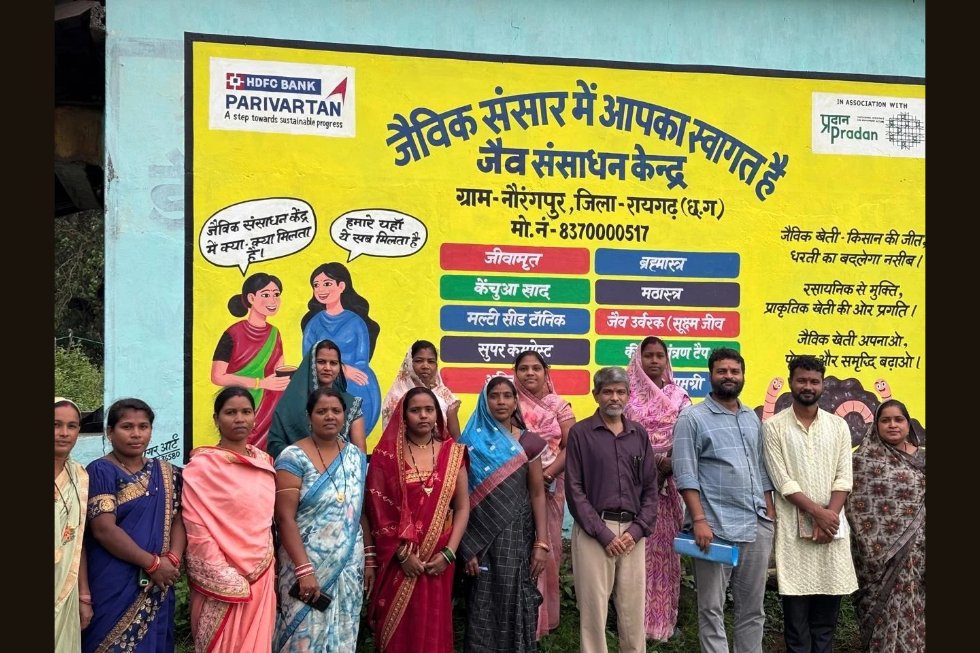





Women accounted for 48.5% of India’s population in 2024. For most of them, the agricultural and allied sectors are their primary source of income, with 80% of rural women engaged in agriculture, 33% as agricultural laborers and 48% as self-employed farmers. They accounted for about 117 million of India’s agricultural workforce, compared with 127.5 million men in 2023–24.
Women’s participation in the rural workforce has increased substantially — from 35% in 2011–12 to 46% in 2023–24. Women contribute 60–80% of India’s overall food production, highlighting their critical role in ensuring food security.
Despite being critical players in agriculture and rural economies, women in India make a huge contribution to the economy, yet this remains unrecognized and underappreciated. The challenge for these women is not limited to increasing their participation in agriculture; rather, the focus should be on creating structures that enable women to use their labor effectively in income- and power-generating processes.
Nearly half of India’s women farmers are recorded as unpaid helpers, rather than farmers, and this gap costs ₹1.2–2 trillion ($13.6–22.7 million) a year. Also, in rural India, women earn 50% less than men, highlighting the persistent and deep-rooted structural inequalities in the agricultural workforce.
Factors such as limited access to land, lack of access to money, market and family responsibilities, and the gender pay gap are preventing them from fully realizing their potential.
India’s experience with women-initiated cooperatives shows that economic collectivization can turn unremunerated work into an efficient economic resource. As India expands its Farmer-Producer Organisations (FPOs) and cooperatives, this experience is necessary to ensure that women become not just participants in the agricultural economy but also its owners and leaders.
The problem, therefore, is not a lack of women’s contribution. It is a lack of institutional mechanisms through which women can collectively capture greater economic value from that contribution.
Government’s emphasis on FPOs and cooperatives: bridging the missing link
FPOs and Cooperatives could become one such mechanism. By pooling production, FPOs/Cooperatives can improve farmers’ bargaining power, access to finance, technology and markets while creating opportunities for value addition and entrepreneurship. Yet women remain significantly underrepresented. As of 2003, more than 6,400 women-led FPOs existed, which account for only about 14% of FPOs.
The Central Sector Scheme for “Formation and Promotion of 10,000 Farmer-Producer Organisations (FPOs)” was launched on February 29, 2020. As of March 1, 2026, all 10,000 FPOs had been established nationwide. Yet only 1,175, or 11.8%, were women-led. This is striking when compared with the estimated 2.3 million registered women farmers.
The gap cannot be explained simply by women’s reluctance to participate. Limited land ownership, restricted access to credit and markets, mobility constraints and inadequate opportunities for leadership can all make it difficult for women to establish and manage producer organizations.
But there is another lesson from India’s experience that deserves greater attention: Women can build and manage economically viable collective institutions when those institutions are designed around their circumstances and give them genuine ownership and decision-making power.
What the older women’s cooperatives teach us
Organizations such as Shri Mahila Griha Udyog Lijjat Papad, the Self-Employed Women’s Association (SEWA) and the Indian Cooperative Network for Women (ICNW) are all examples of women-led companies that have thrived in India. In fact, these organizations share a common philosophy: that, despite hurdles such as small size, a weak negotiating position or limited access to capital, women can effectively address these disadvantages through collective means.
Thus, their importance goes beyond the number of women they helped. More crucially, they have great institutions. They show that women who lack access to financial and educational resources can nevertheless establish the necessary institutions to provide employment, create financial markets and develop leadership.
Nobel laureate Amartya Sen’s understanding of development can help explain why those institutions are important. Development is not only about increasing incomes; it is about giving people the right opportunities to do things in ways that help them control their own lives. Women’s cooperatives in India matter because they give women the resources they need and the power to make their own decisions and improve their lives.
As one example, Lijjat Papad’s transformational journey over the last 60 years demonstrates how collaborative ownership, its members and its unyielding dedication to excellence have fueled the organization’s sustained growth while creating a reliable brand across generations. More importantly, it shows that when everyday women are given ownership, power and the opportunity, they can assume their roles as confident leaders and influential changemakers.
From success stories to a policy lesson
These experiences indicate that women’s economic disadvantage is an institutional issue rather than an individual problem. Women who work alone are more likely to encounter fragmented production and poor bargaining power as well as limited access to financial resources and markets. Through collectivization, many of these challenges may be solved at once.
This does not mean simply putting women into groups. The institutions must generate trust, shared responsibility, economic incentives and effective governance. This is consistent with Ostrom’s insight that successful collective institutions depend on rules and relationships that enable participants to cooperate over time.
Evidence already suggests that women-led FPOs can perform strongly. Research on women-led FPOs indicates that women-run FPOs can outperform male-run and even mixed-gender organizations on many financial measures, including returns on investment, liquidity management, debt effectiveness and operational efficiency.
Women who built through cooperation
The history of the cooperative movement in India has women at its center who have demonstrated that leadership does not depend on a remarkable person; it is about creating the conditions for thousands to be leaders.
This is what women entrepreneurs such as Ela Bhatt, Jaya Arunachalam and Jaswantiben Popat have accomplished: turning collective initiatives into institutions, jobs and dignity for women through efficient, compassionate and servant leadership. Their life stories — from grassroots activism to receiving Padma Shri, the fourth-highest civilian award in the Republic of India — confirm that when women act together, they not only participate in development activities but also create sustainable movements that endure.
A lesson for the International Year of the Woman Farmer
The International Year of the Woman Farmer 2026 offers India an opportunity to move the conversation from recognition to institutional change. India’s women have already demonstrated their capacity to organize, produce, manage enterprises and build durable institutions. Lijjat Papad, SEWA and ICNW are not merely inspirational stories from the past. They are evidence of what becomes possible when women gain collective economic power.
Together, these examples point to a practical lesson for Indian agriculture: Women’s empowerment will be strongest when collective institutions give women resources, voice and ownership — not simply membership.
The challenge now is to carry that lesson into agriculture at scale. With 10,000 FPOs already established, India has an institutional platform through which millions of farmers can potentially gain greater access to markets, finance and value chains. Ensuring that women have an equal role in owning and governing these organizations could transform FPOs from aggregation platforms into instruments of women’s economic empowerment.
The real opportunity is not simply to bring more women into agriculture. It is to ensure that the women already sustaining India’s agricultural economy have greater ownership of the institutions, markets and value chains that depend on their work. India’s women-led cooperatives have shown that collective strength can create that transformation. The next step is to take their lesson to the farm and build a new generation of women-led FPOs and cooperatives that turn invisible labor into visible economic power.
[Casey Herrmann edited this piece]
The views expressed in this article are the author’s own and do not necessarily reflect Fair Observer’s editorial policy.
The Need to Promote the Diversification of Farm Incomes in India
India’s reliance on water-intensive rice and wheat cultivation is placing growing pressure on natural resources while limiting smallholder incomes. Diversifying...
Women’s Empowerment and Economic Growth Through Dairy Cooperatives
Indian agriculture is undergoing a profound shift as women now comprise the majority of the sector’s labor force, yet their...
From Farm to Foreign Shores: How Indian FPOs Are Leading the Agri-Export Surge
India’s agricultural sector is transforming as farmer collectives — cooperatives, Farmer Producer Companies (FPCs) and societies — boost incomes, exports...
Support Fair Observer
We rely on your support for our independence, diversity and quality.
For more than 10 years, Fair Observer has been free, fair and independent. No billionaire owns us, no advertisers control us. We are a reader-supported nonprofit. Unlike many other publications, we keep our content free for readers regardless of where they live or whether they can afford to pay. We have no paywalls and no ads.
In the post-truth era of fake news, echo chambers and filter bubbles, we publish a plurality of perspectives from around the world. Anyone can publish with us, but everyone goes through a rigorous editorial process. So, you get fact-checked, well-reasoned content instead of noise.
We publish 3,000+ voices from 90+ countries. We also conduct education and training programs
on subjects ranging from digital media and journalism to writing and critical thinking. This
doesn’t come cheap. Servers, editors, trainers and web developers cost
money.
Please consider supporting us on a regular basis as a recurring donor or a
sustaining member.
Will you support FO’s journalism?
We rely on your support for our independence, diversity and quality.




Comment