


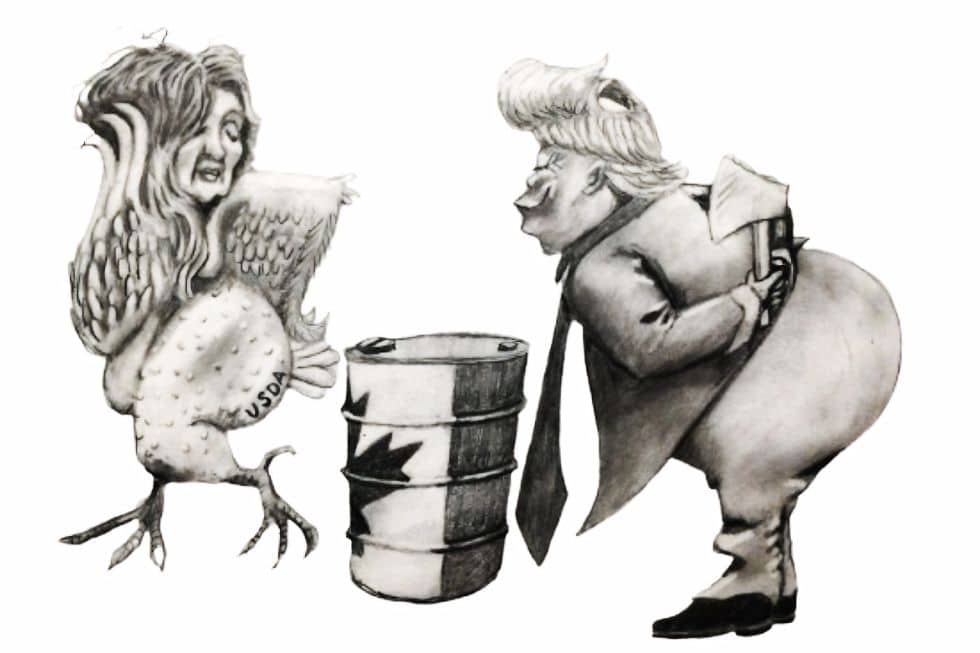



At first hearing, Alberta’s Premier Danielle Smith seems the voice of reason. As I listened to her speech last week outlining why the province would be having a referendum this fall on separating from Canada, I found myself nodding along, lulled by her smooth and yet rousing delivery: “The days of Ottawa dictating and interfering in provincial affairs must come to an end”; “restore provincial rights stolen from Alberta”; “take back our provincial autonomy from the federal government.”
It was only later, when I thought about it seriously, that I realized all the dangers a referendum — or even talk of a referendum — could pose.
There be dragons
First, a referendum on separatism releases a divisive sentiment that cannot easily be put back into the bottle. In 1967, at Montreal’s City Hall, French Prime Minister Charles de Gaulle delivered these infamous words: “Vive le Quebec libre! Vive le Canada francais! Et vive la France!” (“Long live free Quebec! Long live French Canada! And long live France!”) This left a lasting impression on the Québécois, leading them to believe forevermore that they were a people apart from the rest of Canadians. Quebec held two referendums (in 1980 and 1995). And rift and instability continue to this day. If Paul St. Pierre Plamondon, leader of the resurgent, separatist Parti Québécois, wins in this October’s election, he has promised to hold a third referendum.
Second, it gives our powerful neighbor to the south a chance to interfere with and influence our politics. The US had already been involved in over 70 regime changes all over the world, and for them to put their finger on the scale in this referendum would be mere child’s play. There is already talk that the current US government is funding the Alberta separation movement. Earlier this year, US Treasury Secretary Scott Bessent openly stated that Alberta is “a natural partner for the US.”
Third, even talk of a referendum can destabilize the economy and discourage investment. Quebec’s long-running contemplation of separation had a severe effect on its economy. Prior to the rise of the separatist movement in the 1970s, Montreal was Canada’s economic and financial hub. The prospect of separation prompted a massive exodus of businesses from Quebec, and Toronto became the new hub. Thousands of skilled workers emigrated. Quebec’s political risk raised the provincial government’s borrowing costs and increased provincial debt. The stock prices of Quebec-based companies declined.
Fourth, many Albertans may not realize the full import of such a referendum. Certainly, many Brits did not, and they ended up with Brexit. Six years on, the broad consensus is that Brexit has had a net negative impact on the UK, with studies estimating that the economy is roughly 4-8% smaller than it would have been if the country had remained in the EU. Leaving the EU increased trade barriers, customs red tape and shipping costs. Trade became more difficult, especially for small and medium-sized enterprises (SMEs). Business investment in the UK has lagged behind other G7 nations. Freedom of movement has caused labor shortages. Trevor Tombe, professor of economics at the University of Calgary, claims “Alberta would fare no better.”
Fifth, if it were to separate, Alberta — being landlocked — would find it very difficult to survive on its own. It would have to seek the support of a larger, more powerful entity. Fortunately or unfortunately, the US is nearby and happy to assist — if not downright absorb. Since President Donald Trump came to power in January 2025, he has regularly made comments about annexing Canada. A free but unprotected Alberta would be a perfect appetizer. The timing for this referendum could not be worse.
Whoa Bessie!
Smith claims that her main reason for having a referendum is that she will not “silence the voices of hundreds of thousands of Albertans” — as if the majority of Albertans are clamoring for separation. This is misrepresentative on two accounts.
Earlier this year, an Alberta court ruled that a petition circulated by separatists was unconstitutional because it did not consult the indigenous peoples. Smith is against the ruling, saying that this is an “erroneous court decision” that “interferes with the democratic rights of hundreds of thousands of Albertans.” She seems to forget that the indigenous people are also Albertans — and indeed the original Albertans. Chief Sheldon Sunshine of the Sturgeon Lake Cree Nations rightly says, “All of Alberta sits on treaty land, and that’s not going to change.” The First Nations are firmly against Alberta’s separation, and separating against their wishes would be illegal.
Alberta has a population of just over 5 million, of which some 3.9 million are over the age of 18. In that context, the Forever Canada petition (favoring Alberta remaining within Canada) received over 400,000 signatures and the Stay Free Alberta petition (favoring Alberta separating) garnered just over 300,000. Therefore, with some mental fudging, Smith magnanimously claims that “approximately 700,000 Albertans have signed a petition requesting a vote on this issue.” In reality, the Forever Canada petition asked only the simple question, “Do you agree that Alberta should remain within Canada?” In fact, the petition’s leader, Thomas Lukaszuk, has specifically argued against a referendum, calling it an unnecessary expense, socially divisive and damaging to investor confidence.
While Smith presents herself as wanting to hold a referendum only for the sake of her people (she even claimed in her speech that she herself would vote for a united Canada), her background suggests otherwise. Smith used to be a prominent member of the Wildrose Party — a right-wing, conservative and populist party, with an aim of provincial autonomy. Furthermore, she met with Trump at his Mar-a-Lago resort shortly after his election win and also visited the Heritage Foundation, the right-wing think tank behind Project 2025.
The not-so-happy ending
At any one time, there will always be a group of people who are not happy with the status quo, and often with good reason; for years, Alberta has been putting more into the federal pot than it gets back. But Alberta should address this financial imbalance by taking political, legal and structural actions to gain greater control over its finances. Holding a referendum about Alberta separation would be a case of “cutting off your nose to spite your face.”
As the premier of Alberta, Smith’s first duty should be the well-being of the province. And as a member of the Council of the Federation, she has agreed to the objective “to ultimately strengthen Canada.” She seems to be doing neither. She’s using the results of a signature campaign to rip the nation apart. Manitoba’s Premier Wab Kinew said, “There is always a moral imperative to do the right thing.” With this referendum, Smith is putting the province in danger — socially, economically and politically — not just today but for years to come. She blithely claims, “At the end of this debate, and when the referendum is over, we must come together to ensure that our beloved province continues to prosper.” This referendum may be instrumental in ensuring that that will never happen.
[Kaitlyn Diana edited this piece.]
The views expressed in this article are the author’s own and do not necessarily reflect Fair Observer’s editorial policy.
States Push Back as Federal Power Fractures Along Cultural Lines
States are pushing for more control as Washington grows more partisan and less effective. Legal battles and executive overreach are...

Canada Must Strengthen Independence Amid US Annexation Threats and Global Shifts
In light of current and repeated threats from Trump to annex Canada, this article urges Canada to grow up and...
Separatism Remains A Challenge From Western To Eastern Europe
Founded on the nationalism of the 19th century, European states struggle to manage separatist movements in their peripheral regions. In...

Support Fair Observer
We rely on your support for our independence, diversity and quality.
For more than 10 years, Fair Observer has been free, fair and independent. No billionaire owns us, no advertisers control us. We are a reader-supported nonprofit. Unlike many other publications, we keep our content free for readers regardless of where they live or whether they can afford to pay. We have no paywalls and no ads.
In the post-truth era of fake news, echo chambers and filter bubbles, we publish a plurality of perspectives from around the world. Anyone can publish with us, but everyone goes through a rigorous editorial process. So, you get fact-checked, well-reasoned content instead of noise.
We publish 3,000+ voices from 90+ countries. We also conduct education and training programs
on subjects ranging from digital media and journalism to writing and critical thinking. This
doesn’t come cheap. Servers, editors, trainers and web developers cost
money.
Please consider supporting us on a regular basis as a recurring donor or a
sustaining member.
Will you support FO’s journalism?
We rely on your support for our independence, diversity and quality.





Comment