



On June 30, 1989, the radio in our home played military marches. I was ten and understood nothing. A brigadier named Omar al-Bashir had seized power on behalf of Leader Hassan al-Turabi’s Islamist movement, the Sudanese branch of the Muslim Brotherhood. For the first time since its founding in 1928, the Brotherhood held an entire state.
Few outside Sudan noticed. The country seemed too peripheral to matter. Whatever happened in Khartoum, the thinking went, would stay in Khartoum. Within a decade, the West would pay for that assumption. Only in Sudan could the organization govern a full country, with an army, a treasury and a seat at the United Nations, for three decades. Anyone who wants to know what life under the Muslim Brotherhood (Kizan) looks like should study Sudan.
What 30 years looked like from inside
The first thing the new regime did was not pray; it was purge. Within a year, 28 army officers were executed after a show trial during Ramadan. Tens of thousands of civil servants, judges, diplomats, university professors and army officers were dismissed under a policy the movement openly called tamkeen (“empowerment”): the replacement of a state by a party. Detention centers known as “ghost houses” appeared in ordinary neighborhoods, where detainees were subjected to the most brutal forms of torture.
Then the regime turned the state into a war machine. The civil war in the South was proclaimed a jihad (religious struggle). Students and civil servants were conscripted into the Popular Defence Forces. The war killed some two million people and ended only when a third of the country left: South Sudan seceded in 2011. In Darfur, the same regime armed militias that burned villages by the hundred, committed genocide and killed an estimated 300,000 people.
Education was my generation’s particular wound. The movement’s ideology distorted school curricula, while universities became arenas of violence and intellectual decline. Women faced punishment under public order laws, and religious minorities faced discrimination and restrictions on worship. The regime diverted Sudan’s resources to its allies, and corruption spread through the economy. As public wealth flowed into private hands, a country that should have fed the region became one that queued for bread.
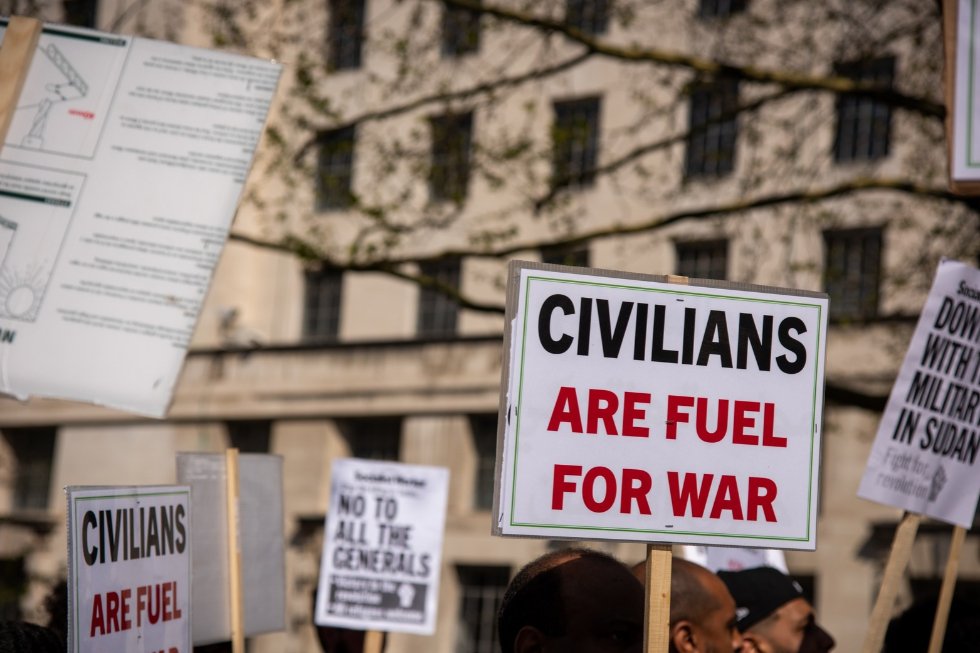
In 2019 we tried to breathe. Millions of Sudanese, most of them young, filled the streets and brought Bashir down, and a civilian government set out on a promising path of reform. In October 2021, the generals, with the Islamists behind them, cut it short with a coup. When the coup failed to produce a stable regime, and an agreement to restore the transition was within reach, the Islamists ignited the war of April 2023. It has since become the world’s largest displacement crisis, uprooting more than 14 million people.
What it did to the West
If the Brotherhood’s state had only devoured Sudan, the world might be excused for having looked away. It did not. From the start, Khartoum understood itself as a base, not a country. In 1991, they established the Popular Arab and Islamic Congress, a standing assembly of militant movements from across the region: Hamas, Hezbollah, Egyptian Islamic Jihad and the Algerian Armed Islamic Group. Washington placed Sudan on its list of state sponsors of terrorism in 1993.
The most consequential guest arrived in 1991. Al-Qaeda founder Osama bin Laden spent five years in Sudan, building roads for the regime and infrastructure for al-Qaeda. In 1995, Sudanese intelligence helped plan the attempt to assassinate Egypt’s President Hosni Mubarak in Addis Ababa, which brought UN sanctions. In 1998, the network bin Laden had assembled in Sudan bombed the American embassies in Nairobi and Dar es Salaam, killing 224 people. Then came September 11.
Twelve years separated the coup in Khartoum from the attacks on Manhattan. In the decade after, Iran’s Revolutionary Guard used Sudan as a base for distributing weapons to its proxies across Africa and the Middle East. Those of us who grew up inside that state learned a lesson the West learned the hard way: A country captured by this movement is never a local problem. It is a platform.
It is in the doctrine
None of this was an accident of personalities. It was doctrine, taught to generations of Sudanese teenagers in the military camps that stood between them and a university place. They marched to chants about carrying war into neighboring countries. One warned America and Russia that their punishment was near. The attempt on Mubarak’s life in Addis Ababa showed how closely that rhetoric could track the regime’s actions.
The chants expressed the Brotherhood’s theory of the state. Hassan al-Banna founded the movement with the ambition of restoring the caliphate and achieving what he called “mastership of the world” (ustāḏiyyat al-ʿālam). In this worldview, territory is a foothold: a place to consolidate power and project it outward. Extremist movements have shown how even a small piece of land can become the source of a much wider threat. The Houthis, operating from territory in Yemen, have disrupted shipping far beyond Yemen’s shores.
The United States has now said this officially. The national counterterrorism strategy released by the White House in May names the Muslim Brotherhood as “the root of all modern Islamist terrorism” and traces al-Qaeda, the Islamic State and Hamas to a single organizational and ideological source.
This is not a position on Islam
Some in the West worry that opposing the Brotherhood means opposing Islam. Sudan’s experience shows why that is wrong: Its victims, from executed officers to displaced families, are overwhelmingly Muslim. The Brotherhood is a political movement seeking control of the state, not a religious community.
The Muslim world has long understood this. Egypt designated the Brotherhood a terrorist organization in 2013, Saudi Arabia and the United Arab Emirates in 2014, and Jordan, which tolerated it for decades, banned it outright in 2025. These are the region’s most established Muslim governments, and they reached their verdict from the inside.
The West is catching up. The US has formally designated several Brotherhood branches, including Sudan’s, as terrorist organizations, while the European Parliament has urged member states to consider listing people and organizations linked to the movement. The debate has moved from whether the Brotherhood is a threat to how to confront it.
Where the question will be decided
The diagnosis is now on paper. The question is where it will be tested, and the answer is not Cairo, Amman or Brussels, where the Brotherhood is in opposition or underground. It is Sudan, where the organization is fighting for a state. Of all the countries in which the Brotherhood operates, Sudan is the only one it has a realistic chance of controlling completely, because it never fully let go. Thirty years of tamkeen left its cadres embedded in the officer corps, the intelligence services, the judiciary and the banks. The 2019 revolution interrupted that grip; the 2021 coup restored it; the war is the attempt to make it permanent.
This is why Sudan’s war is so badly described as a fight between two generals. The dissolved National Congress Party and the Sudanese Islamic Movement are rebuilding their power under cover of the army. The State Department has said the Sudanese Brotherhood has supplied more than 20,000 fighters to the war. General Abdel Fattah al-Burhan is not the alternative to the Islamists; he is the uniform they wear. The Rapid Support Forces have committed monstrous atrocities in El Fasher and across the country, and must be punished for them. But no one should mistake the junta in Khartoum for the cure.
What makes this a multiplied danger rather than a local one is the company the project keeps. Ties with Tehran were restored in 2023, and Iranian drones followed; in August, Century International documented Houthi arms networks running through Port Sudan, amid claims that Houthi engineers and the Revolutionary Guard were training Sudanese forces to build Iranian drones. In May 2025, Washington determined that Burhan’s forces had used chemical weapons, and in September an intelligence dossier reported on by The New York Times and The Washington Post described a chlorine weapons program.
On November 4 in Moscow, Burhan sought a strategic partnership with Russian President Vladimir Putin, offering a free economic zone on the Red Sea and access to Sudan’s gold and copper, a day after his ambassador credited Russia with blocking a nationwide UN arms embargo. Put the pieces together: a Brotherhood-run state on the Red Sea, armed with Iranian drones, a record of chemical weapons use and a Russian veto. It would bind Iran’s corridor from Hormuz to Bab al-Mandeb, a jihadist sanctuary from West Africa to Somalia and Russia’s coup belt in the Sahel, with Europe’s southern flank within reach. The last time this organization had a state, the bill arrived in Nairobi, Dar es Salaam and Manhattan. The next one will not be smaller.
A region divided between two projects
Step back, and the map from the Gulf to the Horn of Africa divides between two projects. One builds: states that bet on trade, infrastructure, normalization and the education of their young. The other burns: Iran and its proxies, the Houthis, the Brotherhood and the jihadist franchises that descend from it, all of which need chaos the way the first project needs calm. Within the burning project, the Brotherhood is the hinge: the ideology that recruits, the network that finances and, in Sudan, the state that shelters.
Counterterrorism that targets only the fighters, drone by drone and designation by designation, while leaving that structure intact, is not a strategy. It is maintenance. You cannot fight the mosquitoes and leave the swamp.
In Sudan, military rule is Islamist rule
In Sudan, the swamp wears a uniform. Every few years a shortcut tempts by some capitals: back the army, restore “stability” and deal with the Islamists later. It is a trap, because the army is the Brotherhood’s shell. The movement did not take power in 1989 by winning an election. It came in a brigadier’s uniform, ruled for 30 years through the barracks, and in 2021 did it again. Sudan’s Islamists have never needed a majority. They have only ever needed a general. To hand the state back to the generals is not to postpone the Brotherhood’s return; it is to complete it.
The reverse is also true, and Sudan has proved it. In two years of civilian government after 2019, legal reforms expanded freedoms, a dismantling committee began unwinding the former regime’s commercial empire, and Sudan was removed from the American list of state sponsors of terrorism and began its return to the international community. For the first time in three decades, the country was leaving the axis of extremism. The Islamists understood exactly what that meant, which is why they staged the coup that ended it. Weakening the Brotherhood and building a civilian state are not two policies. They are one.
The first step is to end the war. War is the oxygen of the Brotherhood’s return: Every month of fighting, whoever fires the shots militarizes society, scatters the civilians who once resisted the movement, and hands it the mobilization it needs to rebuild. A humanitarian truce based on the Quad’s (a US-led mediator group) draft, binding on both warring parties, with a short deadline after which whoever obstructs it is named and sanctioned, would cut off that supply. What follows must be a civilian democratic government that does what no blacklist can: place every armed force under civilian authority and dismantle the movement’s networks inside the army, the intelligence services, the civil service and the economy. Designations can narrow the Brotherhood’s room to maneuver. Only a civilian state can take it away.
I was ten years old when they came. I am 47, and a refugee, as they try to come back. In between, I watched the Brotherhood swallow a state, turn it into a platform, drive two million people into their graves and a quarter of the country out of the union. Sudan has already run this experiment to its end. No one else should have to repeat it.
[Kaitlyn Diana edited this piece.]
The views expressed in this article are the author’s own and do not necessarily reflect Fair Observer’s editorial policy.
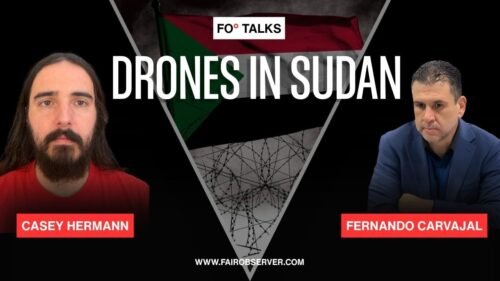
FO Talks: Drone Warfare and Foreign Meddling in Sudan’s Devastating Civil War
In this episode of FO Talks, Casey Herrmann and Fernando Carvajal examine how military rule, Islamist influence and foreign rivalries...
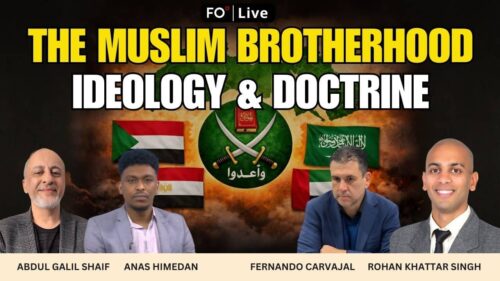
FO Live: How the Muslim Brotherhood Survives and Thrives Across the Middle East
In this episode of FO Live, Rohan Khattar Singh and regional experts examine the Muslim Brotherhood as a decentralized network...
FO Podcasts: The Muslim Brotherhood Explained — Origins, Ideology and Global Influence
In this episode of FO Podcasts, Atul Singh and Cynthia Farahat examine the Muslim Brotherhood’s origins, debating whether it evolved...
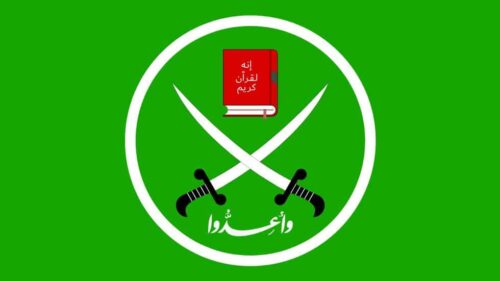
The US Sanctions Sudan’s Muslim Brotherhood
The US recently designated Sudan’s Muslim Brotherhood as a terrorist group amid ongoing conflict between the Sudanese Armed Forces and...
Support Fair Observer
We rely on your support for our independence, diversity and quality.
For more than 10 years, Fair Observer has been free, fair and independent. No billionaire owns us, no advertisers control us. We are a reader-supported nonprofit. Unlike many other publications, we keep our content free for readers regardless of where they live or whether they can afford to pay. We have no paywalls and no ads.
In the post-truth era of fake news, echo chambers and filter bubbles, we publish a plurality of perspectives from around the world. Anyone can publish with us, but everyone goes through a rigorous editorial process. So, you get fact-checked, well-reasoned content instead of noise.
We publish 3,000+ voices from 90+ countries. We also conduct education and training programs
on subjects ranging from digital media and journalism to writing and critical thinking. This
doesn’t come cheap. Servers, editors, trainers and web developers cost
money.
Please consider supporting us on a regular basis as a recurring donor or a
sustaining member.
Will you support FO’s journalism?
We rely on your support for our independence, diversity and quality.




Comment